

Editor’s Note: This post was originally published on May 8, 2019, on sosmadison.com, the website for SOS Madison, one of New Jersey’s largest suicide loss support groups. It has been substantially rewritten and expanded for Sunflowers After Suicide. The core story and personal reflections belong to Jack Klingert, co-facilitator of SOS Madison and father of John, who died by suicide in April 2009.
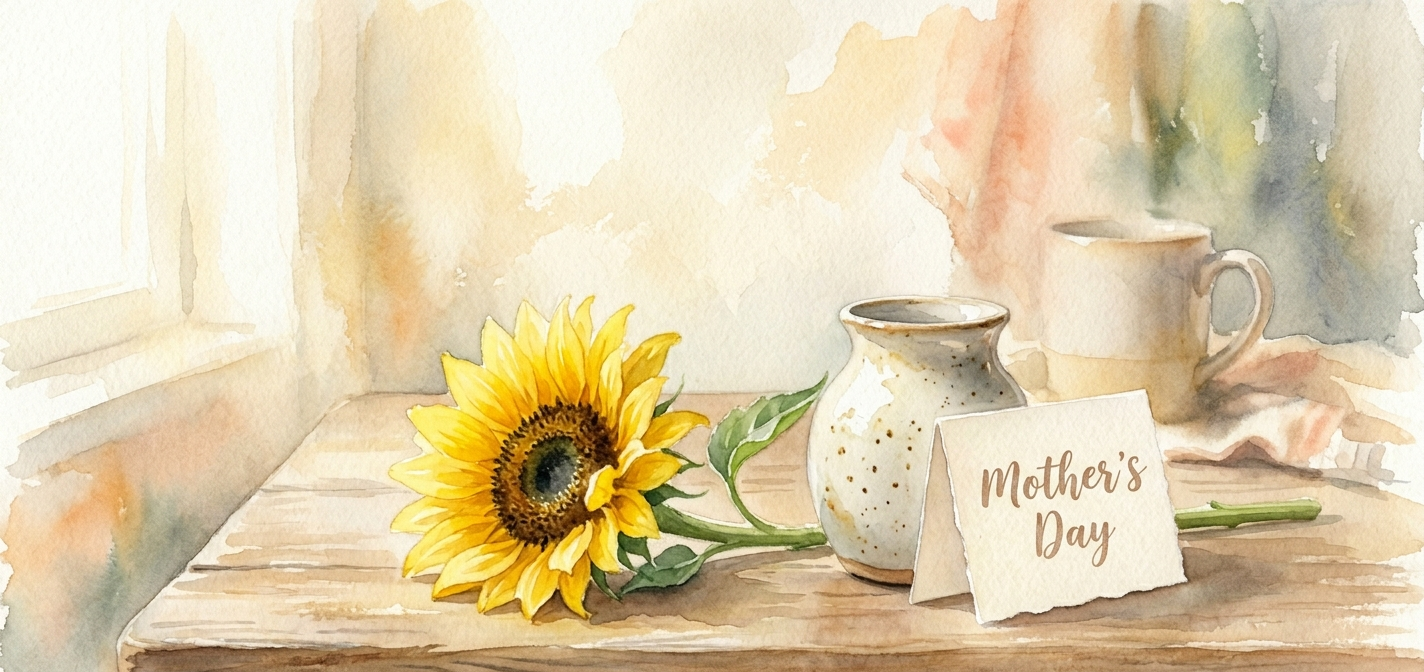
The greeting card displays go up weeks before the day arrives. Stores fill with pink and white. The words on those cards seem written for a world that has not felt what you have felt. “Happy Mother’s Day.” For many survivors of suicide loss, that word “happy” does not fit anymore.
Mother’s Day after suicide loss is one of the hardest days on the calendar. It does not matter whether you lost a child or lost your mother. It does not matter whether this is your first time facing this day or your fifteenth. If this is your first Mother’s Day since the loss, there are no words for what this day asks of you. The first year is its own particular kind of weight. The calendar continues to march on, and the grief rises with it.
I have been following these conversations for more than seventeen years at SOS Madison, our peer-led suicide loss support group in New Jersey. May brings a particular kind of quiet sadness. People come in bracing themselves for the weekend. They come back the following month to tell the rest of us how they got through it.
This post is for you if you are worrying about Mother’s day. Whether you are a mom who lost a child, a father carrying that same loss while the day centers someone else’s grief, a son or daughter who lost their mother, or a sibling watching a parent go through it. There is no right way to feel, and no right way to get through it. But you are not alone in what you are feeling.
Why Mother’s Day After Suicide Loss Hits So Hard
Mother’s Day is built on a very specific kind of sentiment. I call it one of those Hallmark holidays. The cards assume things. They assume your mother is still alive. They assume your child is still alive. They assume motherhood is uncomplicated and joyful, and that the day is one worth celebrating.
After a suicide loss, those assumptions fall away. The holiday becomes a kind of emotional test every year. Will you be okay today? Will you make it through the gathering, the phone calls, the table with an empty chair? Many survivors describe standing in the card aisle and feeling a grief that catches them off guard even when they thought they were prepared for it. Are you even supposed to buy a card for someone who has died by suicide?
This is part of what makes Mother’s Day after suicide loss different from ordinary sadness. The holiday is aimed directly at the relationship that was severed. There is no neutral corner to stand in while the world celebrates around you.
Part of why that is so comes from something grief researcher Dr. John Jordan has documented across decades of clinical work with survivors. Suicide loss carries features that most other grief does not carry in the same way. The death leaves behind an ambiguity that does not resolve; the questions survivors ask about “why” tend to go unanswered for months and years. The stigma that still surrounds suicide can isolate survivors at the very moments they most need support from the people around them. The search for meaning in a death that resists easy answers is ongoing, not something that wraps up between this May and the next May. On milestone days, those features surface together with particular difficulty, because the day itself asks you to stand publicly in the relationship that was lost.
For many survivors, the stress starts before the day itself. Displays go up weeks early. Inboxes fill with subject lines about gifts and brunch reservations. And then there is what happens when you open your phone that Sunday morning. A feed full of bouquets, tributes, and brunch photos before you have had a chance to prepare. If you are already bracing yourself in early May, that is part of this.
Stepping away from social media on Mother’s Day weekend is a reasonable act of self-care. There is no rule that says you have to watch.
When You Lost a Child to Suicide
There is a unique grief that belongs to mothers who have lost a child. It sits in a category that is difficult to describe to anyone who has not lived it.
These are women who raised their children. They fed them and worried about them and drove them to school and showed up for every small milestone. And then one day, without enough warning or with no warning at all, that child was gone.
The first Sunday of May is recognized in many countries as International Bereaved Mother’s Day, a day specifically for mothers who have lost children. It is not widely observed in the United States, but that community exists and is worth finding.
Losing a child to suicide is one of the most disorienting losses a person can face. The natural order of life is fractured. A parent is not supposed to outlive a child. Everything that follows is built on a foundation that has shifted beneath you.
In our support group meetings we hear the stories. The moms who go through the day smiling for other family members while crying in the car on the way home. The moms who find Mother’s Day cards from their children in old boxes and sit with them for hours. The moms who do not answer the phone that Sunday because they do not know what to say when someone wishes them a happy Mother’s day.
The question “how many children do you have?” becomes its own grief event on a day like this one. Survivors often do not know which answer to give, and the silence around it can feel like another loss.
One question sits underneath all of those stories, one I have heard in our support group more times than I can count: Am I still a mother? For a mom whose only child died by suicide, Mother’s Day puts that question directly in front of her. The answer, as far as I have seen and come to believe across seventeen-plus years in my own grief work, is yes. The relationship does not end with the death. The mothering that happened was real. The bond was real. But the question deserves to be spoken out loud, because too many moms are sitting with it alone.
Am I still a mother? The answer is yes. The relationship does not end with the death. The mothering that happened was real.
The most meaningful thing you can give a grieving mom on Mother’s Day is her child’s name. Not a card. Not a call that avoids mentioning the person who died. Her child’s name, spoken out loud, with care.
When You Lost Your Mother to Suicide
The grief of losing a mother to suicide is different in texture but no less painful. There is the ordinary grief of losing a parent too soon, and layered on top of that, the particular disorientation that comes from this specific kind of death.
Many survivors describe a fracture in their sense of who their mother was, alongside a complicated mix of grief, questions, and sometimes anger. That anger is a normal part of this kind of loss, and you do not need to be ashamed of it. Our post on understanding anger and conflicted emotions in suicide loss may help you feel less alone in that.
Losing a mother to suicide can cause you to question who you are. Many people find themselves asking things after a parent’s suicide they would never say aloud. What does this mean for me? Am I at risk for this? Is this how my family handles pain?
If you have your own children, there are layers of grief and joy mixed together. Your kids may be excited about celebrating Mother’s day and making you breakfast in bed, but you are sitting there with a forced smile while you think about the mother you lost. You replay both the good and bad memories you shared with her.
You may also be carrying hindsight bias, the looping replay of conversations and moments, wondering what you missed or what you could have done differently. That particular weight tends to surface hard on days like this one. It is a recognized part of suicide loss grief, and it does not mean you failed.
The American Foundation for Suicide Prevention has written specifically about mourning a mother’s death by suicide. It speaks to this grief in a way that most general bereavement content does not reach, and it is worth reading today.
When You Are a Father or Sibling Who Also Lost Someone
Mother’s Day is not your day. And yet the loss is yours too.
Fathers who lost a child to suicide sit in a particular place on this holiday. They are grieving alongside their partner, often working to hold space for her grief while also carrying their own. They are watching the world celebrate a holiday that points directly at the family that has been forever changed. And they are doing that quietly, because the day is named for someone else. You’re not the mom, you’re just the father.
What I have seen sitting around our group meetings is that fathers on Mother’s Day can feel invisible. Not dismissed by their partners, but unseen by the broader world. There is no check-in call, no acknowledgment from friends, no one asking how they are doing. The loss belongs to both parents. The day only names one of them. Father’s Day is six weeks away, and I am also writing a post specifically for what fathers carry after a suicide loss. But if you are a dad reading this today: your grief on this day is real. Holding space for someone else’s grief while holding your own loss is one of the harder things this grief asks of anyone.
Surviving siblings carry something specific on this day as well. The weight of watching a parent grieve. The unspoken pressure to somehow compensate for the child who is not there, to be enough for two. You cannot fill that space. You were never meant to. Your own grief on this day is real and it belongs to you.
I have written another blog post specifically about what it is like to lose a sibling to suicide . Your sibling was, for many of you, your first friend. The person who shared your bedroom, your parents, your childhood, your family stories. The person who knew things about you that no one else will ever know. You grew up in the same house, under the same roof, shaped by many of the same moments. That bond goes deep. Losing it to suicide does not just leave a hole where a person used to be. It tears apart a whole layer of who you are.
And yet, in so many families after a sibling dies by suicide, the surviving siblings find themselves on the outside of the grief. Their parents are in crisis. Everyone’s attention goes to mom and dad. People ask “how are your parents doing?” and forget to ask about you.
What You Might Feel on Mother’s Day
The range of what you might feel on Mother’s Day is wide.
Sharp grief that returns even on a day when you thought you were doing better. Anger. Guilt. A gentler grief made of memory, the kind that sits alongside gratitude for some small ordinary moment from years ago. All of those things in the same afternoon.
You might also feel something good, and feel guilty about it. A grandchild laughing. A moment at the table that felt almost ordinary. A memory that made you smile before the sadness caught up. A moment of joy does not mean you have forgotten. It means you are still here, still capable of being present. You are allowed to feel all these things at once.
Some survivors feel pressure to perform a particular version of grief for the people around them. To appear okay, or appropriately sad, or to manage other people’s discomfort alongside their own loss. That is one of the more exhausting things grief asks of us. You are not required to perform anything. This is your day to feel what you actually feel.
A Note I Posted About the Strongest Moms I Know
A few years ago I posted something on my personal Facebook page on Mother’s Day. I had been thinking about my wife Teri and all the other moms in our community who carry what they carry every day, and I wanted to say something true about it. What surprised me was not how much it resonated. What surprised me was how many people had been waiting for someone to open that door. I am sharing it here because it still says what I want to say.
This Mother’s Day I would like to talk about the strongest women I know, the moms that have lost a child. To quote Erma Bombeck: “Mother’s Day is a day of appreciation and respect. I can think of no mothers who deserve it more than those who had to give a child back.”
The loss of a child is something no parent should ever have to experience, but sadly, many do. It is not the natural order of life for a child to die before their parents, but it happens. The moms who have lost their children have also lost a part of their heart and soul that day. It is not a hole that can be filled; it is and it always will be there for the child that they love so dearly.
Sure, many people reach out in the early days to show their love and support, but as time goes on, many people get back to their own lives and don’t think about these special moms. Folks see the surviving moms put on their makeup and get back to their lives in the public eye. The mask these moms put on every morning is just that, there is always a missing part of their lives that they will forever miss. They do a wonderful job hiding their grief from the public. It gets hard for them to mention their children in conversation. Society just does a poor job dealing with grief.
Days like today can be overpowering for these moms with both love and grief. Some are lucky enough to have other children, but no child can be replaced. These moms often cry their tears today in the shower, in their pillows or just keep it in. Most people will not mention their deceased child’s name to them. Trust me, they would love to hear you mention their child’s name or share a story about their children. After all, all they have left are the memories of their missing children.
So today, reach out to a mom you may know who has lost a child and let them know you are thinking about them and mention their child by name. The tears they may share with you are tears of joy and for the lovely memories they have of their children. There is so much more we can do in this world besides sending a Hallmark card.
So let me start by telling the following moms, Happy Mothers Day and that I am thinking and praying for them and their missing children today. Please feel free to add to the list.
I went on to list Teri and a long list of moms we had come to know over the years. People added names throughout the day. Stories followed. For moms who rarely hear their child’s name spoken out loud anymore, that simple act meant more than almost anything else could.
Consider giving the people in your life a chance to help. Opening up about where you are, even briefly, tends to give others the invitation they were waiting for. Telling your story on your own terms is something many survivors come to in their own time. There is no pressure and no deadline for it.
A Few Things That Have Helped Suicide Loss Survivors on Mother’s Day
There is no formula for this day. But across seventeen-plus years of support group meetings, some patterns emerge in what people say has helped.
Plan something intentional. Rather than letting the day arrive and reacting, some survivors plan a small act of remembrance. A walk somewhere meaningful. A meal the person who died would have appreciated. Time with photographs. Our guide to surviving the holidays after a suicide loss has ideas that apply to any difficult day on the calendar.
Give yourself permission to set limits. Family gatherings can be meaningful and overwhelming at the same time. You are allowed to leave early. Tell one trusted person in advance so you are not managing it alone. One of the easiest approaches is to make it a breakfast gathering. Breakfast has a natural limit to the time folks will spend with you.
Say something to another grieving mom. Saying someone’s child’s name, or acknowledging that this day is hard, matters for both people. Grief usually keeps that door shut. Opening it even a crack changes something.
Read what other survivors have written. The Alliance of Hope has a Mother’s Day piece by Iris Bolton, who lost her own son and became one of the most important voices in suicide loss support. Our Side of Suicide, What’s Your Grief, and The Mighty each have personal accounts worth reading on this day. For those who carry faith into this grief, Father Rubey’s reflection on Mother’s Day has resonated with many in our community over the years.
Getting Through Mother’s Day After Suicide Loss
For everyone missing their mother or their child today, I hope the day is gentle with you.
You do not need to be okay. You do not need to hold it together or manage anyone else’s grief alongside your own. You are allowed to feel whatever this day brings, including grief and anger and quiet peace and everything in between, sometimes all within the same hour.
To every grieving mom reading this: the work you have done to survive this loss, the work of getting out of bed and carrying what you carry while most people around you have no idea how heavy it is, that work deserves to be seen. I see it. There is an amazing amount of strength and braveness that goes along with moving forward after a suicide loss. The people in our community see it. If no one says it to you today, I will say it here.
To every dad reading this: your grief on this day is real, even when the day does not name you. To every sibling who has been quietly holding everything together for a grieving parent: your exhaustion is real. You are allowed to put some of it down today.
And to everyone grieving a mother today: your loss is real. You are not imagining how hard this is. You are not alone in it.
If this day is hitting you very hard and you need someone to talk to, please reach out to the 988 Suicide and Crisis Lifeline. Call or text 988. It is available around the clock. Grief survivors reach out, not only people in crisis, and you will be heard.
Support groups for suicide loss survivors meet in person and online year-round. There is a place for you there whenever you are ready. AFSP also maintains Mother’s Day resources specifically for loss survivors that are worth bookmarking.
See beyond the suicide, if you can, to the moments you once shared. The memories are still yours. No one can take those.
Live. Love. Laugh.
Posts You May Also Like
- Losing a Child to Suicide: The Grief No One Prepares You For – A post for parents sitting with the unique grief of losing a child to suicide, including what the early months and the long term look like.
- Losing an Only Child to Suicide: The Parent You Still Are – Takes on the question of whether you are still a parent when your only child has died, which the holiday tends to raise.
- Finding Your Way Through the Holidays: A Guide for Survivors of Suicide Loss – Practical ideas for any difficult holiday after a suicide loss, from the first year through the years that follow.
- Understanding Anger and Conflicted Emotions in Suicide Loss – For survivors carrying grief alongside anger and complicated feelings they did not expect.
- Hindsight Bias: Healing the Pain of “Could Have Known” After Suicide Loss – A close look at the looping replay of “what if” and “if only” that many survivors carry, especially on milestone days.
- Finding Your People: The Healing Power of Suicide Loss Support Groups – How peer support groups work, what makes them different from therapy, and how to find one near you.
PRINTABLE GUIDE PDF
A two-page PDF guide has been generated for survivors to print, save, or share.

Leave a Reply