
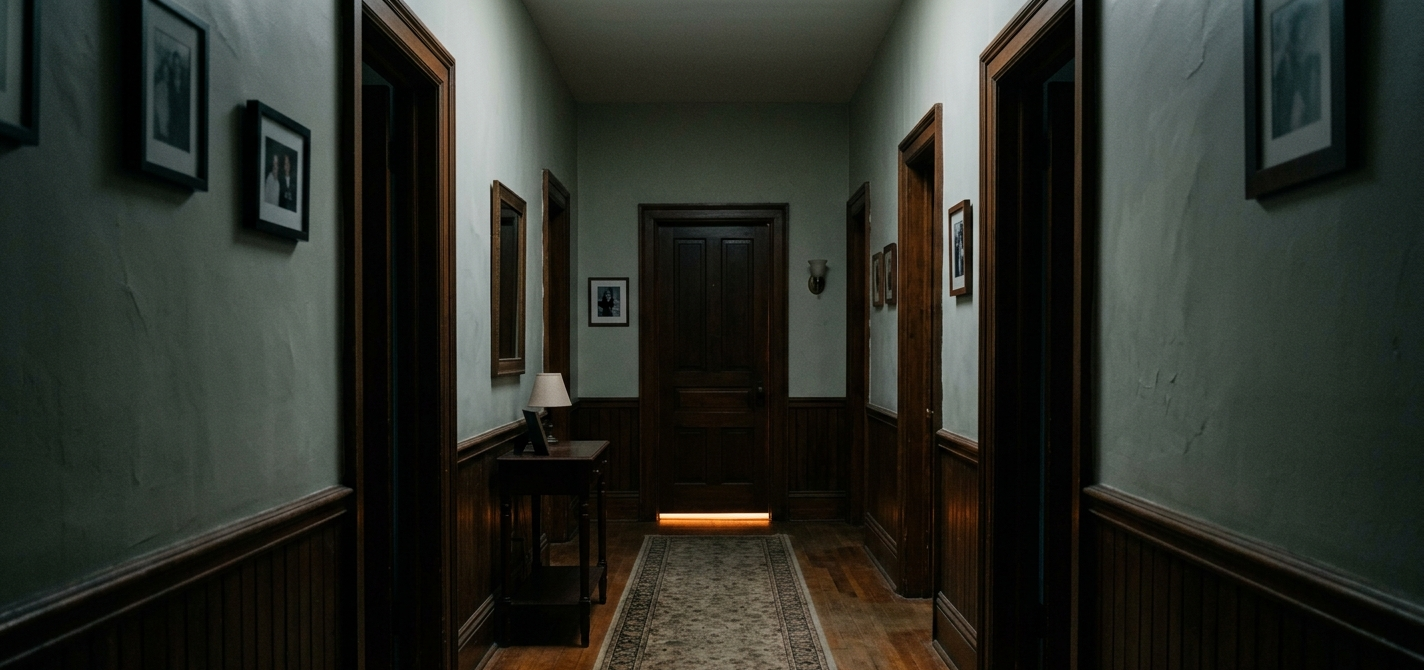

Someone said something at one of our SOS Madison support group meetings that has stayed with me. They said their person was one room over when they died by suicide. That the house was quiet. That there had been no argument, nothing unusual, nothing that registered as a warning. And then it was over.
“How could they have been right there,” they said, “and not called out for me?”
That question lives in so many survivors. It is one of the most painful aspects of suicide bereavement. Not just the loss itself, but how close they physically were to it. The ordinary evening. The unlocked door. The belief that if you had known what was happening ten feet away, you would have done something.
Dr. Richard Heckler is a psychologist who spent years interviewing people who had survived suicide attempts. His book, Waking Up, Alive, drew on those interviews to describe something he called the suicidal trance. It is not a clinical term you will find in a diagnostic manual. It is a description, grounded in real accounts from people who had been inside a suicidal crisis and lived to describe what it was like. What he found helps explain something that many survivors carry without language for it.
What Dr. Heckler Called the Suicidal Trance
Heckler used the word “trance” deliberately. He was not suggesting anything mystical or dramatic. He was describing a specific state of mind that he heard survivors of attempts describe again and again: a kind of total enclosure. A way of experiencing reality that filtered everything through a single, overwhelming conclusion.
The Alliance of Hope for Suicide Loss Survivors summarizes Heckler’s description this way. In the suicidal trance, the person begins to perceive life through a filter that overtakes them and blocks out all else. The trance narrows perspective until the only inner voices are those that push toward death. And critically, in the later stages, the person is no longer able to recognize support when it is available.
That last part deserves some thought. They were not unwilling to recognize support. They were unable to recognize it. The trance is a state in which the brain’s capacity to receive what is being offered has been severely compromised.
Heckler identified four features that show up consistently in suicidal trances, drawn from the accounts of survivors of attempts.
- First, the thinking feels completely logical from the inside. It is not experienced as irrational. It arrives as a coherent series of arguments, a premise followed by conclusions, that frame death as a reasonable response to pain that cannot be endured any longer. The person is not confused. They feel, in a terrible way, completely clear.
- Second, the trance appears as resignation. The person may stop caring about the state of their life. This is what many survivors describe when they look back: a kind of flatness, a withdrawal of investment in anything. It is easy to confuse with depression or hopelessness. In some ways it is both. But in this context it is something more acute.
- Third, as the trance intensifies, it becomes more insistent. It beckons. It presses toward completion.
- Fourth, it comes with a particular vision of the future. One in which the future looks like an endless repetition of present pain, never-ending and without relief. Tomorrow will be exactly as unbearable as today. And the day after that. The trance removes the future as a place the person can inhabit.
The Long Descent Before the Trance Takes Hold
One of the important things Heckler described is that the trance usually does not arrive without a preceding period. He described a pattern of descent: pain that goes unaddressed, withdrawal, and the construction of a facade.
The facade is important. Heckler wrote that people in this descent often protect themselves from further hurt by constructing an outward presentation that conceals what is happening underneath. Here is the part that survivors often recognize with a shock of painful recognition: the facade can be convincing. Not because the person is deliberately deceiving the people around them, but because the facade becomes a way of functioning, of continuing to be present in ordinary life while their interior thoughts and emotions are something entirely different.
Some survivors look back and can identify the moment the facade appeared. The person who seemed to settle. Who started returning calls. Who came to dinner and seemed more like themselves. Who said “I’m fine” and, for a few weeks, appeared to mean it.
That apparent recovery is one of the most painful things survivors carry. Because it can feel, in retrospect, like a deception. Like the person chose to appear better in order to prevent intervention. But what Heckler’s research suggests is something more complicated. For many people, the facade was its own kind of effort. An attempt to stay connected to the world, to remain functional, even as the interior was continuing its slide.
What Survivors of Attempts Tell Us About the Inside
The richest evidence for what a suicidal crisis feels like from the inside comes from people who survived their attempts. Their accounts are consistent enough across Heckler’s interviews, and across decades of subsequent research, to form a coherent picture.
From the inside, the trance does not feel like confusion. It feels like clarity. The mind has arrived at a conclusion that feels certain. The capacity to consider alternatives, to hear counter-arguments, to hold onto anything someone offers, is severely impaired. Not because the person has stopped caring about the people around them, but because the brain has been overwhelmed.
Their brain betrayed them.
Edwin Shneidman, one of the founding figures of modern suicidology, described this as cognitive constriction, the narrowing of the mind’s field of vision under extreme pain until it can only see the suffering directly in front of it. In his work on what he called psychache, the specific unbearable quality of psychological pain that drives suicidal crisis, Shneidman argued that this pain is not ordinary sadness. It is a felt sense of agony so total that the mind cannot hold any other information alongside it.
People who survived attempts often describe exactly this. They describe a point at which the thoughts stopped being something happening to them and became something they were inside. The tunnel, some call it. The sense that there was no other exit. Not a rational evaluation of options and rejection of them. The options simply were not visible.
Kevin Hines is one of fewer than forty people known to have survived a jump from the Golden Gate Bridge. He jumped on September 25, 2000, when he was nineteen years old. What he has said publicly about that moment is one of the clearest accounts available of what a suicidal crisis feels like from the inside. He has described not making a decision in any ordinary sense of the word. He said in an interview: “I didn’t make a decision like you would make a decision to have a slice of pizza or go to a certain school or take a certain job. I was compelled to die by the voices in my head telling me that I had to.”
The instant his hands left the rail, he felt regret. Not a moment later. Immediately. He has said the feeling of depression left in those four seconds of freefall and was replaced by a survival instinct. He wept and prayed to live as he hit the water. His body bore the evidence of how violent the impact was: shattered vertebrae, a broken ankle, a recovery that took weeks. But what stays with survivors who hear his account is not the physical detail. It is the word “compelled.” Not deciding. Being driven. Inside the trance, the mind does not experience itself as making a free choice. It experiences itself as arriving at the only possible conclusion.
Hines has spent his adult life as a suicide prevention advocate, working with organizations around the world. He campaigned for years for a safety net to be installed at the Golden Gate Bridge. When it was finally completed in 2023, he wept. He has said he met thousands of people who survived attempts, and that almost all of them described the same instant regret. Not afterward. The moment they crossed the threshold.
That instant regret points to something that suicidologists have understood for a long time but that survivors often don’t hear:
Most people in a suicidal crisis are deeply ambivalent. Not resolved on dying. Not at peace with it.
Holding two things at once, the unbearable push toward death and the part of them that still wanted to live. The trance does not eliminate that second part. It drowns it out. The compulsion Hines described was not the absence of a will to live. It was a state in which the will to live could not make itself heard above the noise.
This matters because it changes the story of what was happening inside the person you lost. They were not moving toward death because they had stopped wanting to be here. Many were moving toward death while part of them was still reaching for life, still hoping something would shift, still unable to close the distance between that hope and asking for help.
The entire field of crisis intervention is built on this ambivalence. Every conversation ever had at a ledge, a bridge railing, or a hospital bed is a conversation with both parts of the person at once. The fact that people can be reached at all, that presence and listening can tip the balance, is because the balance is never entirely settled. The role of underlying mental health issues can cause a serious increased risk of suicide.
One survivor of an attempt put it plainly in a comment on the Alliance of Hope page. They wrote that the trance is “all consuming” and that the pain becomes something the person is trapped inside, not something they are observing. Another described it as a state that feels like a siren, pulling toward one conclusion, where the pain “feels infinite” and exit through any other door is not accessible.
This is not weakness. This is not selfishness. This is a genuine mental health crisis in which the brain’s normal capacity to consider alternatives, to hold onto hope, to recognize help, has been overwhelmed.
Why They Couldn’t Reach Out from the Next Room
This brings us back to that question from our support group meeting.
If the suicidal trance closes off the capacity to recognize support that is available, then the person in the next room was not choosing silence. They were in a state in which the option of calling out may not have registered as an option at all.
Our recent post on suicide crisis syndrome looked at the formal research on the acute suicidal mental state and found numbers that mirror what Heckler described from clinical observation.
Up to 75 percent of people who die by suicide explicitly denied suicidal intent at their last meeting with a health professional.
Not people who never saw a professional. People who were face to face with a clinician specifically trained to ask these questions, and still said no.
That same research found that between 50 and 60 percent of people experiencing suicidal thoughts do not disclose to anyone at all. Not their doctor, not their closest friend, not their partner. And when researchers looked specifically at people who died by suicide, disclosure rates were even lower.
The person one room over was in a state that research now consistently shows makes disclosure profoundly difficult, and in the final stages of the trance, perhaps genuinely impossible. Not because they had given up on you. Not because you didn’t matter. Because the trance itself had closed off the channels through which reaching out might have happened.
There is another difficult piece to this. Psychologist Thomas Joiner‘s research on why people die by suicide identified something he called perceived burdensomeness, the conviction, distorted by the crisis state, that the people around them would be better off without them. In this state, not calling out is not indifference. It may have been, in a terrible and backwards way, an act of care. The person may have stayed silent because they believed, genuinely believed in that distorted moment, that reaching for you would only add weight to someone who was already carrying enough.
This is not something that holds up to rational scrutiny. But the suicidal crisis state is not a rational state. It is a state in which the brain’s assessment of reality is severely distorted. And if that distortion included the belief that your life would be easier without them in it, then their silence in that room was not a measure of how little they valued you. It was a measure of how completely the crisis had turned their world upside down and impacted their understanding of what was true.
Heckler wrote something that many survivors who have read his work describe as the closest they have found to an answer. He wrote that in the final stages of the descent, people are no longer able to recognize support when it is, in fact, available. Not unwilling. Not refusing. No longer able.
The experience of Kevin Briggs adds something important to that observation, from a different vantage point.
Briggs spent more than twenty-three years as a California Highway Patrol sergeant, most of them patrolling the Golden Gate Bridge. He became known as the “Guardian of the Golden Gate Bridge” for talking more than two hundred people back from the edge. His TED talk on suicide prevention has been viewed millions of times. He is also, it is worth knowing, a suicide loss survivor himself.
On March 11, 2005, Briggs spent an hour and a half talking with a young man named Kevin Berthia who had gone over the rail. Afterward, Briggs asked him what had made the difference, what had brought him back. Berthia’s answer was simple. “You listened. You let me speak, and you just listened.”
In his own 90-minute conversation, Briggs later estimated he spoke for only four or five minutes. Everything else was Berthia speaking, and Briggs bearing witness.
Briggs has said explicitly that in his experience, people in crisis do not want to hear “it’s going to get better” or “you’ll get over it.” Those words do not land. They cannot land. The cognitive state the person is in does not have the ability to receive them.
This matters for survivors in a very specific way. Many of you carry the belief that if you had said the right thing, the outcome would have been different. What Briggs learned across two hundred encounters is that there was no specific right thing to say. What Berthia needed was presence and listening. A trained crisis negotiator, someone whose profession was finding the words, spent ninety minutes doing almost none of the talking.
There are no magic words.
That is not a reason to feel hopeless about what you could have offered. It is a reason to let go of the belief that there were magic words you failed to find. The person you lost was in a state that research now describes as a genuine crisis of the brain, not a solvable problem waiting for the right sentence.
When It Can Turn Fast
One of the hardest pieces of this is that the trance does not always build slowly. Heckler described a pattern that can unfold over months or years. But the research on the acute suicidal mental state also shows it can arrive quickly.
The suicide crisis syndrome research found that symptom scores dropped dramatically in hospitalized patients within days of treatment, which tells a painful story in reverse. It means the state can also intensify rapidly. Someone who seemed genuinely okay last week, who had a real conversation with you, who seemed to be in a better place, could still have entered an acute crisis in the days or hours before they died.
This is one of the most important things for survivors to understand, because it directly addresses one of the most painful forms of hindsight bias that many carry. The belief that if you had paid better attention to the last conversation, you would have caught something.
The research and Heckler’s clinical work together suggest that what was happening in those final hours may have had very little to do with what the conversation looked like from the outside. The interior state and the exterior face can be completely different things, particularly once the facade is in place.
There is something specific that happens in the final stage that many survivors describe. When a person in suicidal crisis moves out of the desperate, agonized ambivalence of the descent and into a final resolution, the agitation can lift. The restlessness settles. The person may seem, suddenly, lighter. More present. Calmer than they have been in weeks.
Survivors often remember this as a sign of hope. A good evening. A real conversation. The sense that whatever had been wrong might finally be easing.
Clinicians have documented this for decades. It is not recovery. It is the resolution of internal conflict once the decision has, in the person’s mind, been made. The ambivalence that was generating the distress has quieted, not because the crisis passed, but because one side of it stopped fighting.
For a suicide loss survivor, this is one of the most painful features of the final stages. The very thing that looked like turning a corner was the last door closing. If you are carrying the memory of a good day, a normal dinner, a moment that felt like hope right before the end, you are not alone in that. Many survivors carry exactly that memory. And it was real. It was a real moment. It just was not what it appeared to be.
What the Research Adds to Heckler’s Picture
Heckler’s work came from interviews. It was observational and qualitative. What has happened in the decades since is that the clinical and neurological research has begun to confirm what he described from the patient side.
The suicide crisis syndrome research, led by Dr. Igor Galynker at Mount Sinai and published in peer-reviewed journals, identified a specific cluster of features in the acute suicidal state.
- Frantic hopelessness, which researchers also call entrapment, is a persistent and overwhelming sense of being trapped with no way out and no way to make the pain stop.
- Loss of cognitive control, where the thinking process itself becomes disrupted.
- Hyperarousal, including severe insomnia.
- Acute social withdrawal.
These are not metaphors. They are measurable features of a specific mental state. And together they describe something very close to what Heckler heard survivors of attempts describe. The person is not thinking the way they normally think. The brain is not processing information the way it normally processes it. The capacity to communicate distress clearly, to hear reassurance, to see alternatives, is severely impaired.
A 2023 meta-analysis in Clinical Psychology Review, covering nearly 100 studies and more than one million participants, found that the most common reasons people gave for not disclosing suicidal thoughts were:
- Fear of embarrassment
- Fear of judgment
- Not wanting to worry the people they cared for.
Many people who were silent were, in their own way, trying to protect the people around them. The silence was not indifference. In many cases it was its own form of care, however painful that is to accept.
What This Means for the Guilt You Are Carrying
I want to be honest about what this discussion about what happens in the end does and does not offer.
It does not explain why the person you lost entered this state, or why it happened when it did. The post on why facts can never fully answer the question “why” speaks to that honestly, and it remains true even alongside all of this research.
What the suicidal trance framework offers is a different way to hold a specific piece of what you carry. The belief that if you had said the right thing, or been in the right room, or asked the right question at the right moment, you could have changed what happened. That belief is almost universal among survivors, and it is one of the heaviest things this grief asks us to carry.
The research behind the suicidal trance, and the formal clinical work that has built on it, suggests something important about that belief. In the final stages of a suicidal crisis, the brain’s capacity to receive what you would have offered was severely compromised. Not because of anything you said or did not say. Because of the state the person was in.
If you are carrying guilt right now, please know that what you are feeling is one of the most common experiences in suicide loss. It deserves time and support. The anger and conflicted feelings that run alongside it are equally real and equally valid. Both of them can coexist with this new information. Understanding the trance does not make the grief smaller. It adds something to how you can hold the hardest questions inside it.
What this research is beginning to establish is not that the person you lost gave up on you. It is that in the final hours, the part of the brain that would have reached for you was no longer available to do that reaching.
I lost my son John to suicide in April 2009. He was seventeen years old and by every measure he was thriving, right up until the months before the end. I know what it is to look back at an ordinary evening and try to find what I missed. I know what it is to believe that if I had been in the right place at the right moment, things would be different.
I have been sitting with these questions for seventeen years. The suicidal trance framework, and the research that has built behind it, has not answered the question of why John died. Nothing answers that completely. But it has given me a different way to carry the question of why he didn’t call out. Not as evidence of failure. As evidence of how acute and total a crisis can be, and how little the person inside it may have been able to do about what was happening.
You reached out in ways you may not even remember. Most survivors did. In some way, in some moment, you reached. Their life may have been extended in way you will never understand from the moments that you did connect with them. But tragically, on that day and in that unfathomable moment they could not connect with you, or with anyone.
The research is starting to explain why the ability of them to reach back may have been far harder than either of you could have known.
If you are looking for a space to bring these questions, suicide loss support groups remain one of the most consistently helpful things survivors find. The American Foundation for Suicide Prevention can help you find a group anywhere in the country. And if you are looking for a clinical professional, our post on suicide loss and therapy covers what to look for in a clinician who has experience with this specific kind of grief.
You are not carrying this alone.
If you are in crisis right now, please reach out to the 988 Suicide and Crisis Lifeline by calling or texting 988. They are available around the clock.
Posts You May Also Like
- Mental Health and Suicide Loss: What the Research Actually Shows Suicide loss survivors face significantly elevated risks for depression, anxiety, and their own mental health crises. This post looks honestly at what the research shows — and what it means for how you take care of yourself.
- Suicide Crisis Syndrome: Why They Couldn’t Just Tell You – The formal research on the acute suicidal mental state and what it tells survivors about non-disclosure and silence.
- The Black Box Project: Why the Warning Signs Were Hidden – Extends the trance concept from interview-based research into digital, timestamped evidence of the same pattern.
- Hindsight Bias: Healing the Pain of “Could Have Known” After Suicide Loss – If you are replaying the last conversations looking for what you missed, this post speaks directly to why that pattern happens.
- Abandonment After Suicide Loss: Why Wasn’t I Enough to Stay – Applies the trance research directly to the specific question of whether closeness should have been enough to prevent the death.
- Guilt – A direct look at one of the most persistent emotions survivors carry after a suicide loss.
- Suicide Is Not About a Desire to Die: Understanding Psychache – On the specific quality of psychological pain that Shneidman described, and what it means for how we understand the person who died.
- The Quest for Understanding: When Facts Don’t Answer the Question “Why” – For survivors who are still searching for an explanation that never quite arrives.
- 988 for Suicide Loss Survivors: What It Is and When to Call – For survivors asking whether 988 could have helped, and what the line offers for their own grief now.
PRINTABLE GUIDE PDF
A two-page PDF guide has been generated for survivors to print, save, or share.

Leave a Reply