
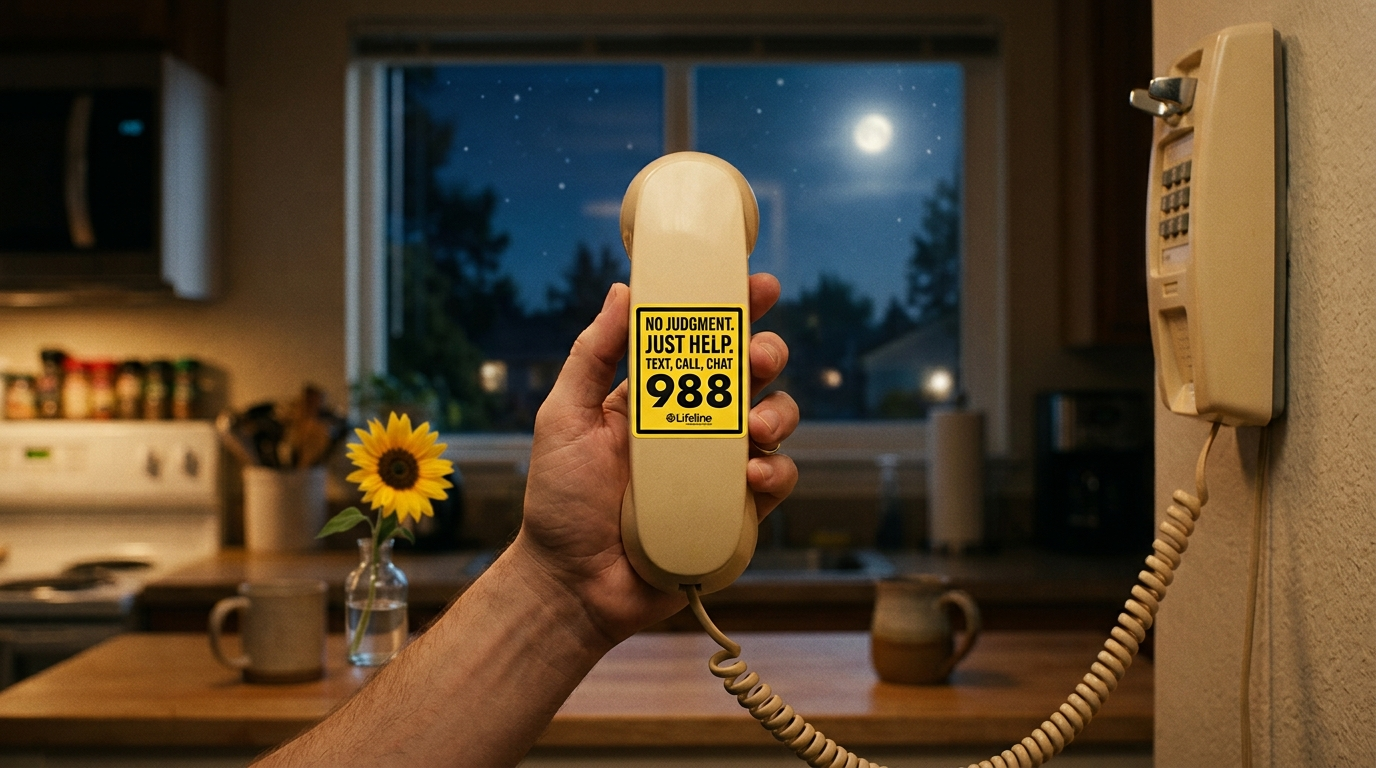

It’s 2am. You can’t sleep. You’ve been lying in the dark for an hour with your mind running through everything again. The “whys.” The last conversation you remember. The image you can’t shake. Maybe it’s been three weeks since the death, or three years. It doesn’t matter. At 2am, grief doesn’t care how long it’s been.
Your therapist’s office is closed. The support group doesn’t meet again for another ten days. Your friends are asleep, and even if they weren’t, you’re not sure you could explain what’s happening inside you right now. A book or a website can give you words to read, those words can’t respond to you. They can’t hear you. They can’t just be there.
988 can.
The 988 Suicide and Crisis Lifeline is available 24 hours a day, seven days a week. You can call, text, or chat with a trained crisis counselor any time, day or night. And if you’re a suicide loss survivor, this line is for you. Not just for the worst possible moments. For grief, too. This post is about what 988 offers specifically for suicide loss survivors, and why it belongs in your grief toolbox.
I’ve been an AFSP-trained co-facilitator at SOS Madison, a suicide loss support group in Madison, NJ, for more than fifteen years. We lost our son John to suicide in April 2009. Over the years, I’ve listened to many survivors talk about how they have struggled alone in the middle of the night because they didn’t know about 988, that there is someone always there, and reaching out was not just allowed but welcome. This post is for them. And for you.
If you are struggling right now, please call or text 988 for the 988 Suicide and Crisis Lifeline. They are available around the clock, for survivors in grief and for anyone in crisis. You do not have to be at the worst point to reach out.
988 for Suicide Loss Survivors: More Than a Crisis Line
The most important thing to understand about 988 is that it is not exclusively for people in suicidal crisis.
According to a SAMHSA report on the transition to the 988 system, as many as 77 percent of contacts to the Lifeline come from people who are not suicidal at the time they call. Three out of four callers are reaching out because they’re struggling, not because they’re actively thinking about ending their lives.
Three out of four people who contact 988 are not in suicidal crisis.
They are struggling.
That is enough of a reason to call.
People call 988 for grief. For anxiety. For depression. For substance use struggles. For the paralyzing distress that comes when life falls apart and no one around you quite understands. They call because they’re terrified for someone they care about. They call because the loneliness of 2am has become too much to hold.
The line was built for emotional distress in all its forms. Grief after suicide loss is emotional distress. A wave of anguish and guilt and unanswered questions at 2 in the morning absolutely qualifies.
If you’ve been telling yourself that 988 is only for people who are actively in danger, set that belief down. It’s not correct. And it’s keeping you from a resource that exists for moments exactly like yours.
Since its launch in July 2022, 988 has received more than 17 million contacts. In 2025 alone, state based 988 call centers answered 4,336,016 calls.
A recent JAMA study found that suicide rates among young people dropped 11 percent after 988 launched compared to projected rates, with states that saw greater increases in answered calls experiencing the largest declines. Early research suggests the line may be making a difference. And it’s available to you.
What Happens When You Call, Text, or Chat
There are three ways to reach 988.
- You can call by dialing 988
- Text 988
- Chat live at 988lifeline.org/chat.
For those who are deaf or hard of hearing, 988 also offers a videophone service for American Sign Language users, connecting callers directly to counselors through a video relay service.
When you call, a brief recorded message lets you know you’ve reached the 988 Suicide and Crisis Lifeline. You can press “1” for the Veterans Crisis Line, “2” for Spanish-language services, or simply wait. A trained counselor will answer. The average wait time nationally dropped to around 21 seconds in recent data. You can briefly wait at 2am.
The counselor on the other end of the call’s job is to listen. They are not there to evaluate whether your grief is bad enough to deserve the call. They are there to be present with whatever you’re carrying.
The range of what 988 can address is broader than many people expect. Crisis counselors are trained to help with suicidal thinking, depression, severe anxiety, grief and bereavement, substance use struggles, panic, and general emotional overwhelm. They can help you work through what you’re feeling right now, clarify what you need, and connect you to local resources when appropriate.
They can also support you if you’re worried about someone else and aren’t sure what to do. If that describes where you are right now, this site has a longer post on becoming an unintended gatekeeper for someone else’s crisis, including what your job actually is and where it ends.
According to the 988 Lifeline’s own training standards, each of the more than 200 crisis centers in the network develops its own training curriculum aligned with 988’s core clinical requirements. Training typically covers suicide risk assessment, trauma-informed care, active listening, de-escalation, and how to support callers across a wide range of situations. Since November 2022, the Lifeline has operated an online learning portal to ensure consistent, research-based training across all centers in the network. The trauma-informed care component is especially relevant here, because grief after suicide loss often carries real traumatic elements alongside the grief itself.
These are not volunteers reading from a script. The people who answer are trained to stay with you in the discomfort, to help you feel less alone, and to connect you to what you need. According to the 988 Lifeline’s own published data, most callers report feeling less depressed, less overwhelmed, less suicidal, and more hopeful after speaking with a counselor.
A note on confidentiality. This concern comes up often and it’s worth addressing directly. The 988 Lifeline is confidential, and its active rescue policy is intended to apply only when a counselor believes someone is in imminent danger and unable to act on their own behalf, not simply because a caller is grieving or having a hard night. In practice, that determination rests on an individual counselor’s judgment in the moment, so no crisis line can promise an outcome with total certainty. What’s true is that grief and emotional distress on their own generally don’t meet that bar, and dispatching emergency services without a caller’s consent is meant to be the exception, not the default. If knowing exactly how this works matters to you before you call, 988’s full 70 page written policy on imminent risk and active rescue is available on their site. An easier summary of their confidentiality policy can be found on their site.
If you’re not sure what to say. You don’t need an opening line prepared. Something as simple as “I lost someone to suicide and I’m having a really hard night” is enough. The counselor will take it from there.
You don’t need an opening line.
You just need to dial.
One practical note: save 988 in your phone right now. Not later. Now. Having it there removes one small barrier at the worst possible moment.
Why Grief After Suicide Loss Is Different
Grief after any death is painful. Grief after suicide loss carries layers that most other bereavements don’t.
There’s the guilt that so many survivors carry, the relentless replay of what might have been done differently. There’s the hunger for answers that never fully satisfies, the “why” that circles back night after night. There’s the stigma, which can make you feel like your grief has to be explained or softened in ways that other losses don’t require. And for many survivors, there’s something that functions like a trauma response alongside the grief. Intrusive images. A startle reflex. A body that stays on alert even when things are calm.
Research compiled by the Suicide Prevention Resource Center notes that people who lose someone to suicide face elevated risk for prolonged grief, depression, anxiety, and in some cases suicidal thinking themselves. That last part is important and worth understanding. Losing someone to suicide places you in a group that can sometimes need a level of active, around-the-clock support that most resources aren’t equipped to provide.
This is not a reason to be afraid of yourself. It’s a reason to know what’s available.
When I look around the room at our support group SOS Madison and hear people describe the early months, the 2am hours come up again and again. The house is quiet. The world is asleep. And you’re wide awake with something that feels too big to hold alone. You’re not imagining it. And you’re not alone in it.
The 2am hours come up again and again in our support group.
You are not the only one lying awake with this.
988 is available in those hours. It’s one of the few resources that actually is.
Understanding the Difference Between Grief and Suicidal Crisis
Grief after suicide loss can feel devastating. The pain is real, the despair is real, and some days can feel impossible. But grief, even grief this intense, is a response to a real and catastrophic loss. The pain reaches toward the person you lost, not toward an exit. It doesn’t mean your life holds no value or your future holds nothing.
A suicidal crisis is different. It moves beyond pain into a state where the mind starts generating thoughts about your own death as a way to escape what feels unbearable. The shift may be subtle at first. From “I am devastated” toward “I can’t keep going.” From “this is too hard” toward “there is no reason to continue.” From waves of anguish that come and go toward a quieter, more fixed feeling that the pain is permanent and escape is the only answer.
If you are thinking about harming yourself, have thoughts that are frightening you, or do not feel safe right now, please stop and contact 988 before reading further.
If you are in immediate danger, call 911 or go to the nearest emergency room. The 988 Suicide and Crisis Lifeline is free, confidential, and available 24 hours a day.
Some thoughts live in between those two, wishing you could be with the person you lost, wondering what it would be like to not wake up some morning. Thoughts like that are common in grief, and they don’t always mean you’re in crisis. They’re also not something to ignore. They’re worth discussing with a counselor even if they don’t feel urgent enough to justify the call. You don’t have to sort out which category a thought belongs in before you’re allowed to mention it.
If you’re unsure which category your thoughts fall into, contact 988 anyway. You don’t have to be certain before you reach out.
That shift matters. Not every survivor will experience it. Many won’t. But the Alliance of Hope for Suicide Loss Survivors and clinical researchers both note that survivors are at elevated risk for their own suicide, particularly in the earlier period of grief.
If you notice your thinking moving in that direction, reaching out is the right response. Not waiting.
If you call or text 988 and the counselor hears signals that you may be in real danger, they’ll shift their approach. They’re trained to work with you on safety, to understand what’s happening, and, if the situation calls for it, to help connect you to local emergency resources. But that escalation is not the default. It’s a response to what the counselor actually hears from you. Most contacts don’t go there. Knowing what happens if they do shouldn’t stop you from calling when you simply need someone to be with you in the dark.
Reaching out before you’re at the worst point isn’t weakness.
It’s exactly what 988 is there for.
If you’re struggling right now, even reading this, 988 is available at this moment. Pick up the phone.
The Question That May Be Sitting With You
If 988 exists now, and the National Suicide Prevention Lifeline existed before it, a painful question sometimes surfaces for survivors.
Could it have helped the person I lost?
I want to approach that honestly rather than brush past it.
There’s no way to answer that with certainty, and I won’t pretend otherwise. Nobody can tell you what would have happened in a different version of that night. Not knowing is its own kind of weight, and it doesn’t lift just because a resource like this exists now.
What we do know is that the line works for a lot of the people who call it. The JAMA research found an 11 percent decline in suicide deaths among young people after 988 launched. That number describes what has happened at a population level. It isn’t a claim about what would have happened for any one specific person, including the one you lost.
And yet we also know, from research into what happens during acute suicidal crisis, why many people don’t reach for a phone in their worst moments. On this blog, posts on suicide crisis syndrome and the suicidal trance explore how a person in acute crisis can become so cognitively narrowed that help-seeking feels genuinely impossible. Not a choice not to call. A feature of the crisis itself that removes the capacity to reach outward.
Is Suicide Preventable? Not Always, and Never Your Fault is a blog post that gets deeper into understanding suicide loss.
This question often travels alongside another one, the sense that you should have seen it coming and somehow made the call for them. If that thought lives in you too, this site’s post on hindsight bias after suicide loss speaks directly to that particular feeling, separate from the question of 988 itself.
Holding that knowledge doesn’t undo the grief. But it may soften one of the questions that can get tangled up inside it.
Your grief exists in the present, even when it pulls you toward the past.
And 988 is for you, today.
What I want to offer here is this: your grief exists in the present, even when it pulls you toward the past. And 988 is for you, today, in the grief you are living right now.
988 Is One Tool in Your Toolbox
Think of 988 as one resource among several, not a replacement for any of them.
- Your therapist or grief counselor can offer something a phone line cannot. Continuity, relationship, treatment, and the accumulation of real understanding over time. If you haven’t found someone who specializes in suicide loss, this practical guide to finding a grief counselor can help you start.
- A suicide loss support group offers something else: the particular recognition that comes from sitting with others who have lived a version of this same loss. The AFSP support group finder can connect you to a group near you. Your friends and family, even those who don’t fully understand, are part of your world in ways no counselor can replicate.
- Online communities like the Alliance of Hope’s 24-hour forum are available around the clock.
- The AFSP Healing Conversations program connects survivors one-on-one with trained peer volunteers who have also experienced suicide loss.
- Books on grief and suicide loss can be powerful. Pages on this blog and others can offer perspective when you need it.
But none of those things can listen to you in real time at 2am when you’re in the middle of something that you may not have the words for. A book can’t ask how you’re doing right now. A forum post sits there. 988 answers with a compassionate human voice.
Therapy and support groups address the long arc of healing. 988 addresses the immediate moment. Both matter. Neither replaces the other.
One honest caveat: 988 counselors vary in their familiarity with suicide bereavement specifically. Some will understand suicide grief and its particular complexities immediately. Others are trained primarily for acute crisis intervention rather than for sitting with the long grief of bereavement. That’s not a reason not to call, but it’s worth knowing that a conversation may feel more or less resonant depending on who answers. If a call doesn’t land the way you hoped, that’s a reflection of that individual counselor, not a verdict on whether 988 can help you. Try again another night. Or call back tonight to talk with someone else.
You Don’t Have to Be at the Worst Point to Call
When we lost our son John in 2009, the nights were the hardest part. Lying awake at 2am with the silence of the house pressing in from every direction. I told myself I didn’t have the right to call a crisis line because I wasn’t the one who had died. I was just the one trying to survive it.
Looking back now, I was wrong. I didn’t understand 988.
988 is also for suicide loss survivors in grief. It’s for the 2am hours. It’s for the moments when the support group doesn’t meet for another ten days and your therapist’s voicemail can’t hear what you’re not saying out loud.
You don’t need to be at the worst point. If you are struggling, that is enough.
And there’s no limit on how many times you can reach out. Some survivors hold back because they feel they’re taking the line away from someone who needs it more urgently. You’re not. Calling on a Wednesday night and again the following Sunday is not a burden on the system. Use it as many times as you need it.
Call. Text. Chat. Three digits 988, any time, anywhere in the country. You can also reach a counselor through the live chat at 988lifeline.org if calling feels like too much right now. The counselor on the other end won’t know your story yet. But they will be there, awake and present, in the middle of the night, ready to listen.
Books and the internet can give you a lot of things. At 2am, they can’t talk with you.
988 can.
One final note, 2am is just this post’s shorthand for whatever hour hits hardest for you. Morning, afternoon, the middle of the night, it doesn’t matter. 988 is there.
Posts You May Also Like
- Finding a Grief Counselor After Suicide Loss: A Practical Guide – A practical walkthrough for finding a therapist who understands suicide loss, including what to look for and how to start the search.
- Finding Your People: The Healing Power of Suicide Loss Support Groups – Why sitting with others who have lived a version of this loss can offer something no other resource can provide.
- Suicide Loss and Therapy – What to expect from therapy after a suicide loss and how it fits alongside other supports.
- Hindsight Bias: Healing the Pain of “Could Have Known” After Suicide Loss – For the survivor whose “could it have helped them” question keeps circling back to what they think they should have seen.
- The Unintended Gatekeeper: When Others Confide a Suicide Crisis – What to do when someone else brings their own suicidal crisis to you, and where 988 fits into helping them.
PRINTABLE GUIDE PDF
A two-page PDF guide has been generated for survivors to print, save, or share.

Leave a Reply