
Editor’s Note: This post was originally published on March 20, 2021, on sosmadison.com, the website for SOS Madison, one of New Jersey’s largest suicide loss support groups. It has been substantially rewritten and expanded for Sunflowers After Suicide. The core story and personal reflections belong to Jack Klingert, co-facilitator of SOS Madison and father of John, who died by suicide in April 2009.
“My God, My God, why have you forsaken me?”
Those words ran through my head on a Friday night in April 2009, as I stood outside under the moonlight with my brother. A local police officer had just confirmed what I already knew in my heart. My son John had died by suicide.
Those words are Matthew 27:46. Most Christians will recognize them immediately. They are the words Jesus cried out as he was dying on the cross. Words of abandonment. Words of loss. A desperate cry for an answer.
I did not plan to think of them in that moment. They simply arrived. And they have stayed with me every Good Friday since.
I knew, standing there, that John had died on Good Friday that year. I did not know how I was going to tell my wife Teri and our daughter that our worst fears had happened. I did not know anything except that I was lost, I felt abandoned, and I needed an answer. It was the moment my faith was truly tested.
Faith Taken for Granted
I came from a large Irish family where faith was woven into everything. Church every Sunday, knowing our priest by first name, the kids active in youth ministry. I thought I understood my faith. I thought I had a handle on it.
I was wrong. Not about the faith itself. About how little I had actually leaned on it. I did not realize how much I would come to need it.
When you are told your teenage son is dead, the questions come fast and they come hard. Why my son? Why my family? Why me? Why any of us? These questions are not academic. They occupy your heart and soul with intense weight. For the first time in my life, I did not have the reflexes to answer them. Nothing I had believed had prepared me for this.
Research on suicide loss confirms what many of us feel in those early hours: the grief that follows suicide is not like other grief. It carries particular weight because of how the death happened. Many survivors also experience what researchers describe as a spiritual crisis. This can look like a shattering of previously held assumptions about how the world works, about protection, about God’s presence or absence. An article at Alliance of Hope for Suicide Loss Survivors, notes that because suicide loss is so traumatic, it can shatter long-held beliefs that a person may never have examined before. That was exactly where I was.
The Three F’s
I often say we survived those first days and weeks because of the three F’s: Family, Friends, and Faith.
John died on Good Friday. That meant a long Easter weekend before we could hold his wake and his funeral mass. It could have been the loneliest stretch of days imaginable. Instead, we were surrounded with our family, friends and our faith. Our pastor came to the house for several hours each day. We talked. We asked questions. We searched for a deeper understanding of what we believed and why. On Easter Sunday, he held mass right there in our family room, with everyone who loved us gathered around. We were lost in our grief, but embraced by our faith.
In those conversations, we also found the time to make sure that John’s funeral service would be symbolic of hope and healing. The music we chose, the readings, the imagery, the stories we shared. All of it was meant to honor John’s life and to offer something to hold onto for everyone who loved him. A local reporter captured many of the themes we had woven into the service, and reading it years later I am grateful we made those choices. The service became a place where grief and faith could sit together, where we could acknowledge the loss without pretending it was something smaller than it was.
Faith did not give me answers that weekend. What it gave me was something else: a framework for enduring without answers. And the belief, imperfect and sometimes shaky as it was, that John was somewhere I would someday reach.
I believed, and I still believe, that God did not call John home. But I believe God was there to welcome him when he arrived. John got the keys, and in the middle of my heartbreak I found some comfort in that. He was back with his grandfather and with others who had gone before him. He was, as he would have put it, in a pretty good place.
The prayer that closes many Christian funeral services, In Paradisum, became something I returned to again and again:
“May the angels lead you into paradise; may the martyrs receive you at your arrival and lead you to the holy city Jerusalem. May choirs of angels receive you and with Lazarus, once a poor man, may you have eternal rest.”
There is a children’s choir recording of this prayer here, if you have never heard it. The Latin text is ancient. Something about children’s voices carrying these words makes them feel closer to heaven. For me it has become a quiet place to return to when Good Friday arrives and I am holding John in my thoughts.
What Grief Does to Faith
I want to be honest with you, because honesty is what I owe anyone who takes the time to read this blog.
Faith did not solve my grief. It did not answer the hardest questions. And there were moments, more than I expected, when it felt distant in a way it never had before.
This is more common than many religious survivors expect, and it can bring its own layer of shame. If you are struggling with your faith after losing someone to suicide, you are not weak. You are grieving. And the grief that follows suicide is its own category of pain.
Studies on spirituality and suicide bereavement consistently show that survivors often experience what researchers call a spiritual crisis. This can show up as anger at God, a sense of divine abandonment, or difficulty reconciling the loss with what they believed about protection, goodness, or meaning. A 2023 review published in the journal Religions examined how spirituality and meaning-making intersect for suicide loss survivors specifically. It found that those who were given space to work through their spiritual struggles, rather than having them dismissed or rushed, were more likely to find a path through the grief. Some survivors find that their faith deepens through grief. Others find it changes shape entirely. Others lose it for a while and find something new on the other side. All of these are real. None of them makes you less faithful or less worthy of support.
What I found, slowly and not linearly, was that my faith was not destroyed by John’s death. It was asked to become something stronger and less comfortable. Something that could hold the weight of the unanswered questions and still remain standing.
If you find yourself in that spiritual rawness right now, you are not alone in it. The AFSP’s Surviving a Suicide Loss resource guide acknowledges the spiritual dimension of this grief directly. So do the facilitators, and fellow survivors who sit in groups like SOS Madison every month. Bring the hard questions. They belong in the room.
Seeking Understanding Across Traditions
Over the sixteen years since we lost John, I have had the privilege of speaking with faith leaders of many faiths and traditions. Rabbis. Priests. Reverends. Monsignors. Bishops. Men and women who had spent their lives sitting with grief and with God, often at the same time.
I was not doing research. I was looking for something much more personal. I needed to understand where John was. I needed people who had wrestled with these questions longer than I had to help me make sense of what I believed and why. There was a hole in my soul. The Easter weekend mass in our family room had not fully closed it. The three F’s had not fully answered it. It was the kind of question that only gets worked through slowly, in conversation, over years.
What I found, speaking with leaders across traditions, is that faith after suicide loss is not a problem any single tradition has solved. Every one of them had sat with families who asked the same questions I was asking. Every one of them had their own way of holding the mystery. Some answers comforted me more than others. None of them came with certainty. But all of them helped confirm what I already believed in my heart. That John had made it. That wherever he is, he is at peace. That a God worthy of the name does not turn away a seventeen-year-old boy whose brain had betrayed him.
Faith and spirituality are deeply personal. Each of us carries the teachings we were given as children. When loss breaks those teachings open, we have to go looking for something that can hold more weight. That search is not a sign of weak faith. It is what faith actually requires of us. Seeking validation and understanding, sitting with rabbis and bishops and reverends, asking hard questions in places that could hold them. That seeking was part of my grief work. It moved me slowly from the questions to something I could stand on.
If you are in that searching place, I want you to know that reaching out to your own faith community, or even to other traditions, is something you are allowed to do. You do not have to arrive with answers. You are allowed to arrive with the hole in your soul and see what the conversation offers.
If You Have Lost Your Faith Entirely
I want to stop here for a moment and speak to a group of survivors who often go unaddressed in conversations about grief and spirituality. Not people whose faith is shaken. Not people who are angry at God and working through it. People who have simply stopped believing. People for whom the loss was the last piece of evidence, and faith did not survive the verdict.
If that is where you are, this post is not going to argue you back.
I have sat in support groups for more than sixteen years. I have met survivors of every kind of faith background, and I have met survivors who had faith before and do not anymore. Their grief is no less real. Their path is no less valid. The three F’s that carried our family through that Easter weekend were Family, Friends, and Faith. If faith is not available to you right now, the first two still hold. Family and friends, or the community of fellow survivors who know this grief from the inside, can carry a great deal.
What I would gently offer is this. You do not have to resolve the faith question in order to grieve. You do not have to believe in God to find meaning. Research on meaning-making after traumatic loss, including suicide loss specifically, shows that the process of building a new understanding of the world after it has been shattered does not require religious belief. It requires time, connection, and the willingness to let the questions stay open rather than forcing them closed. Meaning can arrive through service, through memory, through the community of other survivors, through whatever form of continuation feels true to you.
Some people find their way back to faith eventually, sometimes years later, in a form they would not have recognized before. Others do not. I am not here to tell you which road is right for you.
What I do know is that you are not broken for having arrived here. A loss this large breaks something in almost everyone. The question of what gets rebuilt, and how, belongs to you.
If you are looking for a community that holds space for survivors across every kind of belief system, the Alliance of Hope for Suicide Loss Survivors has an online forum and support groups where survivors of all backgrounds, religious, spiritual, agnostic, and atheist, find understanding and connection. And if you are wondering whether a support group might be the right place to bring these questions, Finding Your People: The Healing Power of Suicide Loss Support Groups talks honestly about what you can expect when you walk through that door.
Jerusalem: Faith Discovered Through Service
In November 2018, I had the opportunity to visit Jerusalem on a business trip. I know that if you are reading this in the early weeks or months after your loss, Jerusalem feels impossibly far away. It was, for me too. Nine years passed between Good Friday 2009 and that trip. I am not describing where you need to be. I am describing where the road eventually led for me, so you know the road can go somewhere.
I spent time in the Old City, including the Church of the Holy Sepulchre and the Western Wall. These are two of the most sacred spaces on earth for Christians and Jews. I was not there on a pilgrimage. I did not plan to be moved. And yet it happened while i walked those streets in a business suit.
At the Church of the Holy Sepulchre, I watched people. Many of them were sightseers. They stood in long lines to photograph Calvary, the location where Jesus was crucified, and to photograph through bulletproof glass, the tomb where tradition has that he was buried . They moved through these places the way I had once moved through my faith: present without being present. Going through the motions. Getting the picture. Not taking the time to ask deeper questions.
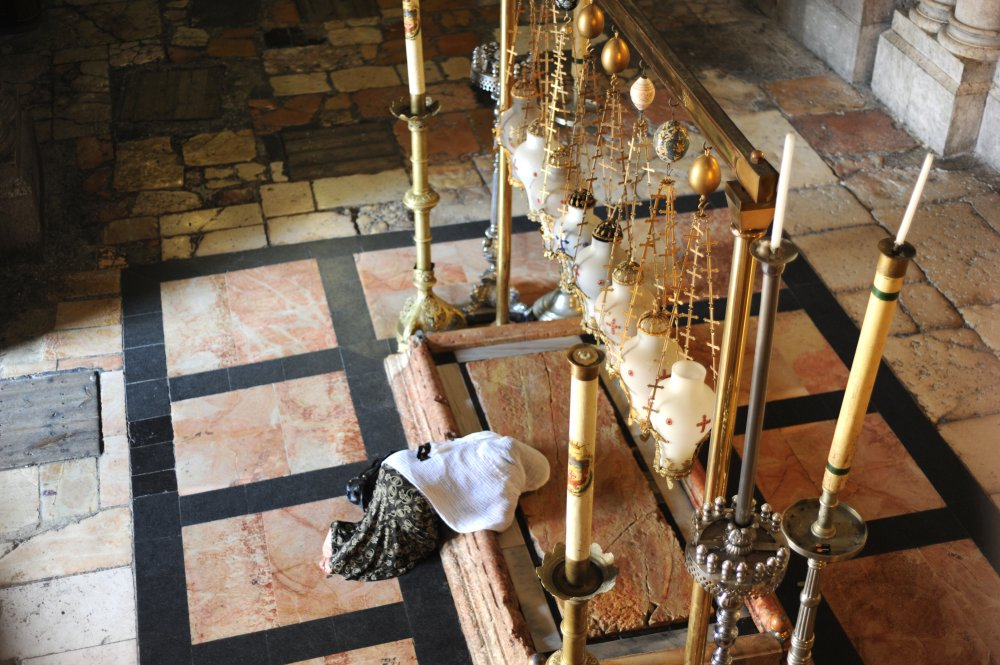
Then I found the Stone of the Anointing. This is the stone where, according to tradition, Joseph of Arimathea arranged for Jesus to be washed, anointed with oils, and prepared for burial. There were no long lines. There was no bulletproof glass. I kneeled and I placed my hands on the stone. I thought about what it meant to use faith in service of another. I prayed that I would be given the wisdom and the opportunity to do the same.
When you remove your hands from that stone, they carry the scent of rose oil. Someone rinses the stone with it every day. You know you were there. There was a hidden gift to the faithful who did reach out.
When I lifted my head from that prayer, the first thing I saw across the church was the Station of the Holy Woman. This is the place where Mary stood as her son was crucified. This is where she felt what I had felt. Loss. Abandonment. The cry for an answer. She had her three F’s too. She was surrounded by those who loved her, those who served her in her grief, those who helped carry the weight she could not carry alone.
I had spent years after John’s death feeling like the Mary of the Pietà, Michelangelo’s famous statue of her alone with her son across her lap, her grief palpable in every fold of marble. That early grief was exactly that: being alone in it, even in a room full of people.
Standing in that church, I realized she was not actually alone. She was held. And the holding was part of the faith, not a distraction from it.
The Western Wall and the Prayer That Changed
I walked the cobblestone streets from the church to the Western Wall. I put on a yarmulke out of respect for the people praying around me. The wall is enormous and old and full of presence. There were hundreds of people there. Tens of thousands of prayer slips folded into its crevices.
Before I approached the wall I stood back and I tried to figure out what to pray for.
In the years before John died, I would have prayed for myself and for my family. Good things, important things, but still oriented inward. That afternoon, for the first time, something was different. I prayed for the people I knew who were hurting. Specific people with specific struggles. I prayed that they would find their own three F’s when they needed them most. I prayed that I could help them.
When I stepped back from the wall, something lifted. I felt a sense of peace I had not expected and could not explain. My God had not forsaken me. He had been reshaping me, slowly and with more patience than I probably deserved, into someone who could actually be useful to others.
That is what suicide loss does, when you let it. It breaks you open. And what grows in that opening, if you tend it, can become something you offer back to the world.
What Faith After Suicide Loss Looks Like Now
Sixteen years of sitting in grief circles with other survivors has given me a particular kind of education. I have heard the questions that come in the first weeks, the first anniversaries, the first holidays that refuse to feel normal. I have heard survivors ask whether God abandoned them, whether their faith was naive, whether believing in anything at all is possible anymore.
I do not have tidy answers. I never will. Fr. Charles Rubey, who founded the LOSS program in Chicago and has spent more than forty years in suicide bereavement ministry, puts it this way: faith is not an easy activity. The mystery of God is not a platitude. It is the only honest landing place for questions that do not have human-scale answers.
What I can say is this. Faith after suicide loss is not the faith you had before. It cannot be. Your heart and soul have been exposed. The faith you had before was not built to hold this weight. The faith that comes through the other side, if you let yourself search for it, is made of different stuff. It has been tested. It has room for the question without being destroyed by it. And it tends to turn outward, toward other people, in ways that faith taken for granted never quite does.
You may be in the early days of asking what you believe now. That is an honest and important question. Take your time with it. Bring it to the people who can sit with you inside the uncertainty, a grief counselor, a trusted pastor, a support group, a friend who understands. And if the weight of the question is too heavy to carry right now, the 988 Suicide and Crisis Lifeline is available around the clock.
If you want to understand more about how survivors search for meaning after loss, The Quest for Understanding: When Facts Don’t Answer “Why” explores the question many of us carry the longest.
And if you want to understand how grief changes shape over the long term, Day 2,922 of Our Journey: The Gift describes what eight years of walking this road actually looks like.
I do not know what your faith looks like right now. I know that on Good Friday in 2009, standing under the moonlight with my brother and a police officer, mine was shattered into something unrecognizable.
I also know what grew from the wreckage.
Every Good Friday is still a tender day for our family. We remember and honor John. We hold Easter differently than we used to. But I no longer look at that moonlit night as the moment I lost my faith.
It was the moment my faith finally became real.
Posts You May Also Like
- Finding Signs and Messages: Experiences of Connection After Suicide Loss – Many survivors describe moments of unexpected connection after loss. This post explores those experiences with honesty and openness.
- The Quest for Understanding: When Facts Don’t Answer the Question “Why” – The “why” question is one of the heaviest any survivor carries, and this post sits with it honestly rather than rushing toward resolution.
- Physics = Love: Continuing Bonds After Suicide Loss – Explores how the bond with the person who died continues to evolve over time, rather than simply ending.
- Ritual and Remembrance – How intentional rituals and acts of remembrance can become anchors for grief, especially on difficult days.
- Finding Sunshine and Forgiveness – A reflection on how forgiveness, including forgiveness of ourselves, becomes part of the longer arc of healing.

Leave a Reply