
Author’s Note: This reflection was originally shared as a personal Facebook post in April 2025, on the sixteenth anniversary of losing my son John to suicide. I’ve expanded it here to offer deeper guidance for others walking this difficult path.
Today marks sixteen exceptionally long years since we lost our 17-year-old son John to suicide. Days like anniversary dates often cause a suicide loss survivor to ruminate about many things. This morning, I found myself thinking about physics concepts, of all things, and how they seemed to mirror something profound about grief and love.
Persistence of Vision: Seeing Beyond Physical Presence
In my undergraduate and graduate degree programs I took numerous physics classes. I’m a geek, not quite Sheldon Cooper, but up there…
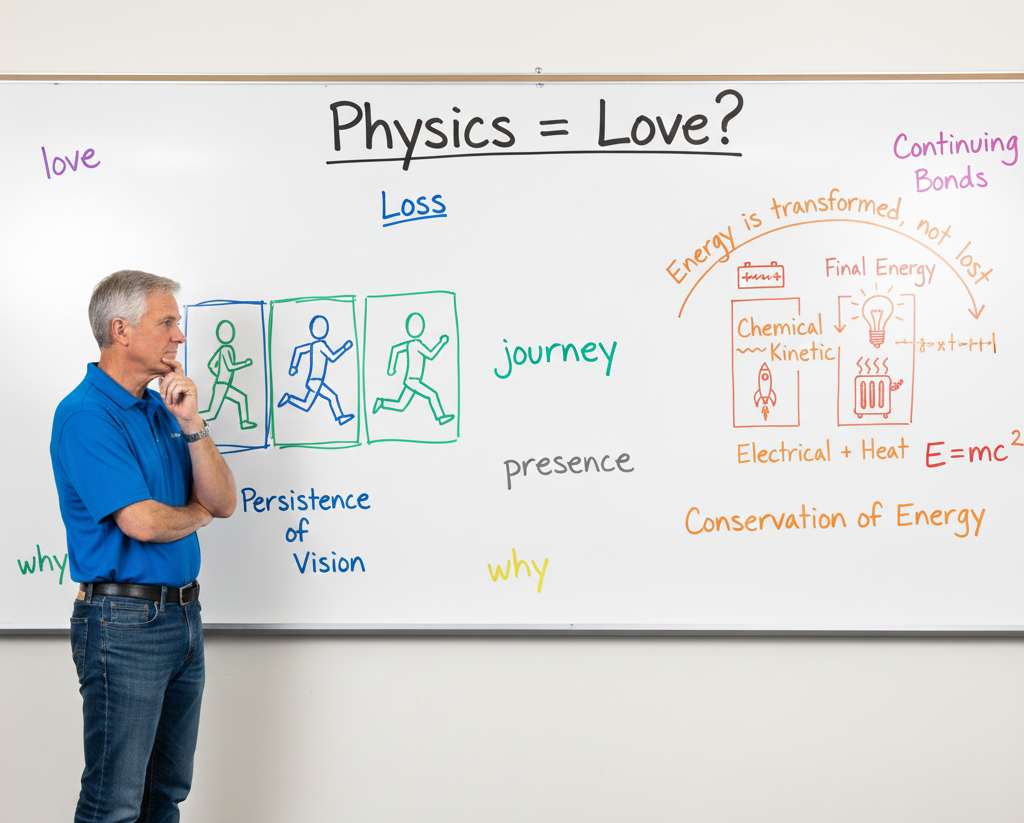
As I approached the anniversary, one physics principle kept coming to mind: Persistence of Vision. It is an optical illusion where the human eye perceives the continued presence of an image after it has disappeared from view. This phenomenon is what makes movies work, our brains filling in the gaps between individual frames to create continuous motion.
While we are surrounded by photos and videos of John, I do not need them to see him. I can still close my eyes and see him clearly. I can still hear his voice, and I can still feel his presence. I know that he is physically gone from our lives, but that does not mean that he is gone from us. He persists in our lives in so many ways, even though he has disappeared from view.
This is what grief researchers call continuing bonds, the understanding that our relationship with someone who died does not end, it transforms. For those of us who have lost someone to suicide, maintaining this connection becomes especially important as we navigate the complicated emotions of suicide grief.
Conservation of Energy: Love That Cannot Be Destroyed
One of the women in our suicide loss support group always used to talk about another physics concept: Conservation of Energy. Simply stated, energy can neither be created nor destroyed, it only changes form. Einstein’s famous equation, E=mc², showed us that energy and matter are interchangeable, nothing ever truly disappears, it just transforms.
Those who knew John knew he was a bundle of energy. He was the first one up to dance, to build a sandcastle, or to play with his younger cousins. He truly lived his life to the fullest, and those around him were drawn into his energy and his love.
So once again, he has disappeared from our view, but we still can feel his energy. He touches our soul in so many ways. His energy gives us the strength to make it through the tough days, those moments when the weight of suicide loss feels unbearable.
In some ways I see him in our grandchildren. Sometimes it is something they say, or a twinkle in their eye when they are doing something mischievous or joyful. It is almost like they have captured some of their uncle John’s energy, carrying it forward into a future he never got to see.
When Physics Explains What Words Cannot
While I was geeking out and thinking of all of these physics principles, I realized what it really comes down to: persistence of vision and conservation of energy may just be scientific ways of describing how your love for someone never goes away. They may be out of sight, but they are never far from you, and you always feel the love.
After over fourteen years of facilitating suicide loss support groups alongside my wife Teri, I have learned that survivors often search for frameworks to understand their ongoing connection with the person who died. Some find comfort in spiritual beliefs, others in psychology’s concept of continuing bonds, and still others, like me on this particular morning, in the elegant simplicity of physics.
The Science Behind Continuing Bonds
Grief researchers Dennis Klass, Phyllis Silverman, and Steven Nickman introduced the continuing bonds theory in 1996, challenging the outdated belief that healthy grief meant “letting go” of the deceased. Their research showed that maintaining connections with deceased loved ones is not only normal but can be an essential part of the healing process.
For suicide loss survivors specifically, continuing bonds takes on additional layers of complexity. We may struggle with guilt about maintaining these connections, wondering if we have the “right” to remember someone who died by suicide. We may wrestle with anger that coexists with love. We may find ourselves renegotiating our relationship with the person who died, working through the complicated grief that often accompanies suicide loss.
Sixteen Years Later: What Remains
While it has been sixteen long years, we know that John is with us every day. The sights, the sounds, the energy of John have not disappeared. They have transformed, shifted, found new expressions in our memories, in our grandchildren’s laughter, in the way we live our lives differently because he was part of them.
This is not about denying the reality of suicide loss or pretending that everything is fine. The grief is real, the trauma is real, and the pain of his absence remains acute even after all these years. But so does the love. So does the connection. So does the energy that was uniquely his.
Maybe it is as simple as Physics = Love.
Finding Your Own Framework for Continuing Love
If you are earlier in your journey of suicide loss, you might wonder if you will ever feel this kind of peace with your ongoing connection to the person who died. There is no timeline for grief, and sixteen years does not make the loss easier, it just makes it different. But what I can tell you is that the love does not diminish. It does not fade. It persists, like an image that remains even after the light source is gone.
Whether you find meaning in physics, spirituality, psychology, or something entirely your own, know that your continuing bond with the person you lost is real and valid. They may have disappeared from view, but the energy of your love for them, and their impact on your life, cannot be destroyed. It only changes form.
In our support groups, I have witnessed countless survivors discover their own frameworks for understanding these enduring connections. Some talk about signs and messages. Others speak of dreams that feel like visits. Some find comfort in creative expression, writing letters or creating art that maintains the dialogue with their loved one. There is no single right way to maintain these bonds.
The Paradox of Presence and Absence
One of the most challenging aspects of suicide loss is learning to hold two truths simultaneously: the person is gone, and yet they remain present. This paradox can be disorienting, especially in the early months and years of grief. We look for them in familiar places. We reach for the phone to call them. We turn to share a joke before remembering they are not there.
But over time, many of us discover that presence and absence can coexist. The person is not physically here, yet they are present in ways that matter. They are present in our values, in our choices, in the love that continues to flow even when it has nowhere to land in the physical world. There is even a Portuguese word for this feeling: saudade, a profound longing for someone or something absent, mixed with the pleasure of having experienced them.
This is where persistence of vision becomes more than just a physics principle. It becomes a lived experience. We continue to “see” our loved ones even after they are no longer here. Not as hallucinations or denial, but as the natural result of a connection that was real, that mattered, and that shaped who we are.
For Those Walking This Path
If you are reading this in the early days, weeks, or months after losing someone to suicide, this talk of physics and energy and persistence might feel abstract or even impossible. That is okay. Grief has its own timeline, and there is no rushing through the devastation of loss.
What I hope you might take from this is, simply permission to maintain your connection to the person who died. You do not have to “let go” to heal. You do not have to stop loving them or thinking about them or feeling their presence in your life. The relationship continues, it just takes on a different form.
Some days, especially in the beginning, this may not feel comforting. The transformation of the relationship from physical to memory, from daily presence to continued bonds, can feel like another loss. That grief is valid too. We grieve not just the person, but the future we will not have with them, the conversations we will never share, the milestones they will not witness.
But as time passes, many of us find that these continuing bonds become a source of strength rather than only pain. We learn to carry our loved ones forward in ways that honor both their life and our ongoing need for connection. We discover, as I did this morning thinking about physics, that love has its own laws, and they are as reliable as any principle of science.
The Truth That Endures
And perhaps that is the most profound truth of suicide loss: our loved ones remain present not despite the laws of the universe, but because of them.
Energy cannot be destroyed. Images persist in our vision. Love endures beyond death. These are not wishful thinking or denial; they are observations about how the world works, how grief works, how the human heart continues to hold and honor those who have died.
On this sixteenth anniversary of John’s death, I am grateful for the framework that physics provides. It gives me language for what I feel but cannot always express. It validates the continuing presence I experience even in the face of profound absence. It reminds me that transformation is not the same as disappearance.
John is not here, and yet he is with us every day. Both of these things are true. And maybe, just maybe, that is what Physics = Love really means.
Other Posts You May Also Like
- Time After Loss: Finding Your Way Forward – Explores how time moves differently after suicide loss and how to navigate the challenging relationship with time as you carry your grief forward while rebuilding life.
- Navigating the Second Year After Suicide Loss – Understanding why the second year often feels harder than the first, and how continuing bonds evolve as protective shock fades and the reality of permanent loss settles in.
- Understanding Anger and Conflicted Emotions in Suicide Loss – Addresses the complex emotions that can coexist with love after suicide loss, including anger, guilt, and the confusing mix of feelings that many survivors experience.
- Telling Your Story After Suicide Loss: A Guide to Sharing on Your Terms – Helps you navigate when, how, and with whom to share your story, honoring both your need for connection and your need for privacy as you maintain your own continuing bonds.

Leave a Reply