

The phone calls had already gone out. The flowers were ordered. Someone, somehow, had managed to contact the funeral home. And there you were, sitting in a room full of decisions you never asked to make, in a fog so thick you couldn’t find the bottom of it. How do you plan a funeral for someone who died by suicide? What do you say, and what do you not say? Do you name the cause of death in the obituary? Are we still allowed to do this the way it’s always been done?
I have been in that fog. When we lost our son John on April 10, 2009, the days between his death and his funeral are both crystalline in memory and completely surreal. I remember the incredible large number of details we needed to make decisions on. And I remember the weight of standing at the center of mourning customs that were never designed for this particular kind of loss.
What I want to share with you here is what I have come to understand after seventeen years, that these death customs, in all their forms, exist for the living. They always have. And you deserve to do them how you need to. As many as you want.
Why We Have These Mourning Customs at All
Human beings have gathered around their dead for as long as there have been human beings. The specific forms change across cultures, faiths, and centuries. But the core purpose does not.
These mourning practices create what researchers call a “liminal space,” a pause in ordinary life where the finality of death can begin to become real. These customs gather community around grief. They give mourners permission to weep, to speak, to hold one another. They say, publicly that this person lived, and this person mattered.
None of that is diminished by the cause of death.
Before the Ceremonies Can Begin
Most people who have not lost someone to suicide do not know about this part. There is a period, sometimes hours and sometimes days, between the death and any possibility of planning a funeral, unlike anything in ordinary bereavement.
When someone dies by suicide, a police response typically follows. A medical examiner or coroner takes custody of the body and cannot release it to a funeral home until the investigation is complete. That process can take a day. It can take several days. You are suspended between the death and any form of ceremony, in a fog that has no bottom, with nowhere to put the grief except into waiting.
If you went through it, you know the particular cruelty of it, the world expects you to be planning, and you cannot plan. You are not just grieving. You are waiting to be allowed to grieve in the ways that humans have always grieved.
The ceremonies do come. They became available to us too, eventually, even though those first days felt like they never would. If you are still in that waiting period right now, hold on.
The Wake and Visitation
The wake has roots going back centuries. The modern visitation is its descendant, a few hours when people who cared about the person who died can come simply to be present. People move through, sign the book, say something or say nothing, and sit for a while.
For suicide loss survivors, the visitation can feel exhausting before it happens and unexpectedly sustaining once it does. You may find yourself watching the door, dreading certain questions, bracing for the wrong thing to be said. Some of that will happen. Someone will say the wrong thing. But most people come because they genuinely want to stand with you in your loss, and that standing matters more than they may know.
You don’t owe anyone an explanation at the casket. You don’t owe anyone details. You can say “we lost him” or “she passed away” or nothing at all, and that is enough. Some families choose to disclose the cause of death openly. Others do not, at least not in those first raw hours. Both choices are yours to make. There is no single right answer. If you are thinking through how and when to share the cause of death, Telling Your Story After Suicide Loss walks through that decision carefully.
The Funeral Service
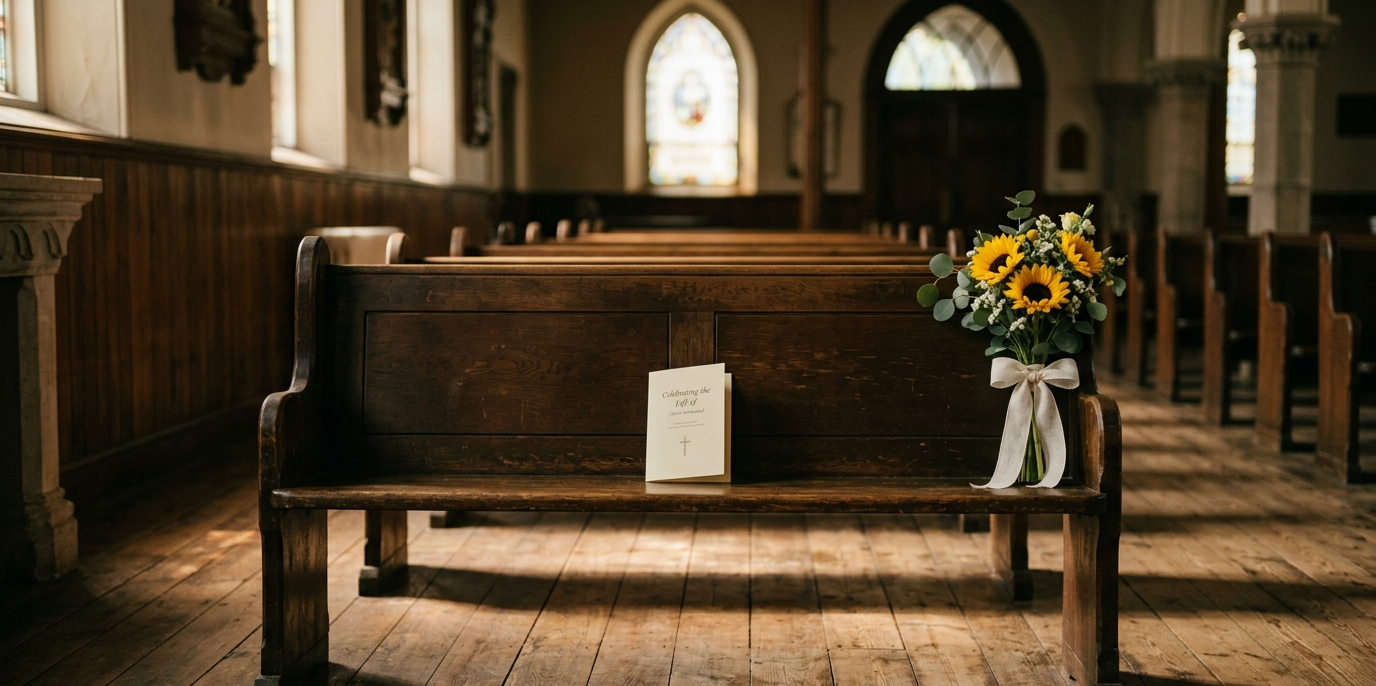
At John’s funeral, an empty vase was placed on the altar at the beginning of the service. One by one, his sister and each of his cousins walked forward to place a sunflower in that vase, from the oldest cousin down to the youngest. In the middle of the most devastating day of our lives, those sunflowers became something else entirely. A beacon. A reminder that John had loved these flowers because they were always smiling.
I tell that story because it is the truest thing I can say about what a funeral can be. It can hold grief and beauty at the same time. It can be the place where the people who loved someone find a way to say so, together.
A funeral service can take many forms. A religious service follows the liturgy of a particular faith tradition, which for many survivors is a deep source of comfort and familiarity. A celebration of life is less formal, often built around photos, music, personal tributes, and memory. A graveside service is brief and intimate. Some families do all three in sequence. Some do only one. There are no obligations here.
What tends to matter most is that the service feels true to the person who died. The readings chosen. The music selected. The photograph displayed at the entrance. The speaker who knew them best and says so without boilerplate expressions.
Music deserves particular mention, because it does something at funerals that words cannot always do. A piece of music the person loved can open a room in a way that bypasses the brain and goes straight to the heart. Readings work similarly, whether from sacred texts, secular poetry, or something the person themselves wrote. I have written more about music specifically in When Music Becomes a Bridge to Healing and The Role of Music in Healing From Suicide Grief. If you are planning a service and feel lost about what to include, start there.
The Cemetery
There is a particular quality to the moment at the grave. Whatever has been said or sung, whatever ceremony has surrounded the death, the cemetery is where the body or the ashes are finally laid in the ground. For many survivors, this is when the reality lands in a way it hasn’t before. It can be the toughest moment.
The graveside is also, over time, a place to return. Many survivors find that visiting the grave becomes a meaningful practice of its own, not because the person is there in any final sense, but because it is a physical place where the bond can be honored.
There is a painful dimension to suicide loss and grave sites. Research has found that some families, out of shame or fear of judgment, hide or minimize their person’s grave, choosing unmarked stones or locations where few will see. Some religious traditions have historically restricted burial rites for those who died by suicide, though most have moved away from those positions. If you have encountered this, please understand that the impulse to hide is stigma at work. It is not the truth about your person.
Your person deserves to be remembered. Their name deserves to be legible on a stone. Their life deserves to take up space.
The Repass
The repass, sometimes called the reception or the gathering after, is among the oldest of all the death customs. It is the meal that follows the burial, the coming together of the community to eat and be with one another.
In African American tradition, the repass has long been an elaborate and genuinely communal event, drawing on West African roots that understand food and gathering as integral to honoring both the dead and the living. In Irish tradition, the gathering after the burial is where the real storytelling begins, where the grief and the laughter arrive in the same hour and neither one is considered out of place.
The repass is for the living. It is nourishment in the most literal sense, because many of you have not been eating. It is also permission to be human after a few hours of being formal. Loosen the tie, kick off the shoes. The casseroles that appear on your doorstep in the days before the funeral, the neighbor who brings a ham without being asked, these are the repass impulse working before anyone has put it in those terms.
Sitting Shiva
For Jewish families, the period of mourning that follows burial is called shiva, traditionally observed for seven days. The family remains at home. The community comes to them. Mirrors in the house may be covered. The bereaved are released from the ordinary obligations of daily life, from cooking and cleaning and going to work, so that they can grieve without interruption.
The beauty of shiva, from a grief perspective, is that it does not ask the bereaved to do anything except receive. The community takes on the work of showing up while the bereaved are held inside the grief. Grief needs time, and grief needs witnesses. The structured nature of the practice makes both possible.
Other Faiths, The Same Human Need
Every major faith tradition has developed its own answer to the same question, what do we do when someone we love dies? The forms are different. The underlying impulse is similar.
In Islamic tradition, burial happens as quickly as possible, ideally within 24 hours. The body is ritually washed and wrapped in white cloth. The funeral prayer, Salat al-Janazah, is performed by the community at a mosque or open prayer space. A three-day mourning period follows, during which the bereaved receive visitors and accept condolences. Weeping is permitted and understood as a natural expression of love.
Hindu tradition centers on cremation, understood as a way of releasing the soul from the body so it can continue forward. The eldest son traditionally lights the funeral pyre, which carries its own weight for parents who have lost a child. A 13-day mourning period follows, during which family gathers, observances are performed, and food is offered. On the 13th day, a ceremony called shraddha formally closes the mourning period.
Buddhist practice varies considerably across traditions, but chanting and meditation near the body are common in many of them. In Tibetan Buddhism, a 49-day mourning period is observed, based on the belief that consciousness spends that time in transition before rebirth. The 49-day span is not a number chosen arbitrarily. It is a recognition that grief is long, that transition is long, and that the community’s responsibility to hold both does not end at the graveside.
How We Learn These Customs, and Why That Can Cause Conflict
Most of us did not sit down and study mourning practices. We absorbed them as children.
You learned how your family grieves by being there when someone older died. Someone dressed you in dark clothes and brought you to a funeral home or a house of worship or a home with the mirrors covered. You watched the adults around you, absorbing what they did, what they said, whether they cried in public or stepped outside to do it. Those early experiences became the template. An open casket or a closed one. A formal Mass or a simple graveside service. You may not be able to articulate why a particular custom matters to you. It just does. It is what your family did.
The person across from you at the kitchen table, trying to make these same decisions in the same fog, absorbed a completely different template. They grew up in a different family, a different faith tradition or none at all. What feels essential to you may feel foreign to them. Neither one of you is mistaken. You are simply standing in different inheritances.
In ordinary bereavement, these differences can usually be negotiated. But suicide loss is not ordinary bereavement. The death was sudden. Decisions must be made immediately, under pressure, while neither person is sleeping or eating or thinking clearly. The gap between two people’s inherited assumptions about how death should be handled can widen very fast under those conditions, and the grief can spill into conflict about the service, the obituary, who to invite, what to put on the stone.
If you and your partner are in that conflict right now, or came through the service still carrying hurt about decisions that felt wrong, that is common. It is not evidence that your relationship cannot survive this loss. It is evidence that two people with different histories were asked to do something impossibly hard together, at the worst possible time. Marriage After Losing a Child to Suicide addresses the longer arc of that work. If the grief is landing differently across your extended family, Talking with Family About Your Grief After Suicide Loss is a good place to start.
Children at the Service
Whether to bring children to the funeral is one of the questions that comes up most often in the weeks after a suicide loss. There is no single right answer. But there are some things worth knowing.
When John was four years old, Teri and I brought him to his grandfather’s wake. We had talked with him beforehand about what he would see. We went to the casket together, said our prayers, and returned to our seats. A few minutes later, John turned to us with complete sincerity and said, “Where are the bones?”
He was four. His entire understanding of death came from picture books and cartoons. He expected a skeleton. What he found instead was his grandfather, looking like himself, peaceful in a suit. The question made perfect sense given everything he knew. It drew a few quiet smiles in an otherwise somber room, and it started a conversation. He was learning the only way children actually can.
That is the argument for bringing children. Not to spare them the grief, but to let them learn alongside the adults, with preparation and with someone beside them whose only job is to attend to them. Children kept away from the ceremony absorb a different lesson, that death is something to be hidden. A child’s imagination, left without information, will often fill the gap with something worse than reality. A child told beforehand what they will see and what they are allowed to do is far better equipped than one brought in without context.
There is also a dimension specific to suicide loss. Children who lose a family member to suicide will carry questions for a long time. Allowing them to be present at the ceremony, to see community gathered, to hear the person spoken of with love, gives them something to hold onto. It says we are not hiding this person. We are honoring them.
Child grief specialists and bereavement researchers have studied this question, and the weight of expert guidance points in the same direction, prepared children who are given the choice fare better than children who are excluded. The National Alliance for Grieving Children is one of the leading organizations on childhood bereavement, and their resources are grounded in that research. The Good Grief network’s guide to supporting children at the funeral home offers concrete, practical steps for parents working through this specific situation. The Dougy Center has specific resources for children grieving a death by suicide. And AFSP’s guide Children, Teens and Suicide Loss is worth keeping close if you are parenting through this loss.
How Suicide Loss Changes the Situation
Everything described above is available to you. None of it is contingent on the cause of death. And yet, for many survivors of suicide loss, the mourning customs that should offer comfort become a source of additional pain. The stigma that surrounds suicide does not stay outside the funeral home. Suicide has wrongfully carried a long history of being treated as shameful, sinful, or criminal, and those associations do not simply disappear because a family needs to plan a service. Some families feel pressure to conceal the cause of death in the obituary. Some encounter well-meaning relatives who say things that reopen wounds.
Research on suicide bereavement consistently identifies stigma as a factor that can complicate the grieving process, sometimes significantly. When survivors feel they cannot speak openly about how their person died, they lose access to the community acknowledgment that these mourning practices are specifically designed to provide. The ceremony still happens, but it happens at a distance, with something withheld. That withholding costs something.
This is documented experience among suicide loss survivors. It is not your imagination, and it is not your failure.
What You Can Still Do
These ceremonies are still yours. The funeral is still for the living. The gathering is still for the living. The grave is still for the living. And you are among the living, whether or not it feels that way right now.
Many survivors find, over time, that the ceremonies they were most afraid of become the ones that gave them the most. The funeral where someone said out loud that your person died by suicide, and the room did not collapse. The gathering after where someone told a story you had never heard before. The grave you visit every April and bring whatever you need to bring. Some families choose to name the cause of death in the obituary. Some, years later, wish they had. The act of saying the word is a small but real act of resistance against the stigma that would prefer silence.
If you are planning a service now, or preparing for an anniversary, or thinking about a graveside practice of your own, you are allowed to do this fully. You are allowed to speak your person’s name. You are allowed to choose the music that was theirs. You are allowed to let the repass go long and let the stories come.
You are not alone in any of this. That truth holds, even when the room feels very quiet.
Posts You May Also Like
- Celebration of Life After Suicide Loss: Ideas to Honor a Life – For when you’re ready to plan a separate gathering focused on speeches, photos, and shared memories, once the funeral itself is behind you.
- Obituary After Suicide Loss: What to Say and How to Say It – The obituary decision that usually comes before the service itself, with real wording options and a printable family worksheet.
- Ritual and Remembrance – On the role that ritual plays in keeping connection alive after loss, and how survivors create meaning through intentional acts of remembrance.
- Disenfranchised Grief After Suicide Loss: When No One Sees It – For anyone who has wondered whether they were even allowed to grieve this loss, including at the wake itself.
- When Music Becomes a Bridge to Healing – How music can reach the grief that words cannot touch, and how survivors use it to stay connected to the people they lost.
- Understanding Anger and Conflicted Emotions in Suicide Loss – A look at the complicated emotional terrain that often sits alongside grief, including emotions that can feel unwelcome at formal services.
- Dealing With Difficult Questions After a Suicide Loss – Practical guidance for survivors on how to handle the questions that come from others, including the ones you least expect.
- Physics = Love: Continuing Bonds After Suicide Loss – On the science and the soul of staying connected to the person you lost, and why the bond does not end at the grave.
- Preserving Photos and Videos After Suicide Loss: A Complete Guide – For after the service, a practical guide to making sure the photographs gathered for the wake never get lost.
Printable Guide PDF
A two-page PDF guide has been generated for survivors to print, save, or share.

Leave a Reply