
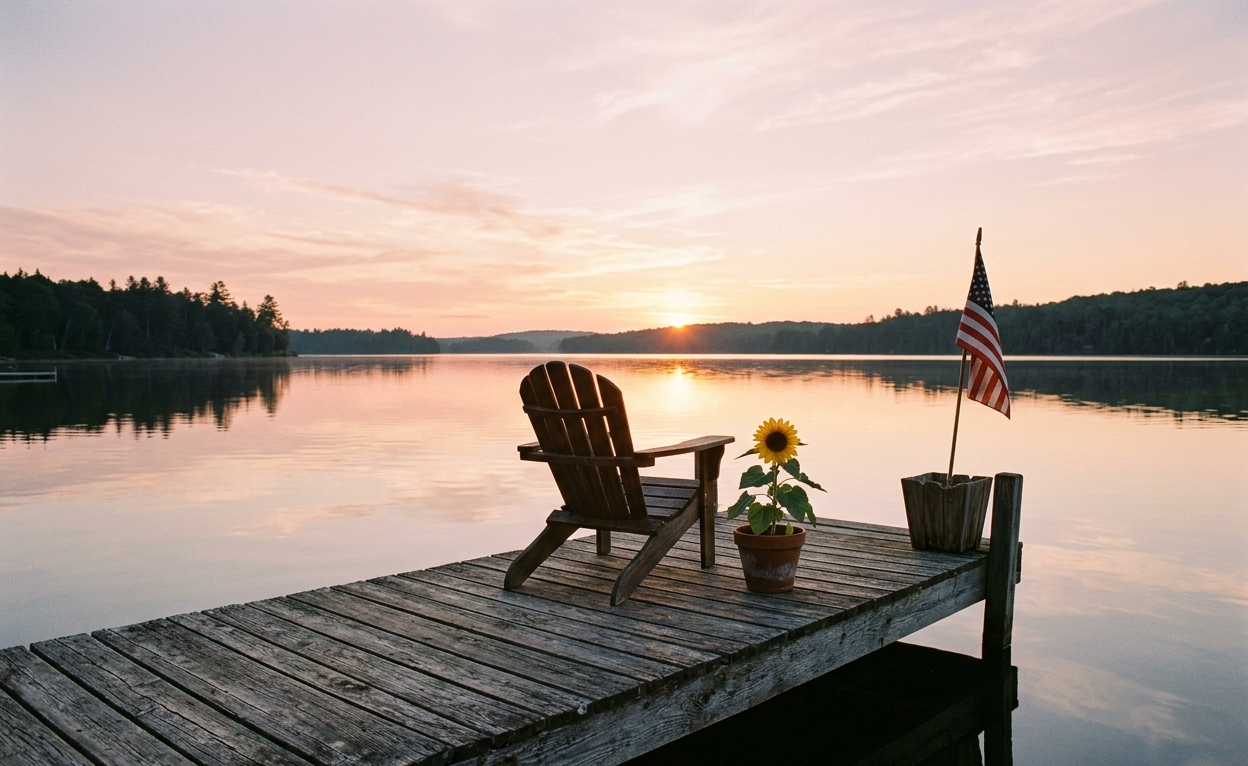

The neighborhood starts early on Memorial Day weekend. Someone is dragging a grill out of the garage. Flags are going up on the neighbor’s front porches. Someone three houses down is already asking where you are headed this weekend. Here in New Jersey everyone starts talking about opening their beach house.
Memorial Day after suicide loss is one of those days that arrives without permission and asks more of you than you may have. It is a day built around family and friends gathering, around the beginning of summer, around the stories we tell about the people we have lost.
For many survivors, it is also the day when the absence of the person who died hits with surprising force in the most ordinary places. The cooler you always packed together. The fishing poles in the garage. The chair someone always sat in.
I am a suicide loss survivor and an AFSP-trained facilitator who has co-led SOS Madison, our New Jersey suicide loss support group, for more than fifteen years. I have heard about this weekend in almost every meeting at this time of year. The dread of it. The numbness that settles in on Friday. The way the holiday’s cheerfulness can feel like an accusation.
You are not alone in any of it.
Memorial Day Has Always Been About Honoring Those Who Fell in Battle
There is a passage I come back to at this time of year. It is from Norman Vincent Peale’s 1966 book The Healing of Sorrow, and it discusses the words of a pastor, the Reverend Warren Stevens, who delivered a eulogy for a young man who had died by suicide.
Stevens told those who gathered that the young man had been “killed in action fighting a civil war.” He had not died on a foreign battlefield, Stevens said. He had died on his own. The adversaries he faced were as real to him as the casket was to everyone seated in that room. They were powerful adversaries. They took his energy and his endurance. They exhausted the last of his courage. And in the end, they overwhelmed him.
But Stevens did not stop there. He asked the mourners to consider what the young man had won, not what he had lost. A host of victories, Stevens called them. The daily victories of kindness and thoughtfulness. Of love for family and friends, for animals and books and music. Every day that he had gotten up and kept going against odds that no one around him fully understood. Stevens asked the mourners to remember not the years they thought he had left, but the depth and intensity with which he had lived the years he had.
Peale, writing around that eulogy, turned his own compassion toward the families left behind. His heart went out to them, he wrote, because he knew they suffered terribly. He addressed the guilt directly, the way it arrived like a tidal wave. And then he said: lift up your heads and hearts. Surely you did your best. And surely the person who is gone did their best, for as long as they could.
I have read those words many times since losing our son John in 2009. They do not answer all the questions. Nothing does. But they touch on something important. The person we lost was fighting something real. They were on a battlefield most people never saw. And they deserve to be remembered on a day that was built for exactly that, for honoring those who gave everything they had in a fight that was ultimately too much for them.
This day belongs to you. It belongs to them as well.
For the Families the Flags Don’t Always Name
For families who lost a service member to suicide, Memorial Day carries a specific and painful weight.
Some of those families know both kinds of loss at once. Their person served. They wore a uniform. They came home carrying invisible wounds from battles that continued inside them long after their deployment had ended. One survivor who left a comment on the Alliance of Hope after reading the Peale essay described her son exactly this way. He had served in the Army for ten years, deployed to Afghanistan and Iraq, earned a college degree, built a good life. No one knew how deep the war inside him had run.
The numbers tell a harder version of that story. According to the VA, nearly eighteen veterans died by suicide every day in 2022. The Department of Defense reported that 471 service members died by suicide in 2024. A 2021 study estimated that four times as many active duty members and veterans have died by suicide as died in combat since September 11, 2001.
The frequently quote statistic is that 22 past and active duty service members die each day by suicide.
Their families are grieving two losses at once. The loss of a person who served, who sacrificed, who was shaped by experiences most civilians will never understand. And the unique grief common to a suicide loss, which brings its own silence and its own questions.
If this is the suicide loss you have experienced, your person’s name belongs among those honored today. The Veterans Affairs survivor resource page offers specific support, including no-cost bereavement counseling and chaplain services.
Their service was real. Their battle was real. Their memory deserves to stand in the light today.
And for those of you who did not lose a service member, the Stevens/Peale reframe still holds. Every person who died by suicide was fighting something. The silent skirmishes in their soul, as Stevens described them, were as real as any battle. This day can also reflect that truth.
When the Summer Traditions Become Too Heavy to Face
Memorial Day is also the unofficial beginning of summer. And summer, for many loss survivors, is one of the hardest seasons.
The traditions that were built around the person you lost are suddenly in sharp focus. The barbecue where they always insisted on burning something on purpose as a joke. The lake trip you took every Fourth of July. The beach vacation where they stayed in the water an hour longer than everyone else. These traditions were built around someone who played a role in them that no one else can fill. Not because the people around you are incapable, but because this particular person at this particular place at this particular time in your life cannot be recreated. Nor should they be.
Some survivors try to do everything exactly as before the loss. They go to the same lake, rent the same cabin, sit at the same table. Sometimes that is right. Sometimes it works. More often it is excruciating, because trying to replay a tradition perfectly without the person who made it what it was can leave you feeling their absence more sharply than before.
You may also be too numb to attempt any of it. That is not failure. That is how grief work.
The Alliance of Hope has written specifically about summer grief and how it arrives unannounced, because it falls between the formally acknowledged grief holidays. What they describe matches what I hear at our support group meetings. The formal holidays get attention. Summer grief does not. But it is just as real. It still stings.
A Summer of Rediscovery, Not Erasure
The dual process model of grief, developed by researchers Margaret Stroebe and Henk Schut, describes two healthy kinds of days. Loss-oriented days, when you are fully in the grief. And restoration-oriented days, when you step back into life. Both are necessary. Neither cancels out the other. You do not have to earn restoration days by grieving enough first. It can feel like a roller coaster with ups and downs.
This summer might be a time to explore rather than repeat. Not because the old places are wrong, but because new places carry less weight. A beach you have never been to together. A hiking trail you have never walked. A farmer’s market in a town you have been meaning to visit for years. These places do not yet have the absence woven into them. They offer a little more room to breathe. The ghosts are not necessarily there.
Stevens asked mourners to remember the intensity with which the young man had lived the years he had. That framing has stayed with me. The person you lost may have lived just as intensely. They loved things. Animals, music, family, all things beautiful and honorable. That life can come with you into this summer. Not as a ghost, but as a presence. You can carry their daily victories into new places.
I have written before about changing the old normal and exploring new roads after a suicide loss. It is not about running from grief. It is about discovering what you are capable of carrying forward. And sometimes the answer surprises you.
If new experiences feel like too much right now, please know that facing the summer with patience is also a legitimate path. No pressure. No timeline. Just the quiet permission to get through it however you can.
Carrying Them Into the Summer With You
One of the most important things John R. Jordan’s clinical framework for suicide loss grief affirms is that:
Healing does not require letting go of the person who died.
Continuing bonds theory, developed by grief researchers Dennis Klass and Phyllis Silverman, established what many survivors already know intuitively. The relationship does not end at death. It changes form.
The person who died had a life full of victories Stevens would recognize, the daily acts of love, the humor, the specific things they cared about, the ways they showed up for the people around them. Those victories belong to you now. You carry them. They are part of what makes you, you.
You might bring the person you lost to a new trail by thinking about what they would have said about the view. You might honor them at a barbecue with their favorite food set out, not as a performance for others but as a private act of love. You might say their name before a meal, or plant something they would have chosen, or simply sit somewhere beautiful and let yourself miss them out loud.
The post Physics = Love: Continuing Bonds After Suicide Loss goes deeper into this idea. The people we lose do not disappear from the world. They persist in us, in the daily victories they left behind, in the love they gave and the love we still carry for them.
Talk With Your Family Before the Grill Is Lit
If you are reading this before the weekend arrives, please consider having the conversation with your family now, not on Saturday afternoon when everyone is already in the middle of it.
Children and teenagers often want to go back to normal. They want the barbecue to look like it always did. That impulse is real and deserves it’s space and understanding. It is also incomplete on its own. Adults often feel the gap more sharply in those same familiar spaces. Both things can be true at once.
Asking what people need before the weekend begins gives everyone more room. You will not arrive at a perfect plan. That is all right. An honest plan is better than a perfect one.
The post Surviving Suicide Loss as a Family offers grounding for those conversations, and the post Talking With Family About Your Grief After Suicide Loss goes deeper into the tension between different grievers under one roof.
Healing in the Open Air This Memorial Day and Beyond
If I could offer one practical suggestion for this weekend, it would be this: go outside.
Not the cookout necessarily. Not the crowd. Just outside.
Research consistently shows that time in nature reduces grief-related rumination and stress. For survivors who often describe feeling frozen in grief, that movement matters. A walk in a park. Sitting in a garden. Picking flowers. Swimming in the ocean. Watching the water from somewhere quiet. These are not distractions from grief. They are part of how grief moves through you.
Even if it is raining outside, or inside your heart.
Some of you will visit a grave today. Or a spot where ashes were scattered. Or a garden where something was planted in their memory. The Memorial Day cemetery visit carries its own particular weight for suicide loss families. Other headstones will have small flags. Families will be arriving with flowers. The whole country is engaged in an act of remembrance at the same moment you are standing there. Some survivors find that unexpectedly grounding, being part of something larger on a day that can feel very isolating. Others find it harder than other cemetery days, the contrast between public ceremony and private grief too sharp. Go if it feels right. Stay home if it does not. There is no required way to honor someone today.
The self-care post here covers some of the ways survivors care for themselves without forcing positivity. Getting outside is near the top of that list. Start with five minutes. That is enough.
Memorial Day falls at the moment when the weather, in much of the country, is finally cooperating. The longer light at the end of the day. The warmth. Your body knows the difference between winter grief and a late May evening. Let it.
Memorial Day After Suicide Loss: Lift Up Your Heads and Hearts
Norman Vincent Peale wrote those words to the families left behind after a suicide loss. Lift up your heads and hearts. Not as a demand for cheerfulness. Not as a denial of what happened. But as a recognition that the people we lost did their best, for as long as they could. And we are still here, carrying both their memory and our own lives forward.
Memorial Day after suicide loss can hold both things at once. It can be a solemn day of private remembrance, the kind that has no ceremony and no flag and no public acknowledgment, just the weight of a name carried quietly through a holiday weekend. And it can also be the first day of a summer that you are still, slowly, learning to inhabit without them.
You do not have to perform joy for anyone. You do not have to make the day look right for anyone else. You only need to know that the grief you carry is real, that the person you lost fought something real, and that their daily victories deserve to be remembered alongside their death. Not instead of it. Alongside it.
If this is your first Memorial Day without them, please be gentle with yourself. Grief ambushes arrive without warning on days like this. They are not setbacks. They are love, expressing itself the only way it can right now.
And if you are further down the road, still carrying this but carrying it differently, know that Teri and I and the community at SOS Madison are here. The AFSP support group finder can connect you with a peer-led group near you. You do not have to carry this alone.
One more thing worth mentioning: Father’s Day is three weeks away. If that day carries its own weight for you, the post Father’s Day and Suicide Loss is there when you need it.
Remember them. Honor them. And when you are ready, step outside. Summer is waiting.
If you are in crisis right now, please call or text 988 to reach the Suicide and Crisis Lifeline.
Live. Love. Laugh.
Posts You May Also Like
- Facing the Summer With Patience – A gentle look at what it means to move through the summer after suicide loss when you are not sure you have the strength to face it.
- Spring After Suicide Loss: When the World Moves On Without You – On the particular ache of a world waking up when grief holds you in place.
- Physics = Love: Continuing Bonds After Suicide Loss – How the relationship with the person you lost continues, transforms, and becomes part of how you carry your grief forward.
- Ritual and Remembrance – On the acts and moments of honoring that survivors create when formal ceremonies cannot hold what they need to hold.
- Grief Ambushes After Suicide Loss: When Grief Catches You Off Guard – For when the barbecue or the lake or the smell of sunscreen brings you back in a way you did not expect.
PRINTABLE GUIDE PDF
A two-page PDF guide has been generated for survivors to print, save, or share.

Leave a Reply