
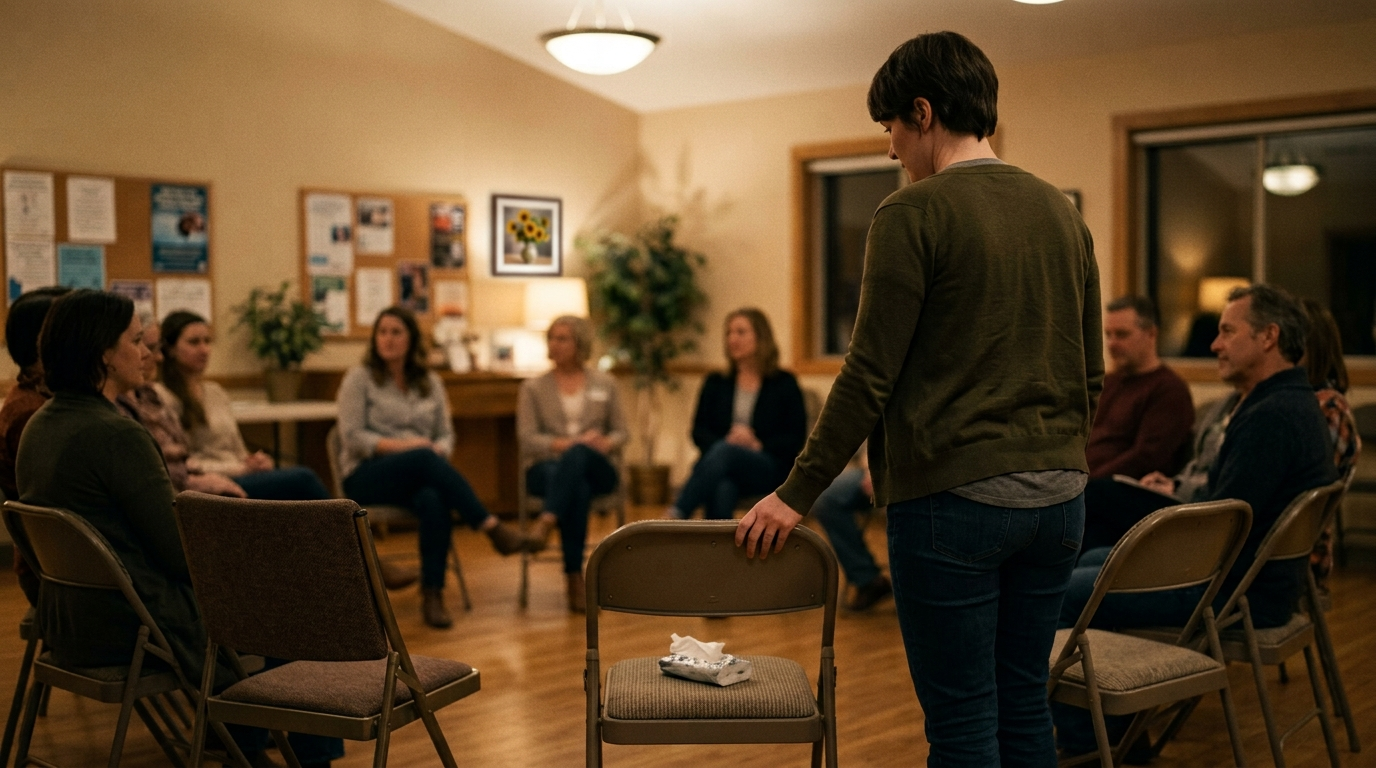

People continue to ask me over the last fifteen-plus years of facilitating our support group, whether they are even allowed to join the group. They are not family. They are not a spouse or a parent. They are a coworker who sat three desks away. A former roommate. Someone who dated the person for eight months more than two years before the death. When they come, they sit in the back at first. They ask me, quietly, after the meeting, whether this is really for them.
That question, whether you are allowed to grieve, is one of the clearest signs of disenfranchised grief I know. Disenfranchised grief after suicide loss is grief that the people around you do not fully recognize, and it shows up everywhere in this community, not only in friendships and coworker relationships but in the silence that follows almost any suicide death, regardless of who you were to the person.
If people had the words for when your grandmother died after a long illness, and go quiet or say the wrong thing entirely when they learn how your person died, you are not imagining the difference. Suicide grief is genuinely different, and a lot of that difference comes from what other people do, and do not do, once they know.
Quick answer: Disenfranchised grief is grief that others do not fully recognize, validate, or make room for. After a suicide loss, it happens for several overlapping reasons, including stigma around the cause of death, relationships society does not treat as central (friends, coworkers, exes), and institutions like workplaces that offer no formal recognition. It is common, it is documented, and it is not something you are doing wrong.
If you are in crisis right now, please call or text 988 for the 988 Suicide and Crisis Lifeline.
Survivors of suicide loss carry real, elevated risk of their own, and grief that no one seems to see can make that heavier still.
What Disenfranchised Grief Actually Means
Grief researcher Dr. Kenneth Doka first described disenfranchised grief in 1989. He used it for a specific pattern, grief that is real, but that the people around the griever do not openly acknowledge, socially support, or publicly validate. The loss happened. The pain is real. The world around the griever simply does not treat it that way.
It can happen for a few different reasons. Sometimes the relationship itself is not one society treats as central, a friendship, an ex-partnership, a former roommate situation. Sometimes the loss is real but its circumstances make people uncomfortable, which is a common aspect of what happens after a suicide. And sometimes it is institutional. There is no line on a form for this kind of grief, no HR policy that names it, no rituals built for it.
Our post on when a friend dies by suicide goes deeper into Doka’s framework specifically for friend survivors, who run into this constantly. What this post covers is the wider pattern, because disenfranchisement after a suicide loss is not limited to one kind of relationship. It reaches almost everyone this community includes.
Why Disenfranchised Grief Is So Common After Suicide Loss
Grief after any death is hard. But when someone dies by suicide, the stigma around the cause of death adds a layer that grief after cancer or a heart attack simply does not carry.
Research backs this up. A review of suicide bereavement research published in Dialogues in Clinical Neuroscience points to a meta-analysis of 41 separate studies that found people bereaved by suicide report significantly higher rates of rejection, blame, shame, and stigma, along with a greater need to hide the cause of death, than people bereaved by other causes of death. That pattern holds across dozens of studies, not just one. Suicide loss survivors are carrying a documented, elevated burden of judgment, and other people’s discomfort with the cause of death often adds an outer layer of that judgment on top of whatever guilt a survivor is already carrying inside.
To be quite honest, I think a lot of people would never treat a cancer death this way. Nobody asks a family whether they saw the signs before a heart attack. Nobody quietly wonders what happened at home before a stroke. But after a suicide, those questions come, sometimes spoken, more often just sitting behind someone’s eyes while they decide how to respond to you.
Suicide does not just take someone.
It changes how the world is willing to grieve them with you.
Many people just don’t understand what suicide really is. Unfortunately their brain betrayed them, and in ways most people never see. That is not something the people around you always understand right away, and their discomfort with what they do not understand becomes, for a lot of survivors, the disenfranchisement itself.
The Judgments You Feel Without a Word Being Said
This is the part that is hardest to explain to someone who has not lived it.
Many survivors describe a particular kind of loneliness that has nothing to do with being physically alone. It is the loneliness of sitting across from someone who clearly does not know what to say, and watching them say something small and careful instead of something real. It is noticing who asks how you are doing and who stops asking after the first week. It is feeling, in a room full of people who loved your person too, like your specific grief does not have an assigned seat.
In our suicide loss group SOS Madison, I have heard some version of the same questions from people in almost every kind of relationship this loss can touch. Am I even allowed to feel this loss?
You are allowed. Full stop.
Disenfranchised grief does not mean your grief is smaller. It means the people around you have not yet been given a way to recognize it.
Is it normal to feel like you are not allowed to grieve? Yes. This is one of the most common experiences survivors describe in friendships, coworker relationships, dating relationships, and any bond outside the immediate family. Mourning rituals, funerals, bereavement leave, and even the casual social script of “how are you holding up” tend to center whoever is legally or biologically closest to the person who died. That does not mean your grief is smaller. It means the ritual was not built with you in mind.
It shows up beyond the relationships already named here, too. Extended family members who were closer to the person than some of the immediate family. Teammates and coaches. A neighbor who checked in on someone every day for years. A teacher who watched a student for four years and then, suddenly, did not. Every one of them carries real grief, and almost none of them are handed a script for what to do with it.
The relationship does not have to be legally recognized for the grief to be real.
The Relationships No One Prepared You to Grieve
Three relationships come up again and again in our meetings, and each one carries its own particular flavor of being overlooked.
- Coworkers. You may have spent more waking hours with this person than with your own family. You knew their coffee order, their kids’ names, the thing that was bothering them last Tuesday. And then the news arrives through a company email or a hallway rumor, and you are expected to be at your desk the next morning as though nothing happened, because nothing happened to you, officially.
- Former dating partners. A relationship can end, sometimes badly, and the grief can still be enormous when that person dies. You may not have spoken in months or years. You may still carry an entire private history no one else in the room knows about. There is no accepted way to show up to a funeral as someone’s ex, so a lot of people in this position do not show up at all, and grieve somewhere no one can see them do it.
- Former roommates. You built a version of daily life together, the small domestic rhythms that never make it into an obituary. Then that life ends and there is nowhere obvious to put the grief, because roommate is not a category anyone built a ritual around.
If you recognize yourself in any of these, the grief you are carrying is not a smaller version of what a family member carries. It is its own full thing.
One more relationship deserves a direct mention, even though it looks different from the three above. I have spoken with clinician survivors, therapists, counselors, and other treating professionals, over the years, and one pattern comes up again and again. When they describe this loss to people outside their profession, many say it was a friend or an acquaintance, not a patient, because naming the real relationship risks breaking the confidentiality they owe that person even after death. That means a lot of clinicians carry this grief without being able to ask for support using its real name. A research review from Ohio’s Department of Mental Health and Addiction Services found that 62 percent of clinicians surveyed had a client die by suicide while under their care, and most described relying on informal support from colleagues rather than any formal channel, largely out of concern for confidentiality or simply not knowing where else to turn. If that describes you, the Coalition of Clinician-Survivors runs support groups built specifically for clinicians carrying this, where that confidentiality does not have to stand between you and being understood.
When Institutions Don’t Recognize Your Loss
Disenfranchisement is not only something people do to you. Sometimes it is built into the systems around you.
A 2026 qualitative meta-synthesis published in Archives of Suicide Research looked at how families bereaved by suicide experience disenfranchisement, and it identified something worth mentioning. The researchers described two separate tracks.
- One is relational, the friends and family members who pull back or say the wrong thing.
- The other is institutional, the police, the media, the schools, the workplaces, the systems that were never built to recognize this specific kind of loss at all.
The institutional track shows up in ways survivors do not always expect going in. A police investigation that treats the death as a case file before anyone has had a chance to grieve it. Local news coverage that reduces a whole life to a headline about how it ended. A funeral home or a faith community that hesitates over how, or whether, to acknowledge the cause of death, which our post on funerals, wakes, and the gathering after looks at directly. None of these systems set out to disenfranchise anyone. They simply were not designed with suicide loss, or suicide grief, in mind.
Most companies offer bereavement leave for a spouse, a child, a parent, sometimes a sibling. Almost none offer it for a coworker, a close friend, an ex-partner, or a former roommate, even when that relationship carried real weight. Survivors in this outer circle often go back to work within a day or two of learning the news, because there is no policy that says otherwise, and no manager trained to know what to offer instead.
I have sat with people in our meetings who did not know if they were allowed to take a single day. Not because anyone told them no. Because no one told them yes, either, and asking felt like admitting a grief no HR form had a space for.
A system does not have to say no to your grief.
Saying nothing at all does the same thing.
If this is what work looks like for you right now, our post on returning to work after suicide loss covers what that looks like even in high-pressure roles, and what small things can help.
When Other Grief Gets Words and Yours Gets Silence
There is something specific about watching someone else’s grief get met with casseroles and condolence cards while yours gets met with silence.
When a coworker loses a parent to a long illness, people usually know the moves. Group flowers arrive. Someone organizes a meal train. The office understands, without being told, that a few rough weeks are coming. There is a script, and most people know their part in it well enough to perform it without thinking.
When a suicide loss happens, especially to someone outside the immediate family, a lot of that infrastructure simply is not there. People are not sure what the etiquette is. Some assume it is not their place to say anything at all, so they say nothing, and the silence reads as indifference even when it is really just uncertainty.
The words people reach for are different too. “She’s in a better place now” comes easily after a long illness. After a suicide, a lot of people cannot find the sentence at all, so they change the subject, or they ask something clumsy about what happened, or they simply stop bringing it up. None of that is usually meant to be mean or cruel. It is discomfort with something they have never been taught how to talk about.
The Suicide Prevention Resource Center describes suicide bereavement as especially intense grief that can be further worsened by the stigma still attached to suicide. That combination, real grief plus a world unsure how to respond to it, is what disenfranchisement actually feels like from the inside, and it is a big part of why staying connected to other people takes real, deliberate effort after a loss like this. Our post on when the world keeps turning looks at what that effort actually takes.
Other grief gets casseroles.
This grief often gets careful silence instead.
If you are in the middle of this right now, and it feels like your suicide loss grief does not have anywhere to land, that feeling is common. It is not a sign that something is wrong with how you are grieving.
What Can Help When This Happens
Disenfranchised grief is not something you are doing wrong. It is a gap between what you are carrying and what the people around you have been equipped to recognize. That gap can close, even if it does not close all at once.
A few things genuinely help.
- Give yourself permission first. You do not need anyone else’s confirmation that your grief is real before you are allowed to feel it. If a relationship mattered to you, the loss of it matters. Say that to yourself directly, even if no one else has said it to you yet.
- Build a small script for the moments that catch you off guard. Something as simple as “This loss has hit me harder than people might expect, and I’d rather not get into why right now” gives you language for the workplace hallway or the extended family gathering without requiring you to explain the whole thing on the spot.
- Find one person or one space where the full truth is welcome. It does not need to be a big circle. One friend who can sit with the real version of this, one therapist familiar with suicide loss, one support group meeting, is often enough to keep the grief from staying entirely sealed off.
- Consider a peer support group built specifically for this loss. You do not need a specific title, spouse, parent, sibling, to belong in a room built for suicide loss. If the loss reached you, the room is for you. Finding Your People: The Healing Power of Suicide Loss Support Groups walks through what that looks like and how to find one. If you are looking for something either online or in person, AFSP’s Find a Support Group directory lists suicide loss groups across the USA.
- Build your own ritual if the usual ones did not include you. A 2025 qualitative study on men’s experiences of suicide bereavement, published in Frontiers in Public Health, found that survivors who maintained a continuing bond with the person they lost, through private visits, conversations, or small personal rituals, fared better than those who tried to suppress the grief entirely or manage it alone through overwork or substances. The same study found that channeling grief into something active, peer support, advocacy, or simply staying connected to people who understood, was one of the clearest protective factors identified. Our post on men grieving suicide loss goes further into why that pull toward suppression shows up so often, and what to do instead.
- Reach out even if you are not sure you count. AFSP’s Healing Conversations program pairs survivors with trained peer volunteers one on one, and Alliance of Hope’s community forum is built for exactly this kind of grief, no relationship category required to belong there.
If you are the kind of person who apologizes before asking for help, talking with family about your grief has language that might make that first conversation easier, whether the person you are talking to is family by blood or simply family in the ways that mattered.
You do not need permission to grieve someone who mattered to you. Not from an employer, not from a HR form, not from the people who are not sure what to say to you right now. The relationship was real. What you are carrying is real.
Disenfranchised grief after suicide loss is common, it is documented, and none of it means your pain is smaller than it feels. It means the world has not caught up yet to how many people a single suicide loss actually touches. Our post on how many people a suicide loss really reaches puts real numbers behind that, and how many different kinds of relationships deserve a seat at that grief. You do not have to wait for the world to catch up before you let yourself feel what you feel.
If no one else has said it to you yet, I will.
You are allowed to grieve this. All of it.
Posts You May Also Like
- When a Friend Dies by Suicide: Your Grief Counts Too – A deeper look at Dr. Kenneth Doka’s disenfranchised grief framework specifically for friend survivors, including practical ways to build your own mourning rituals.
- Roadblocks to Healing After a Suicide Loss – Eight reflective questions on the internal barriers, including shame and stigma, that keep survivors from reaching out.
- Returning to Work After Suicide Loss: Managing High-Pressure Roles While Grieving – What it actually looks like to go back to work while grieving, even without formal leave or recognition.
- Talking With Family About Your Grief After Suicide Loss – Language and approaches for the conversations that feel hardest to start, with family or with anyone whose recognition matters to you.
- Finding Your People: The Healing Power of Suicide Loss Support Groups – How to find a peer support group and what to expect from your first meeting.
PRINTABLE GUIDE PDF
A two-page PDF guide has been generated for survivors to print, save, or share.

Leave a Reply