

The funeral is a blur for many suicide loss survivors. The receiving line, the flowers, the hands you shook without remembering whose they were. A celebration of life after suicide loss usually comes later, its own separate gathering built to acknowledge the life of a person rather than just the ending, and that is exactly what makes it so hard to plan. What actually fills two hours that isn’t just more grief? What do you hand people to do besides stand around holding a paper plate, not knowing what to say?
In fifteen-plus years of facilitating SOS Madison, I have sat with a lot of families working through this exact question. What they want, almost without exception, is for the day to be about the person, not about the way they died. They want someone laughing at a story about the person they lost, then having the freedom to cry two minutes later, without either reaction feeling wrong.
That is the whole point of a celebration of life. It gives you room the funeral rarely has, room for speeches that actually sound like the person talked, photo displays that show more than the last hard year, and activities that pull real memories out of a room full of people who came because they cared and have no idea what to do with that caring once they arrive.
This post is about that pulling together such an event. What to ask people to say. What to do with the photos and video you already have. What kind of interactive pieces, including a remembrance jar many families find surprisingly meaningful, actually work in a room full of grief and love at the same time.
How a Celebration of Life Is Different From the Funeral
Some families plan two events, not one. The funeral or wake happens first, often within a week of the loss, following whatever your faith tradition or family custom requires. If you are still sorting through those decisions, Funerals, Wakes, and the Gathering After walks through that first layer.
A celebration of life is the second event, and it doesn’t have to follow any of those rules, or happen only once. Some families hold one larger, formal gathering weeks or months after the funeral, once there’s enough distance from the funeral itself to actually be prepared for it. Others choose something smaller and quieter instead, shortly after the loss, on the first holiday without the person, or on the anniversary each year going forward. Where it happens matters less than who is in the room. A religious facility offers structure and familiar ritual. A restaurant or community room suits a mid-sized group who wants food and conversation built in. A home, yours or someone else’s, is the most personal option, and often the easiest choice for a smaller gathering built around a holiday or an anniversary.
None of the ideas below require a big production or a hired planner, and none of it is mandatory either. Some families decide the funeral was enough and skip a separate gathering entirely, which is a perfect choice. For families who do want one, most of what makes it work is small and easy to set up in an afternoon, whether you’re hosting fifty people in a hall or six around your own kitchen table.
What matters more than any single activity is the intention behind it, that everyone in the room understands this is for remembering a whole life.
Keep the Room Pointed at the Life, Not the Final Chapter
Every choice you make for this gathering, the music, the photos, the way you introduce a speaker, either points people back toward the person who lived or accidentally points them toward the way that life ended. That difference is worth thinking through before the day arrives, not during it.
The person you lost is not defined by suicide. That is, sadly, just how the story ended. A celebration of life is one of the few places you get to correct that balance out loud, in front of the people who need to hear it as much as you do.
This doesn’t mean avoiding the subject entirely. Some families choose to mention it, once, early in the program, in a sentence or two, and then let the gathering move toward what it is actually for. The American Foundation for Suicide Prevention’s guidance on speaking safely about suicide loss is a useful gut check here. It isn’t about hiding what happened. It’s about not reducing a full life to its last chapter, and not describing the death in a way that could be painful or unsafe for anyone else in the room who is carrying a struggle of their own.
If you are worried about getting this balance wrong, you are not alone in that worry. Most of the families in our support group meetings wrestle with this exact question before their own gatherings, and there is no perfect script to hand you.
What tends to help is deciding in advance, together, what you do and don’t want said out loud, and letting one trusted person hold that boundary if it comes up unexpectedly.
Inviting People and Letting Them Know What to Expect
People want to come, but they often don’t know what they’re walking into, and that uncertainty can keep them away or make them anxious once they arrive. A short, clear invitation, whether it’s a text, an email, or a printed card, solves most of that.
Include the practical basics first. Date, time, location, and roughly how long it will run.
Then say plainly what kind of gathering this is.
A line like “we’re gathering to remember [name] and share stories, not to repeat the funeral” tells people exactly what tone to expect, and gives them permission to bring a memory instead of dread.
If there will be structured moments, a memory-sharing time, a video, a jar on the table, say so briefly. People who know a moment is coming can prepare something to share if they want to, and people who’d rather just be present can plan for that too. Neither response needs an explanation from you.
The invitation is also the easiest moment to ask for photos and videos.
Ask people to send a photo or two, or several if they have them, ahead of the gathering rather than bringing prints on the day. Given a little lead time, you can actually print the best ones for the photo table or work them into the video slideshow, instead of scrambling to scan them the morning of.
It also helps to say plainly who is welcome. Are children included? Is this open to anyone who knew the person, or kept smaller and closer? Naming this up front prevents the awkwardness of people wondering, or worse, people staying home because they assumed they weren’t invited.
One practical tip. Ask someone other than yourself, ideally one of the helpers who naturally step in after a suicide loss and is already handling other logistics, to actually write and send the invitations. Handling this while you’re still early in grief is one more weight you don’t have to carry alone.
Speech and Memory-Sharing Ideas: What to Ask People to Say
A single, formal eulogy isn’t the only option, and for many families it isn’t even the best one. A celebration of life has room for something looser, an open memory-sharing time where several people are invited to speak briefly rather than one person carrying the whole thing alone.
If you want structure without asking anyone to write a full speech, hand out prompts instead. A few that tend to work especially well.
- Share one memory that still makes you laugh.
- Describe a time this person showed up for you when it mattered.
- Name one thing you learned from them, on purpose or by accident.
- What’s a phrase, joke, or expression they always used?
- If they could see this room right now, what would surprise them most?
- What’s something about them most people here never got to see?
These questions work because they ask for a specific moment, not a summary of an entire relationship, and specific moments are what people actually carry with them when they leave.
Give people an out. Not everyone who wants to say something can get through it standing at a microphone, and that isn’t a failure. Offer a written option too, a card someone else can read aloud on their behalf, or a jar where written memories go without ever needing to be spoken in front of a room. Telling Your Story After Suicide Loss covers more about deciding what to share and on whose terms, which applies just as much to a five-minute story at a celebration of life as it does to a longer conversation with family.
One practical tip. Ask one or two people ahead of time to be ready to go first.
An open floor with no one starting it tends to stay empty out of nerves, not because people have nothing to say.
Photo and Video Ideas That Bring Them Back Into the Room
A single memorial poster of posed portraits tells people how someone looked. It doesn’t tell them who someone was. The photos and video that do the most work at a celebration of life are the ones that show a full life in motion, not just its formal moments.
Consider organizing photos by chapter rather than by chronology; childhood, a hobby or sport, friendships, an era they loved. Laid out this way, guests naturally start telling each other stories as they walk past, which is often the real point of a photo table anyway.
A short video slideshow, five to seven minutes, set to music the person actually liked rather than generic memorial music, tends to land warmer than a longer one. Keep it looping quietly in a corner rather than making it the center of the program. People can step toward it when they’re ready and step away when they need to.
If family or close friends can’t be there, out of town, older, managing their own health, consider recording the memory-sharing time, or streaming it live on a phone propped on a stand. It doesn’t need to be polished. An unedited video of people actually talking about the person often means more to someone watching from a distance than something produced would, and it gives them a way to feel present even from far away.
If you’re still gathering images or footage and aren’t sure where to start, Preserving Photos and Videos After Suicide Loss cover practical ways to collect what’s scattered across phones, cloud accounts, and other people’s photo albums.
A memory table works alongside the photos.
A few personal objects.
A favorite book.
A piece of gear from a hobby.
Something with their handwriting on it.
Objects give people something to hold while they talk, and holding something while talking is often easier than talking with empty hands.
Interactive Activities: Memory Cards and a Remembrance Jar
Some of your guests will want to talk. Others will want something to do with their hands instead, especially the ones grieving quietly who are never going to walk up to a microphone no matter how gently you invite them.
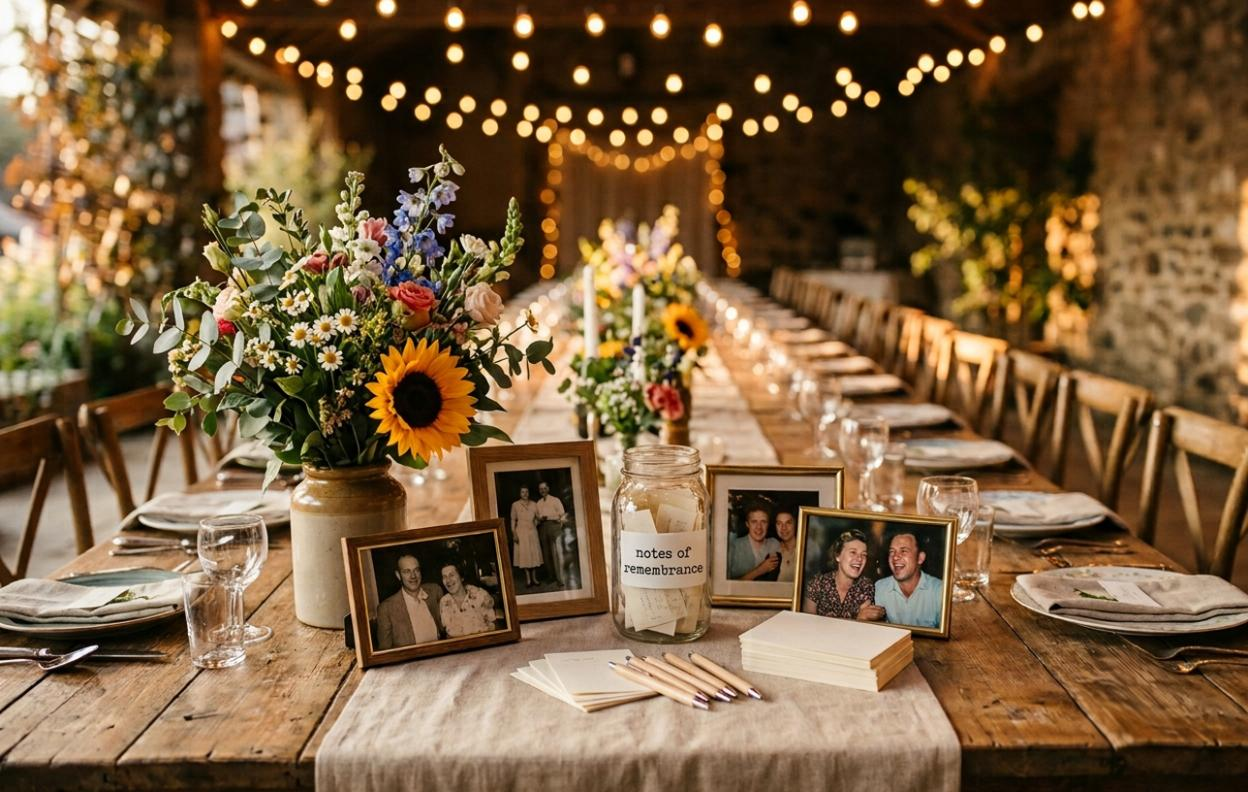
Memory cards are a potential solution for that. Print or handwrite a stack of prompt cards, similar to the speech prompts above, and set them out at each table with pens.
Guests write a memory, a lesson, or a single sentence about the person and drop it in a basket, jar, or pin it to a board as they finish.
It gives quiet grievers a way to participate without ever having to speak out loud, and it gives the family something to keep and read again, long after the gathering is over.
A remembrance jar is a related idea, adapted here from a simple activity described by What’s Your Grief, a grief education site that originally built it for Thanksgiving tables missing someone. Set out a jar, a bowl, or anything else on hand, along with slips of paper and pens, and a small sign asking guests to write down a memory, a lesson, or something they’re grateful for having known about the person. Guests slip their notes into the jar throughout the gathering.
Some families read a handful aloud at a chosen moment, before a toast or between the program and the reception. Others prefer reading them privately as a family in the days afterward, since some notes carry more feeling than expected.
There’s no wrong way to run either activity, and you don’t need to decide how the notes will be used before you set the jar out. Give yourself permission to figure that part out once you see what people actually write.
A guest book, or simply a nice notebook set out on a table near the entrance, gives every guest a place to leave a name and a quick note as they arrive, even the ones who won’t stop by the jar or pick up a card later. It’s a small thing, but families often find it becomes one of the most-read keepsakes afterward.
A ready-made set of twenty memory prompts, grouped by theme so guests can find one that fits quickly, is available at the bottom of this post as a companion printable you can set directly on the jar table or print onto individual cards.
A Simple Order for the Day
You don’t need a formal program to make a gathering like this feel purposeful, but a rough order of events helps guests know when to expect quiet moments and when to expect mingling.
A simple shape that works for many families.
- A welcome, brief, just enough to say why everyone is there and roughly what the next hour or two will look like.
- An open period for people to look at photos, sign the guest book, or write a memory card, while everyone is still arriving and settling in.
- The structured memory-sharing time, wherever speeches or open-mic stories happen, placed once most guests have arrived rather than right at the start.
- Food or a shared meal, which gives people a natural place to keep talking once the structured part ends.
- A closing moment, lighting a candle, a final toast, or simply someone thanking the group for coming.
None of this needs to be rigid, and plenty of families skip a step or reorder one entirely. Knowing roughly what’s coming keeps the day from feeling like it’s drifting, and gives you, as the host, permission to move things along when you need to.
Taking Care of Yourself and Your Guests During the Gathering
You are grieving too, even while you’re the one making sure everyone else has somewhere to sit and something to do. Ask one of your helpers, quietly and ahead of time, to watch for when you need to step outside for a few minutes or hand the next part of the program to someone else entirely. Hosting this well doesn’t mean holding it together the whole time.
Keep an eye on the people in the room as well. If the person you lost was young, some of the friends there are grieving as peers, and peer loss like this can weigh on a young person’s own mental health more heavily than adults often expect.
Even among adults, a gathering built around loss can surface a struggle in someone else that has nothing to do with the day itself. Ask that same helper, or a second one, to notice if anyone seems overwhelmed and quietly check in, with a quiet room or a porch to step out to if the conversation needs privacy.
If someone tells you or a helper that they’re struggling, you don’t need the right words. The 988 Suicide and Crisis Lifeline is available any time, by call or text, and offering that number, or simply sitting with someone while they use it, is enough. You’re not responsible for fixing what someone else is carrying that day, only for not leaving them alone with it.
Looking for a Longer List of Ideas ?
If you want a much longer menu of general ideas beyond what’s covered here, a few sites collect dozens at once. None write specifically for suicide loss, so use your own judgment about what fits, keeping the focus on the life rather than the final chapter as you go.
- Parade’s roundup of celebration of life ideas covers tribute options from photo displays to naming a star after the person.
- After’s list of celebration of life ideas leans into themed gatherings built around a hobby, useful if the person had one strong passion you want the day to reflect.
- MyFarewelling’s collection of unique celebration of life ideas covers less conventional formats, an outdoor movie night, a scrapbook table, a small group hike to a meaningful place.
Questions Families Ask When Planning a Celebration of Life After Suicide Loss
Is it okay to laugh at a celebration of life after a suicide loss?
Yes.
Grief and joy aren’t opposites in this room, they’re two things the same gathering can hold at once. Laughter at a good memory isn’t a betrayal of how the person died. It’s proof their life mattered as much as the loss does.
- Do we have to talk about how they died? No. You’re allowed to keep the focus entirely on who the person was. If you do want to mention it, one brief, honest sentence early in the event is usually enough. There’s no requirement to explain, justify, or go into detail, and doing so rarely helps anyone in the room.
- What if some family members want to talk about it openly and others don’t? This disagreement is common, and both positions usually come from love rather than conflict. Decide together, before the day, roughly what will and won’t be said, and give one trusted person the job of holding that line if it comes up unexpectedly. Surviving Suicide Loss as a Family goes deeper into this kind of disagreement and how families move through it together.
- How soon after the funeral should we hold it? Whenever it makes sense for your family. Some hold it the same week, in a separate, less formal setting. Others wait a month, three months, or a meaningful date. The community that shows up to grieve tends to be largest while the loss is still fresh, so the window for a big turnout does tend to narrow the further out you go. Research on cultural grief rituals backs up what most families already sense, that grieving together, rather than alone, strengthens both community support and emotional processing after a loss.
A Room Worth Building
Whatever you choose for this celebration of life, the point isn’t to get every detail right. It’s to give the people who cared about your person a room to actually be with the whole of who that person was, not just the fact of how they died. A jar of handwritten memories. A photo table organized by the seasons of a life. One brave person willing to go first at the microphone. None of it undoes the loss.
All of it makes the loss a little less lonely to carry, for you and for everyone else standing in that room, finally knowing what to do with the paper plate in their hands.
If you’re still early in this and want more on the broader gathering, Funerals, Wakes, and the Gathering After and Ritual and Remembrance both go further into why these moments matter long after the day itself has passed.
If you’d rather talk this through with people who have stood where you’re standing, Finding Your People: The Healing Power of Suicide Loss Support Groups can help you find one near you, or connect one-on-one through AFSP’s Healing Conversations program.
And if planning any of this, especially near an anniversary or a first holiday, is hitting harder than expected, that’s common, not a sign you’re doing this wrong. The 988 Suicide and Crisis Lifeline is available any time, by call or text, for you as much as for anyone else in this post.
The people who show up to a celebration of life came because the person you lost mattered to them too.
Give them somewhere real to put that.
It helps more than either of you might expect.
Posts You May Also Like
- Funerals, Wakes, and the Gathering After: Honoring Someone We Lost to Suicide – The broader gathering this post builds on, covering the funeral and wake itself.
- Ritual and Remembrance – On why intentional acts of honoring matter, both right after a death and for years afterward.
- Telling Your Story After Suicide Loss: A Guide to Sharing on Your Terms – Helpful for anyone deciding what to say, and how much, at a gathering like this one.
- Finding Your People: The Healing Power of Suicide Loss Support Groups – For connecting with others who understand this particular kind of planning and grief.
- Preserving Photos and Videos After Suicide Loss: A Complete Guide – Once the gathering is over, a full guide to backing up and protecting every photo and video collected for it.
PRINTABLE GUIDE PDF
A three-page PDF guide has been generated for survivors to print, save, or share.
PRINTABLE MEMORY PROMPT CARDS
A ready-made set of twenty memory prompts, grouped by theme so guests can find one that fits quickly, is available to download that you can set directly on the jar table or print onto individual cards.

Leave a Reply