

This post was originally published on December 18, 2022 at SOS Madison, the suicide loss support group I co-facilitate with my wife Teri in Madison, New Jersey. I have revised and expanded it here, and left the dates exactly as they were written, because the counting itself is part of what this post is about.
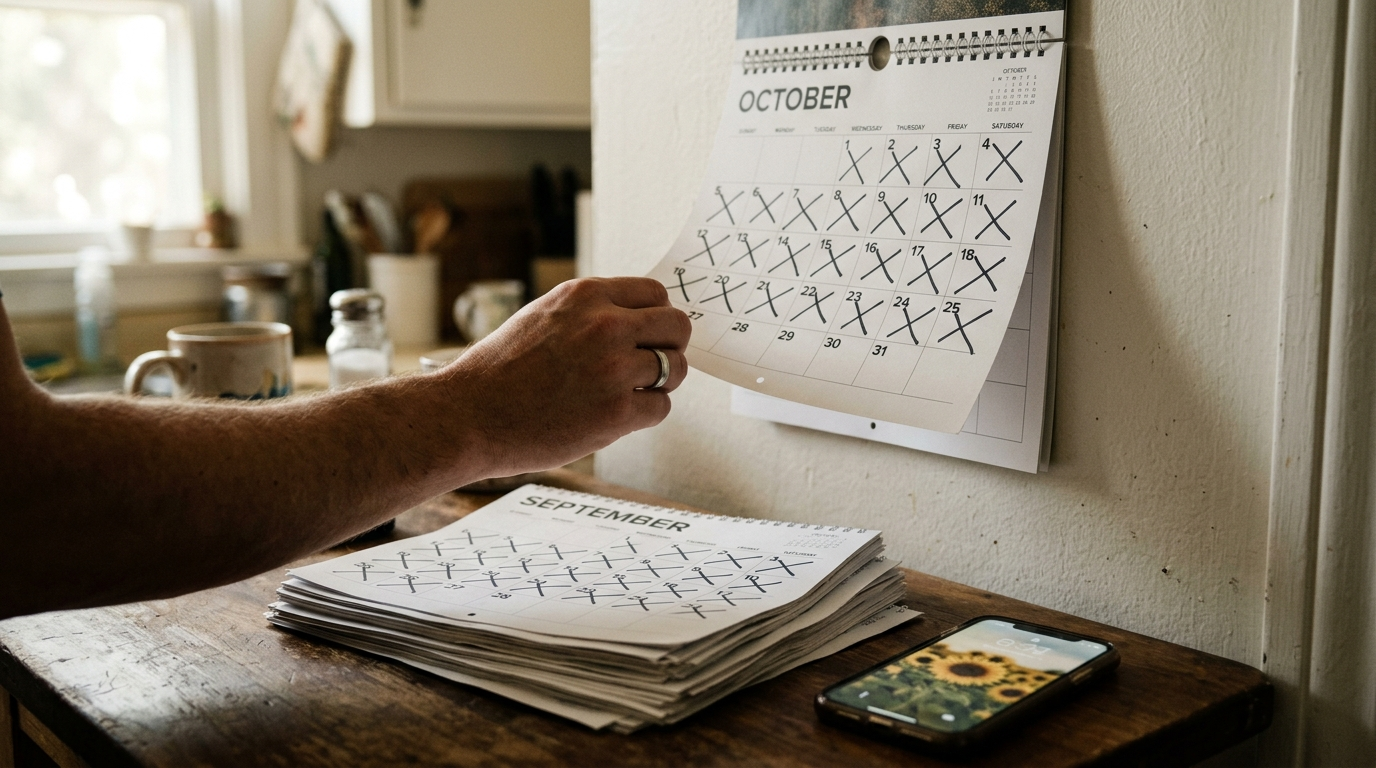
Somewhere around the third week, I started counting days. Not days on a calendar so much as a private countdown that had nowhere to go. One day since it happened. Then a week since it happened. Then, God help me, a month since it happened. In some ways a month felt like both nothing at all and something I was not sure I could survive. The days both dragged on and flew by at the same time while we were sitting in shock.
In seventeen plus years of sitting with newly bereaved survivors in our suicide loss support group meetings, I have learned that nearly everyone starts counting. It is one of the first things grief does to a person, and it is where any honest conversation about long term healing after suicide loss has to begin.
Long term healing does not mean the counting stops. It means the numbers eventually point toward something besides the day someone died.
On December 18, 2022, my wife Teri and I marked 5,000 days since we lost our son John to suicide on Good Friday, April 10, 2009. He was seventeen. Five thousand days is roughly thirteen years and eight months, more time than a person can really hold in their head all at once, and that particular morning it still felt like it had happened yesterday and also like it had happened to someone else entirely. It was a big round number, 5,000. One I could not avoid.
But 5,000 was never the number that mattered most to me. John was alive for 6,244 days. Those two numbers sit next to each other in my mind and ask a real question. What are we actually supposed to measure after a loss like this, the days we have survived without someone, or the days we were lucky enough to have them at all?
If you are early in this and cannot picture surviving another week, I want to walk you through what seventeen-plus years of counting has actually taught me, about grief, about what genuinely helps, and about why I stopped being afraid of that number 5,000.
If you are in crisis right now, please call or text 988. The 988 Suicide and Crisis Lifeline is available around the clock, and milestone days like this one have a way of bringing pain back to the surface even years after a loss.
Why Survivors Start Counting the Days
In the earliest weeks, counting is not really a choice. It is closer to a reflex. I could not have told you the date on the calendar most days during that first month, but I could have told you, to the hour, exactly how long it had been since the police officer told me about our son’s death.
Counting is common enough that I no longer think of it as unusual, even though it can feel strange, almost obsessive, to the person doing it. The American Foundation for Suicide Prevention estimates that as many as 135 people are affected by a single death by suicide, which means a great many people are somewhere in this exact counting phase right now, today, in ways their coworkers and neighbors will never see. With 6.6 million new suicide loss survivors each year in the USA, we are not alone.
Many survivors describe the counting as a kind of proof. Proof that they are, despite everything, still here. Days survived become evidence. It is not morbid. It is closer to keeping score in a game none of us agreed to play.
Counting the days is not a sign that something is wrong with you.
It is one of the ways a devastated mind holds onto proof that time is still moving.
To be quite honest, I still catch myself doing that math sometimes, more than seventeen years in. The habit does not fully disappear. What changes is what the math ends up measuring.
Grief researcher Therese Rando has a name for what a day like this one can do, a subsequent temporary upsurge of grief, sometimes shortened to “STUG”. A specific date does not need any other reason to knock the wind out of you. The date itself is reason enough.
If the counting right now has you feeling like you are coming apart at the seams, you are not overreacting, and you are not alone in it. Feeling Shattered describes that specific kind of early disintegration better than I can summarize in a paragraph here.
If the counting has started to come with intrusive images, a racing heart, or a sense of danger that will not settle no matter what you do, that is worth paying attention to as well. Trauma After Suicide Loss goes further into when grief like this crosses into something trauma-focused support can genuinely help with. It can and does happen, and a grief counselor can assist you with it.
Grief Work, Not Time, Is What Moves You Toward Long Term Healing After Suicide Loss
“Time heals all wounds” is one of the emptiest things anyone ever says to a griever, and, to be quite honest, it is not true.
Time by itself does not heal a suicide loss. I have watched survivors try to simply wait it out, without support, without letting themselves actually feel what they felt, and the grief did not go anywhere. It went underground. It came out sideways, years later, in ways that surprised everyone, including them.
Healing is rarely something that happens to a person passively. The clinical framework developed by grief researcher Dr. Jack Jordan, who has spent decades working specifically with suicide loss survivors, describes healing as active work. It means containing the initial shock, rebuilding a shattered sense of safety, and slowly repairing the assumptions a person once held about the world. In plain terms, that means healing is not something time does to you. It is something you do, in small and repeated ways, usually with other people helping you do it.
Grief work is not time passing.
It is choosing, again and again, to feel what is actually there instead of walking around it.
A 2022 follow-up study of people attending suicide bereavement peer support groups found real improvements in wellbeing and a real drop in grief reactions among participants who kept attending, and that improvement held even after researchers accounted for how much time had simply passed since the loss. It is a small study, not a controlled trial, but it points toward the same thing many of us see in group. The support itself seems to matter, not just the passage of time.
For Teri and me, the single biggest piece of that work was finding a suicide loss support group, out of pure desperation, within two months of losing John. I came out of a world of corporate leadership. I had never sat in a support group in my life. What I found there was lifesaving, and I mean that word literally, not as a figure of speech. That is the reason we have spent more than fifteen years co-facilitating our group since.
Here is one small, practical thing worth knowing. If you are early in this and not ready to talk in a group setting, most groups, ours included, will let you sit quietly in the back and say nothing the first time. You do not have to earn your seat by speaking. All we ask is that you just introduce yourself and who you lost. That way we can get the names right.
For many survivors, part of that grief work involves untangling guilt from grief specifically, which is its own separate task. Moving Beyond Guilt walks through that in more depth than I have room for here.
What Long Term Healing After Suicide Loss Actually Feels Like
By 5,000 days, John is still in my thoughts every single day. His voice is still something I can call up without trying. What has changed is not how often he crosses my mind. What has changed is the ratio.
In the early years, remembering him mostly hurt. The pain sat on top of everything else, and even a good memory arrived wrapped in loss. Somewhere well past the first few years, that ratio started to shift. Now, more often than not, the memory arrives first and the ache trails behind it, smaller than it used to be.
Suicide loss does not get smaller over time. You get bigger around it. Grief counselor Lois Tonkin gave this idea a name decades ago, “growing around grief“, and it still describes the shift better than almost anything else I have found.
Many survivors in our group have described this same shift in their own words, less like a wound closing and more like growing large enough to carry the loss without it running their entire life.
You do not heal by shrinking the loss.
You heal by growing large enough to carry it without it running your whole life.
Some suicide loss survivors describe real growth on the far side of years of grief work, more compassion, a sharper sense of what actually matters, a different kind of patience with people who are struggling. That growth does not make the loss worth it. Nothing makes a loss like this worth it. But the growth is real, and many long-term survivors, myself included, experience some version of it. What Does Healing Look Like? goes further into this particular shift if you want a fuller picture of it.
The 6,244 Days That Matter Most
Here is the thing about 5,000. It was never the number I wanted anyone to remember.
John was alive for 6,244 days, and those are the days that matter most.
He was a junior in high school, a football player, a second-degree black belt in Taekwondo, active in his church youth group, the kind of kid teachers wrote genuinely nice things about without being asked to. Those 6,244 days held an entire, special, unique person, not a symbol and not a cautionary tale.
When you lose someone that young, you want the world to remember them as more than how they died. You want people to still say their name. When someone says “John” to me now, even seventeen plus years later, it puts something warm in my chest that has never once gone away.
A book is not judged by its last page. It is judged by everything that came before it, the whole of it, every chapter. We carry John’s whole book with us, not just the final one.
John is not defined by suicide.
That is, sadly, just how he died.
The physics-minded part of me has written at more length, years after this post first went up, about why that carrying never really stops, in Physics = Love: Continuing Bonds After Suicide Loss, if the idea of a bond that outlasts a death interests you.
If You Are Still Counting in Weeks, Not Years
People ask me sometimes, in group, whether it ever stops hurting this much. Not fades. Stops. I do not know your exact grief, because I am not walking in your shoes, but I do know that the specific, earth shattering impact of the earliest weeks does not stay at that intensity forever.
When does the grief actually start to feel different? For some of the survivors I have sat with over seventeen plus years, something genuinely shifts somewhere in the second or third year, not into ease, but into something survivable in a way the first months truly are not. That is not a fixed schedule. Other survivors I know did not feel anything shift until much later, and some are still waiting for it. Research summarized by the Suicide Prevention Resource Center reflects a similar pattern seen in group settings. Acute, disorienting grief after a suicide loss tends to soften for many people over the first several years, even as waves of intense grief can return for a lifetime around anniversaries and other markers.
If today happens to be one of your own counted days, whatever number it is, I am not going to tell you it gets easier on some fixed schedule. I am going to tell you it gets different, and that different has, for me, mostly meant more bearable.
Different is not the same as easy.
But different, over years, becomes something you can actually live inside.
If your grief has stayed exactly as intense as it was in the first weeks for a year or longer, and it is still making it hard to function, that specific pattern has a name now. It is called prolonged grief disorder, and it is a recognized, treatable condition, not a personal failing. Ordinary long-term grief does not look like this. But if it sounds like you, it is worth discussing it with a grief counselor.
Something You Get Through says this better and at greater length than I can here, and Picking Up the Pieces walks through what the actual, practical rebuilding looks like once you are ready for it.
If you are also looking for in-person peer support, SOS Madison’s meeting information connects survivors in northern New Jersey with our group directly, and AFSP’s support group finder can help you locate one wherever you are. They list both online and local in-person groups.
Where the Counting Eventually Led
I wrote the original version of this post back when 5,000 was the number sitting on my mind. It seemed huge. It seemed like I had already climbed a mountain of grief. Since then, the counting kept going, the way it does, and it eventually led somewhere I did not expect when I wrote this.
Years after this post first went up, I wrote about crossing a strange and specific milestone, the exact day the years without John finally outnumbered the years we had him. If you are the parent of a child who died young, or you lost someone else young enough that the math eventually tips this direction, Grieving Longer Than They Lived picks up almost exactly where this post leaves off.
I also wrote, on a particular birthday of his, about the strange and exact symmetry of seventeen years with him and seventeen years without him, in Seventeen Years and Still Counting. Between the two of them, they carry this story further than 5,000 versus 6,244 ever could on its own.
I am leaving this post exactly where I wrote it, at 5,000 days, because the counting itself, the specific, private, sometimes strange practice of counting, is part of what I want you to see here. It was real to me then. It is still real to survivors reading this for the first time today.
I still count, sometimes, more out of habit than need. Not to punish myself with the number, and not to prove anything to anyone else, but because the counting is part of how this particular story gets told. 5,000 days. 6,244 days. Two numbers that used to feel like they were fighting each other and now feel like they belong in the same sentence.
If you are early in this and the idea of counting for years sounds unbearable, I understand that completely. I am not going to promise you a date when it stops hurting, because that promise would not be true, and you have probably already heard enough promises from people who mean well and genuinely do not know. What I can tell you, from inside seventeen plus years of long term healing after suicide loss, is that the counting changes what it is measuring. Eventually it stops being a countdown away from someone and becomes closer to a record of how long you have managed to carry them forward with you.
We will keep saying his name. John Edward Klingert. We will keep telling the stories from those 6,244 days to anyone who will sit still long enough to hear them. And hear them again and again. And we will keep counting, because for us, counting has become one more way of refusing to let him be reduced to a single terrible day.
Posts You May Also Like
- Grieving Longer Than They Lived: A Suicide Loss Milestone – The milestone this post was quietly building toward, the exact day the years without John outnumbered the years with him.
- Seventeen Years and Still Counting: Long-Term Survival After Suicide Loss – A later reflection on the strange symmetry of years lived with John against years lived without him.
- Day 2,922 of our Journey: The Gift – An earlier milestone post reflecting on the hidden gift inside a devastating loss.
- Physics = Love: Continuing Bonds After Suicide Loss – Why the bond with someone you lost does not have to end for you to heal.
- What Does Healing Look Like? – A closer look at the specific shift long-term survivors describe between the early years and later ones.
PRINTABLE GUIDE PDF
A two-page PDF guide has been generated for survivors to print, save, or share.

Leave a Reply