
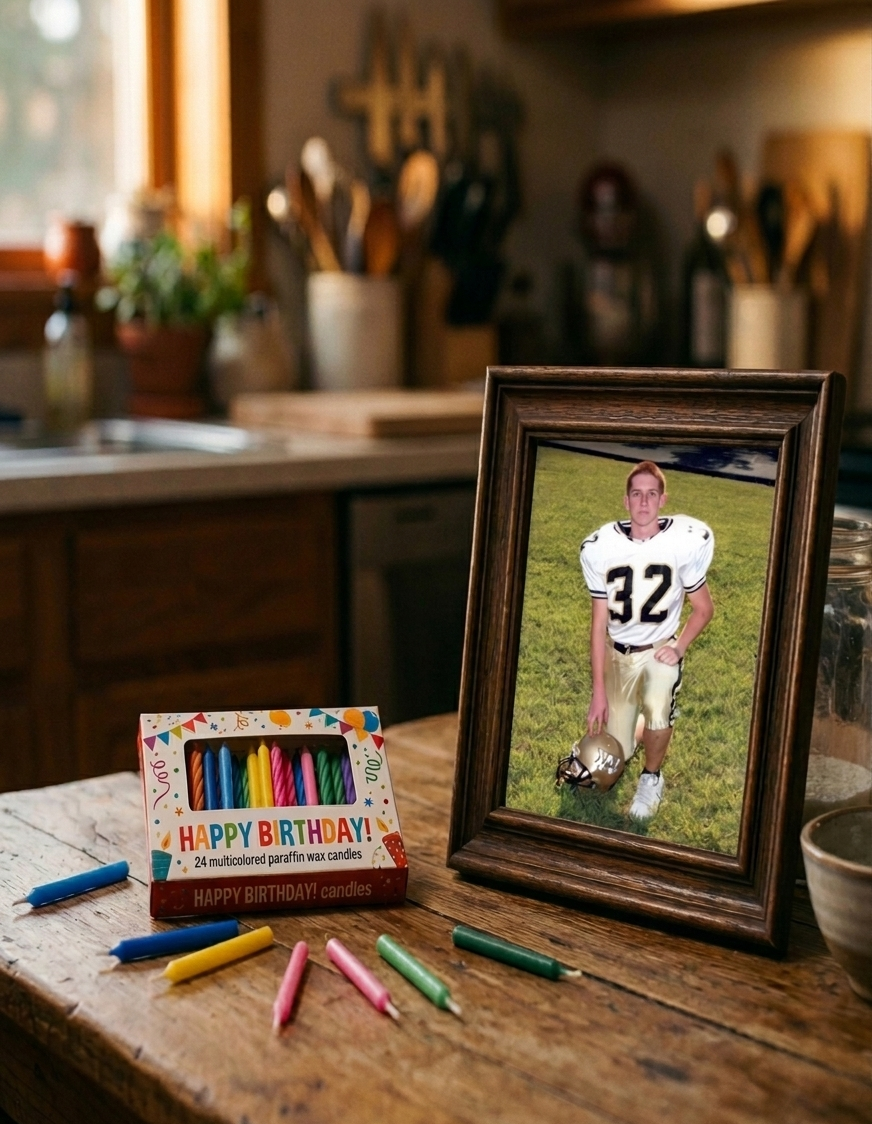

Today is John’s birthday.
Today he is thirty-four. I know that because thirty-four years ago, he came into our lives and changed everything about who we were and who we were going to become. He was the kind of kid who lit up a room. A mischievous smile. A bear hug that meant something. A glimmer in his eyes that I still see when I close mine.
John died by suicide on April 10, 2009. Our son. He was seventeen years old.
And now, on this birthday, I find myself sitting with a number that stopped me: seventeen years with John, and now seventeen years without him. Equal halves of something that should have been a whole long life.
There is something both heartbreaking and beautiful in that symmetry. I am not sure I have the words for it. I have been looking for them for a while now.
What I do know is this. If you are years out from your loss and someone just told you that grief gets easier, you may have felt a familiar frustration. Because it does not get easier, exactly. It gets different. The shape of it changes. And if you are reading this from early in your grief, wondering if anyone survives this far out and what it actually looks like, this post is for you too.
Long-term survival after suicide loss is real. It is not tidy. But it is possible, and it is worth being honest about. If you are early in your loss and wondering how anyone makes it this far, keep reading.
The Myth of “Moving On”
Our culture has an uncomfortable relationship with long grief. Frequently there is an unspoken expectation that grief has a shelf life. People who have not lived a loss like this often mean well when they suggest that years have passed and things should be getting back to normal.
There is no “back to normal.” There is only forward, and forward looks a lot different than anything that came before.
In seventeen years of sitting with survivors in our support group, I have heard more versions of this story than I can count. Someone says it has been four years, or seven, or twelve, and then apologizes for still being affected. As if the years themselves were some kind of failure. They are not. They are evidence of how much we deeply cared for the person we lost.
What research on suicide loss actually shows is somewhat helpful. Studies on survivors bereaved by suicide have found that the intensity of grief bonds tends to persist longer than in other types of bereavement, not because something is wrong with the griever, but because of what was taken and how. Dr. John Jordan, a clinician who spent decades working with suicide loss survivors, found that suicide grief carries extra weight because survivors are left without a ready explanation for the death, and because most of us quietly wonder what we could have done. The world does not give us a ready-made story for suicide the way it does for other kinds of loss. We have to build that meaning ourselves, over time, from the pieces.
That takes years. It is supposed to.
Moving Through, Not Past
There is a phrase I wrote in a post for John’s birthday this year that I keep returning to. “We have moved through our loss, but we have never moved past you.”
I think that is the most honest thing I know about long-term grief.
Moving past someone implies leaving them behind. It suggests the grief and the love both get packed away somewhere and life resumes as if the loss were a temporary interruption. That is not how this works. That is not how any of this works.
Moving through is something else entirely. It means the loss becomes woven into who you are. It changes the texture of every day without consuming every day. You learn to carry it rather than being crushed by it. Slowly, unevenly, and with setbacks, you find that you can still laugh, still be present, still love the people around you, and still feel the hole at the same time.
John owns a piece of my heart that time simply cannot touch. Seventeen years have not changed that. I do not expect another seventeen years will either.
The concept researchers call “continuing bonds” speaks directly to this. Rather than the old model of grief, which assumed that healing meant detaching from the person who died, the continuing bonds framework recognizes that most bereaved people maintain an ongoing relationship with the person they lost. The Alliance of Hope has written thoughtfully about this, describing it as creating a new kind of relationship rather than severing the old one. For survivors of suicide loss specifically, that bond tends to be particularly durable. I wrote about the science behind it in a post called Physics = Love: Continuing Bonds After Suicide Loss, and it remains one of the pieces I feel most captures what long-term grief actually looks like from the inside.
You are not meant to stop caring for them. You are meant to learn to care for them differently.
What Grief Looks Like This Far Out
For anyone in the early months of loss reading this, I want to be direct with you. Long-term survival does not mean the grief disappears. It means the grief changes.
In the early days and months, grief can feel like a physical assault. You cannot sleep, cannot eat, cannot focus. The shock is its own layer on top of everything else, and suicide loss in particular carries a traumatic dimension that other bereavements do not always have. Research consistently shows that survivors bereaved by suicide are at elevated risk for PTSD symptoms and for what clinicians now call prolonged grief disorder, a condition where grief remains acutely disabling well beyond what is typical. This is not weakness. It is a recognized response to a particular kind of loss, and it has effective treatment.
For many survivors, though not all, the acute phase softens over time. What remains is something quieter and more permanent. Certain days are harder than others. Birthdays. The anniversary of the death. Father’s Day. New Year’s Eve. A song that comes on without warning in the middle of an ordinary afternoon.
Marking the birthday of someone who died by suicide is one of the hardest recurring days in long-term grief. I have stood at John’s grave in the snow and in the rain on every one of his birthdays since we lost him, just as I did for every birthday when he was alive. That is seventeen consecutive years of standing there, singing Happy Birthday, with a tear in my eye. I expect to stand there next year too. The weather has never stopped me. The love is what keeps me going back.
Someone in our group once said something that has stayed with me for years. She had lost her son more than a decade earlier and had finally stopped measuring her grief against what other people thought she should feel. She said: “I’m not trying to get over it anymore. I’m trying to get good at carrying it.” That is one of the most honest descriptions of long-term survival I have ever heard.
Ritual as a Lifeline
One of the things that has helped me most, across seventeen years, is ritual.
Every year on John’s birthday, Teri, our daughter, and I go to Olive Garden. It started as the easiest thing to do that day, maybe because we needed something familiar when everything felt unrecognizable. It became a tradition. Now it is something we hold onto. I can already hear John’s commentary about the unlimited breadsticks. I will take some breadsticks home this year, just like he would have.
Ritual does something important for long-term survivors. It creates a container for the grief that might otherwise have nowhere to go on hard days. It is also a way of honoring the person who died, of saying: you are still here in this day. You are still counted.
I have written before about the role of ritual and remembrance after suicide loss, and the research supports what many survivors discover on their own. Meaningful rituals on significant dates are associated with healthier integration of grief over time. They are not about holding on unhealthily. They are about saying, with intention, that this person’s life mattered and is still worth marking.
If you do not yet have rituals around your loss, it is not too late to build them. They do not have to be elaborate. They just have to be yours.
What the Hard Years Teach You
This year feels a little different. The last of John’s grandparents passed away recently, all four of them are now gone. There is something layered about that loss on top of the original one. I will admit I am a little jealous today. I know exactly what is happening up there. John was never one to let a birthday go by without a celebration, and knowing him, he has already got everyone laughing, singing, and wearing something ridiculous on their heads.
Faith has been complicated for me since we lost John. I am not going to pretend otherwise. My Irish Catholic roots gave me a framework that was tested, shaken, and rebuilt in ways I could not have anticipated. John died on Good Friday, and for a long time that felt like a cruel detail rather than a meaningful one. What I eventually found in that date, and what I wrote about in Faith After Suicide Loss: What Good Friday Taught Me About Faith, is that even the hardest days can hold something worth holding onto. What has come back is real, even if it looks different than what it was before. That complexity is part of long-term survival too. Most long-term survivors I know have had their beliefs challenged in some way by this loss, whether those beliefs were religious or philosophical or simply about how the world is supposed to work.
What many survivors also report, years out, is something that researchers describe as post-traumatic growth. That is not a phrase I use lightly, and I am careful with it because it can be weaponized to suggest that grief should lead somewhere tidy. It does not always. But for many people who have lived through a suicide loss, there is something that emerges over time that was not there before. A different kind of empathy. A sharper sense of what actually matters. A willingness to sit with other people in their pain without flinching. That has certainly been true for me.
There is a video I share often with survivors who are years into this, a talk given by then Vice President Joe Biden at a TAPS event for military families, many of whom had lost someone to suicide. It is not a political talk. It is a grief talk, and one of the most honest ones I have ever heard from a public figure. Biden lost his wife and daughter in a tragic car accident in December 1972, just weeks after being elected to the Senate and before he was even sworn in. He speaks about how he kept going, how the pain changed shape over decades, and what it means to find purpose on the other side of loss. Whatever your politics, this is worth your time. Watch the video here.
Dr. John Jordan’s clinical work with suicide loss survivors describes this kind of growth as part of a longer process of psychological reintegration, rebuilding the assumptive world that was shattered by the loss. That rebuilding takes years. It takes community. And it is never finished in the sense of being complete. But it moves.
The Song That Keeps Coming Back
Every year on John’s birthday, a song finds its way back to my heart. “Jealous of the Angels” by Jenn Bostic captures something I have never quite been able to put into words myself. This year, for the first time, I think I fully understand why that title speaks to me. I am jealous of the angels. I am jealous of his grandparents who get to be with him now. But I also know, in a way that has nothing to do with certainty and everything to do with faith rebuilt from the rubble, that he is safe. That he is at peace. That somewhere, a birthday is being celebrated in a way that would make him very happy.
Music has a particular power in long-term grief. It becomes a bridge. I wrote about this at length in When Music Becomes a Bridge to Healing, and I hear it constantly from the survivors who have been at this as long as I have. A song does not just remind you. It returns you. It puts you back in the room with the person you lost in a way that almost nothing else can. It can bring tears and smiles at the same time.
If there is a song that does that for you, let it do its work. Even when it hurts.
You Are Allowed to Still Be Here
Here is the thing I most want to say to long-term survivors reading this today.
You are allowed to still be in it. You are allowed to struggle with the larger anniversaries, the five-year mark, the ten, the fifteen, and yes, even the fifty. If you are grieving a suicide loss after ten years or twenty and the weight of a particular day still catches you off guard, that is not regression. Those milestones have a particular weight. They invite reflection whether you want them to or not. Only you know what is in your heart and how it has or has not healed, so do what you need to do on those days. There is no right way to mark them. You are allowed to cry at the grave seventeen years later. You are allowed to feel jealous of the angels, to feel the symmetry of equal years with and without, to feel both heartbroken and grateful in the same afternoon. None of that means you have failed at grief. It means you cared deeply for someone.
And to the person in early grief who is reading this wondering if anyone survives this far out: we do. Not unchanged, and not without hard days, and not by moving past the people we lost. But we survive. We keep going to the grave. We keep ordering the breadsticks. We keep singing Happy Birthday in the snow.
We stay, because they are still worth staying for.
If you are looking for support in your own long-term survival, The Compassionate Friends offers community specifically for bereaved parents, grandparents, and siblings, with chapters across the country. And AFSP’s I’ve Lost Someone page is a starting point for survivor programs including Healing Conversations, a one-on-one connection with a volunteer who has been through this themselves.
You do not have to carry this alone, however long it has been.
Someday, when nature finally calls and our time here is done, we will make our way to heaven. Until then, we still have things to do down here. Still living to do. Still loving to give. Still a reason to get up in the morning and do the best we can with the time we have left. That is not a betrayal of them. It is what they would want for us.
We will get there someday, buddy. Save us a seat.
Posts You May Also Like
- Forever Young: The Remix That Taught Me to Dance Again – A companion reflection on what “forever seventeen” means, told through an unexpected song rather than a birthday.
- Day 2,922 of Our Journey: The Gift — An earlier anniversary reflection on the same ongoing count, and on what Iris Bolton’s concept of the gift hidden in loss took most of eight years to make visible.
- Ritual and Remembrance – Explores why creating meaningful rituals after a suicide loss helps survivors honor the person they lost and hold grief in a way that sustains rather than overwhelms.
- Grieving Longer Than They Lived: A Suicide Loss Milestone. – Explores the Balance Point, the day when you have been grieving longer than the person you lost was alive, and what this milestone reveals about the long arc of survival, integrated grief, and carrying someone forward after many years.
- Physics = Love: Continuing Bonds After Suicide Loss – Uses the language of physics to explore how the bond with the person who died never disappears; it simply changes form.
- Physical Health After Suicide Loss: The Long-Term Toll – The physical dimension of long-term survival, including what the research shows about the body’s health over years of carrying grief.
- When Music Becomes a Bridge to Healing – A personal reflection on how music can return us to the person we lost and serve as a powerful and unexpected source of comfort in grief.
- Healing After Suicide Loss: What the Journey Actually Teaches – The conceptual companion to this milestone essay: what the whole arc of healing from suicide loss actually involves, including the thousand choices, the continuing bond, and what still surprises after seventeen years.
- Something You Get Through: Finding Hope After Suicide Loss – An honest look at what hope means in the context of suicide grief, and why surviving is something different from healing completely.
- The Hard-Fought Hallelujah: Finding Spiritual Healing After Suicide Loss – Spiritual healing after suicide loss is perhaps the most complex and least discussed part of the grief journey. This post explores the three paths of healing (intellectual, emotional, and spiritual) and what it looks like to find your own hard-fought hallelujah after years of struggle and searching.
- When Grief Stalls After Suicide Loss: What Comes Next – Long-term survival is possible, but the road to it is not automatic. If you are years out from your loss and something still feels stuck rather than integrating, this post asks the honest questions about what may be in the way and what the next step might look like.
- Obituary After Suicide Loss: What to Say and How to Say It – What we would say differently in the obituary today, and reassurance for anyone revisiting what they wrote in the first raw days.

Leave a Reply