
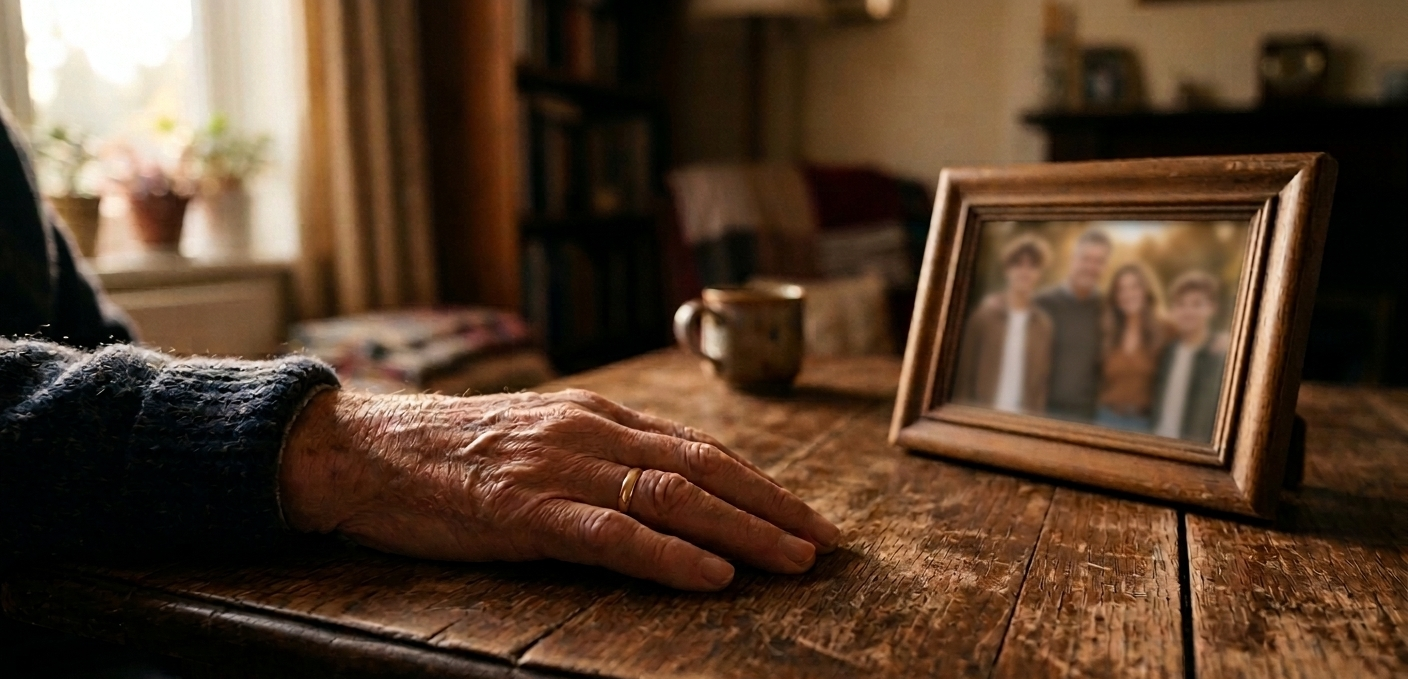

There is no word in the English language for a parent who has lost a child to suicide.
Widow. Widower. Orphan. Every major relationship loss has a name. But the loss of a child has no equivalent. Some people who study languages say that is because the concept is so unbearable that cultures across history refused to name it. That absence of a word says something about how far outside the normal order of things this loss sits. And when that child died by suicide, the weight of what is unnameable becomes something else entirely.
I know this from the inside. Our seventeen year old son John died by suicide in April 2009. We found ourselves in a place we had no language for and no map to. John was an outstanding student, a football player, active in his church youth group, a second-degree Black Belt in Taekwondo. None of that prepared us for what parental grief after suicide actually feels like. There was no roadmap for what came next. There still isn’t. But there are fellow travelers, and that matters more than a word or a map.
If you are here because you lost a child to suicide, this post is for you. Not a clinical overview. Not a list of stages. Just an honest conversation about what this specific grief carries, written by a bereaved parent who is still walking the same road. There is hope, there is healing, but it does not come early or easy.
One thing before you read further. If you are in the early days or weeks of this loss, you don’t need to take in everything here at once. Some of what follows will feel immediately familiar. Some of it, like the milestones, the long view, the slow work of rediscovery, may belong to a later chapter of your grief that you haven’t reached yet, and that’s exactly as it should be. Read what speaks to where you are right now. The rest will be here when you need it.
When People Don’t Know What to Say
The silence can be its own kind of wound.
After losing a child, many parents describe a strange isolation settling in around them. Friends who were close suddenly become awkward and distant. People say the wrong things. Or say nothing at all, not because they don’t care, but because they are overwhelmed and afraid to make it worse.
“At least they’re no longer suffering.” “God needed another angel.” “Have you tried keeping busy?” These phrases come from a place of care. Unfortunately, they land like boulders crushing your heart.
What we often need is simpler than most people realize. We need someone to say the name of the person who died. We need to hear, “I am so sorry. I don’t know what to say, but I’m not going anywhere.” We need presence more than answers.
When the people around you go quiet, or say too much, or say the wrong things entirely, it is not a measure of how much your child mattered. It is a measure of how hard it is for human beings to sit with a grief this large. That doesn’t make it less painful. But naming it for what it is can help keep the isolation from swallowing you whole.
There is an added layer when your child died by suicide specifically. In our support group, we have an expression for what happens when you say the “suicide” word out loud: “it’s like you handed them a tarantula.” They just want to drop it and run. Not because they don’t care, but because they don’t know what to do with it. Suicide carries a weight in our culture that ordinary death does not, and people who have never been close to it often freeze, back away, or change the subject entirely.
That reaction shapes a question many bereaved parents face that other grieving parents do not face in the same way: “what do I tell people?” Some parents say suicide openly and absorb whatever reaction follows. Others use softer language to protect themselves. Others say nothing and carry the silence like a second loss. All of these choices are valid. What is not valid is the judgment, spoken or unspoken, that can attach itself to this kind of death. The fear that people see your child’s death as a reflection of your failure as a parent is one of the most corrosive things this grief carries. It is also, largely, a weight you are placing on yourself on behalf of others who are not actually saying it. Most people don’t know what to think. They are not in judgment. They are in shock and uncertainty, just like you. The stigma around suicide is real in the culture. It is not always real in the room.
You might find it useful to read more about navigating social connections after loss and how to manage the relationships that feel hardest right now. You get to choose how much you share about the circumstances that surround the loss of your child.
The Milestones You Will Never See
Nobody warns you about the wedding invitations.
Or the graduation announcements. Or the moment a friend calls to say they’re going to be grandparents. As you move through your loss, these things arrive in ordinary ways, and they hit like something you weren’t braced for, even though part of you has been dreading them since the day you lost your child.
Parenting is a forward-looking act. From the moment a child is born, parents are already imagining forward. The first day of school. Driving lessons. Graduation. Watching them fall in love. Standing at the back of a wedding ceremony with eyes full of tears. Grandchildren. All of it. When your child dies, you lose not only who they were. You lose every version of who they were going to become. This kind of grief doesn’t have a single moment of loss. It has hundreds of them, stretched across the rest of your life, arriving one by one at the door. You learn how to take deep breaths, you learn how to put on a mask so you don’t show your heartbreak.
Many of us have felt what I call jealousy. We don’t want to feel it. We know the other family didn’t do anything wrong. But it rises up anyway when another couple’s child reaches something that our child will never reach. Researchers who study parental grief have documented this response widely. It is not a character flaw. It is what happens when love has nowhere to go.
What I can tell you, from the other side of the earliest years, is that these waves do not stay at the same height forever. They still come. But over time, most parents find that the wave arrives and passes without pulling them all the way under the way it once did. That is not the same as it getting easier. It is the slow building of a different kind of strength.
If you can, find people who understand this specific grief. The Compassionate Friends have spent decades supporting parents through exactly this, including the long, milestone-triggered waves that come years after the loss. Their chapter network and online communities can be a place to bring these feelings without having to explain them from the beginning.
What Happens to the Future You Planned?
Parents don’t just raise children. They build a life that has their child built inside it.
You saved money for a future that included them. You kept a bedroom ready. You imagined the holidays, the homecomings, the phone calls that would stretch longer as they got older and had more to say. You had a version of yourself in mind, twenty years from now, that still had your child in it.
That version of yourself is gone too. And nobody quite tells you that’s part of what you’re grieving.
For some parents, the loss feels not just personal but existential. What was all of it for? I remember asking that question in ways I couldn’t have put words to at the time, standing in rooms that suddenly felt like they belonged to a life I no longer lived. It felt like the entire foundation of my life had shifted. Everything built on it was in a different position than it used to be.
For parents whose child was their only child, this goes even deeper. There is no “at least there are other children,” a phrase that drives a stake through the hearts of those who do have other children. The role of parent, which may have been central to your identity and your whole sense of the future, now sits without a clear shape. This is a grief within a grief, and it deserves to be named. If this is where you are, your loss is not lesser for being singular. It is its own complete and devastating thing.
The sense that there is no future is real. It is also, as grief gradually reveals, not permanent. It is what grief does to time. Many parents describe a slow process of rediscovering what matters to them, separate from the future they had planned. That process cannot be rushed. But it does happen, and it is worth knowing that.
Their Room. Their Things. The Toys You Were Saving.
At some point, usually long before you are ready, someone will suggest it is time to deal with the room.
Maybe it comes from a well-meaning family member who worries you are holding on too tight. Maybe it comes from some internal pressure you can’t quite name. Maybe the door has been closed for months and you haven’t been able to open it. Maybe you open it every day and stand in the doorway until you can’t anymore.
Whatever is happening with that room, it is yours to figure out. And when you are ready to talk about it, the people in your household who loved your child are facing the same empty space. Those conversations, as hard as they are, can sometimes be the ones that matter most.
Many parents describe it as one of the most charged places in the house. Everything in it still holds the shape of the person who is gone. The clothes still carry a scent. The books still have a bookmark in them. The desk still has whatever was on it the last time they sat there. Parents who leave these things untouched for months or years are not doing something wrong. They are honoring a reality that the rest of the world moved past far too quickly.
What is harder to talk about are the things you were saving for later. The stuffed animal you thought you might someday give to a grandchild. The books from when they were small. The toys in a box in the closet. These are objects that carried a future inside them. They were part of an imagined life that was still ahead. When your child dies, those objects become something else. They are a future that has no place to land.
Some parents find ways to repurpose them that feel like a form of honoring rather than letting go. Others need them to stay exactly where they are, for as long as they need them there. Both of those things are right. I remember looking at John’s kindergarten t-shirt with his fellow classmates’ names on it, wondering if I ever could get rid of it. Years later, I still haven’t. And I have stopped asking myself whether I should.
If decisions about the room and belongings feel completely paralyzing, it can help to talk them through with a grief counselor or in a support group where other parents have faced the same thing. The AFSP survivor resource guide has practical guidance on working through early decisions, including the ones that feel too heavy to approach.
The Hole in Every Family Photo
I remember the first family photo we took after losing John.
I looked at it and all I could see was the hole. Not the people who were there. The person who wasn’t. The space where he should have been standing. That space didn’t register as empty. It registered as John-shaped. As absence with a specific outline. It still sits to this day behind a dresser in his bedroom. It’s not something I want to look at, but I also don’t want to throw away the rest of the family. If you have a photograph like that somewhere, you know exactly what I mean. There is no right answer for what to do with it.
That experience doesn’t go away. It changes over time, but it doesn’t go away. Every family gathering that gets photographed from now on will have that same hole in it. Graduations. Holidays. Weddings. The pictures you take when grandchildren arrive. They will be missing in all of them, and you will know it, even when the people around you in the frame don’t see what you see.
This is one of the aspects of parental loss that is almost impossible to prepare for and rarely gets spoken about. The photograph is supposed to be a record of who was there. What it becomes, for a bereaved parent, is also a record of who was supposed to be there and isn’t.
Some parents stop taking family photos for a while. Some find ways to keep the person who died present in those moments, a framed photograph on a table in the background, a chair left empty by choice, a flower placed deliberately. Our daughter’s wedding photo is one filled with immense love and joy, but I still see a hole. And that is ok. Some find that, over time, the images begin to hold both the loss and the love at the same time rather than only the absence. None of these responses is wrong. They are all ways of trying to hold the same impossible truth, that life is continuing, and that someone is missing from it.
The ritual and remembrance post here talks about how intentional acts of memory can transform what might otherwise feel like absence into something that honors the person who died. It won’t make the hole in the photograph disappear. But it can change what the hole means.
Your Surviving Children
If you have other children, they are grieving too.
And they may be doing it quietly, in rooms you can barely see into right now, at a time when your own grief is consuming most of what you have. A young child processes this loss differently than a teenager, and a teenager differently than a young adult. Some will show their grief openly. Others will go silent to protect you. The age shapes how it comes out, but the loss is real at every stage.
Surviving siblings are often the forgotten mourners. They are grieving the person they lost. They may also feel like they’ve lost you, watching you struggle. Many feel pressure to hold themselves together, to not add to your burden. They may be angry. Or guilty. Or frightened about their own mental health in ways they have told nobody. Research on families after suicide loss confirms how often this goes unspoken on both sides.
When love becomes hypervigilance after a suicide loss is one of the most common experiences for bereaved parents. The fear that another person you love is in danger. The watching. The counting exits, tracking moods, listening for what isn’t being said. It can become its own form of grief, a grief for the ease and trust you used to feel before you knew how quickly everything can change.
Your surviving children need support that is separate from yours. The AFSP’s guide for children and teens affected by suicide loss is a good starting point. Getting them connected to their own grief counselor or a peer group for young people who have experienced this kind of loss can make a genuine difference.
And it is okay to tell them that you are struggling. Children, especially older ones, already know. What helps them is honesty, not performance. You don’t have to have the answers. You have to show them that staying present, even while grieving, is possible.
The Weight of Guilt and Regret
The questions arrive before you’re fully awake.
What did I miss? What did I say? What didn’t I say? Was there a moment I could have changed what happened, and did I walk right past it? The mind runs back over everything, again and again, searching through the past like someone going back through a dark house looking for a light switch. In our support group we refer to this as “playing the videotape over and over.”
I know this territory. John had been diagnosed with bipolar disorder less than four months before he died. Four months. There are no words for how insufficient that window was to understand what was happening, to find the right help, to know what to look for. We had him in every treatment program we could find, but after his death, we questioned if we did enough. The grief that followed was full of the questions parents carry. It has taken years to reach even a partial peace with the fact that loving someone and being able to save them are not the same thing.
Love can’t prevent a heart attack, or stop cancer. But for some reason we thought it should have been enough to save our child.
Guilt is grief’s way of trying to find a lever. If I caused this, then perhaps I could have prevented it. Someone in our support group once described guilt as a job she had never applied for and could not figure out how to quit. That language stuck with me because it captures something true. The guilt is not a verdict. It is grief looking for a foothold.
There is something else that lives alongside the guilt and is harder to say out loud. Many parents feel anger at their child. Not just at themselves, not just at the world, but at the person who died. Rage, sometimes. For leaving. For not saying something. For this, when there were people who loved them completely and would have done anything. I remember standing alone in the backyard cursing at the sky.
If you have felt this, you are not alone and you are not a monster. Anger after this kind of loss is real, well-documented, and understandable. It doesn’t mean you love your child less. It means you loved them without reservation, and the loss is total, and the mind looks for somewhere to put the force of that. The anger and the love exist at the same time. They always have. Grief doesn’t erase the complexity of the relationship. It intensifies it.
Parents who lose a child to suicide carry more guilt and shame than almost any other group of bereaved people. That is not an impression. Dr. John Jordan, whose forty years of clinical work with suicide loss survivors is among the most thorough in this field, identifies guilt and self-blame as among the central burdens parents carry, and specifically notes that we search backward for what we could not have known in the forward direction. The hindsight bias is real and well-documented. Before the death, most of us were not withholding attention or care. We were living in a life where our child appeared, by most measures, to be okay, or struggling in ways that weren’t yet readable as a crisis.
That understanding doesn’t erase the guilt. But it can slowly loosen its grip. The posts on moving beyond guilt and the nature of guilt in suicide loss may be worth sitting with as part of that work.
The Question That May Never Have an Answer
The mind wants a reason.
That is not a weakness. It is one of the most human things there is, especially for a parent. You spent years being the person who could find the answer, make it better, fix what was broken. And now there is a question at the center of everything that will not yield to any amount of searching or effort or love.
Why did my child die by suicide?
Most parents who lose a child to suicide will spend years asking it. Some find partial answers that bring partial peace. A diagnosis, a pattern that becomes clearer in retrospect, a note that offers something. Others find nothing that fully explains it, and they learn, slowly and painfully, to carry the question itself rather than wait for the answer before they can begin to heal.
Our culture doesn’t help with this. We are trained to expect that every tragedy has a discoverable cause, a clear reason, a moment that explains it. Suicide rarely works that way. The full truth of what your child was carrying in those final days or hours often went with them. That is not a failure of your attention or your love. It is the nature of a pain that hides itself, even from the people closest to it.
What the clinical research tells us is that suicide is rarely the result of a single cause. It is usually the convergence of biological vulnerability, mental health, circumstance, and a level of internal pain that exceeded what could be borne in that moment. That framing doesn’t answer the why. But it does resist the simplest and most devastating version of the question, the one that begins with “what did I do?” Because the answer to that version is almost always the same. You were a parent living a life with a child who did not let you see the full depth of what they were carrying. That is not a failure of love. It is a feature of how this kind of pain works. It hides.
Some parents find peace in accepting that only their child knew the full truth of it, and that truth went with them. Others find that asking a different question, not “why did this happen?” but “who was my child, and how do I keep carrying them forward?”, slowly becomes more bearable to live inside. There is no correct path through this. There is only the path you find.
Your Marriage Under Pressure
Grief is not synchronized between two people. It never is.
Between partners, one of you may need to talk about your child constantly. The other may barely be able to say the name. One may find comfort in photographs and rituals. The other can’t be in the same room with them yet. One may want to stay busy. The other can’t get off the couch. These differences don’t mean the relationship is broken. They mean two people are drowning in sorrow and grabbing for different things.
What the research on bereaved parents shows, and what I have watched across many years of sitting in support groups with couples who have lost a child, is that the strain is real and significant. Some couples pull apart. Some find that the shared loss becomes, eventually, a kind of bond that nothing else in their lives has the weight of. The difference often comes down to one thing: whether they can find a way to stay in some form of communication, even when the grief is pulling them in different directions.
The danger is when the difference becomes distance, and distance becomes a wall neither partner knows how to breach.
I wrote an entire post on what marriage after losing a child to suicide actually looks like and what has helped some couples survive it. If the distance is already significant, couples grief counseling with a therapist who understands trauma and suicide loss can make a real difference. There is no shame in needing that. This is one of the hardest things two people can go through, and no one should be expected to navigate it alone or together without help.
Rediscovering What Matters
At some point, not soon and not on any schedule, many parents find themselves asking a different kind of question.
Not only “why did this happen?” but “who am I now, and what do I do with the time I still have?”
I don’t think I could have asked that question in the first years. I wasn’t ready for it. I was still trying to locate the floor beneath my shaking feet. But somewhere in the middle years after losing John, I started to notice that some things mattered to me in ways they hadn’t before, and some things that had once felt urgent had gone completely quiet. Loss does something to your sense of priority. It strips away a lot of what wasn’t real.
Some parents find new meaning in advocacy work, in speaking their child’s name in public, in doing something that contributes to a world where fewer families have to know this grief. Others find it in quieter things. A deeper presence with the people still here. A personal interest they had set aside. A community they had never fully entered. Researchers who study long-term grief describe this as post-traumatic growth, not a return to who you were before, but a changed person who has been broken open and slowly put back together in a different shape.
This is not a silver lining. It is not a lesson the loss was supposed to teach. It simply happens, for many people, when they stay present long enough to let it.
The AFSP’s survivor-facing resource hub is a good place to begin finding community if you don’t yet have one. The AFSP support group finder and the Alliance of Hope can connect you with people who will not need the loss explained to them. You do not have to find meaning right now. Surviving this period is enough. But meaning is available when you are ready, and it does not require that you stop grieving. The two can exist at the same time.
A Word About the Road
The grief of losing a child to suicide does not resolve. It changes shape. Time does not heal all wounds.
In the early months, it is total. It occupies every room. Over time, for most of us, it becomes something carried rather than something that carries us. That shift doesn’t happen because the love decreases or because the person is forgotten. It happens because we slowly, and with enormous effort, reconstruct enough of ourselves to hold both the loss and a life at the same time.
That is not moving on. There is no moving on. It is learning to carry the weight in a way that leaves your hands free for the things that remain. It’s about learning to move through the loss.
John would have been in his early thirties now. I grieve that person too, the man he would have become. I also carry him in every conversation I have with a newly bereaved parent, in every support group meeting, in the sunflowers that mean something specific and irreplaceable to our family. He is still present. That is not grief’s failure. That is one of the things grief, slowly and painfully, makes possible.
Within two months of losing John, I found my way to a support group out of desperation, needing to be in a room with people who understood this particular loss. What I found there was lifesaving. If you are in the early months of this, please reach out for help. A grief counselor who understands suicide loss, a support group, a conversation with another survivor through the AFSP’s Healing Conversations program. You should not be doing this alone.
One of the first things I did, and one of the most helpful, was read My Son, My Son by Iris Bolton. Bolton was a grief therapist who lost her own son to suicide, and she writes from inside the same impossible place. For many bereaved parents, it is the first book that makes them feel genuinely less alone. If you haven’t found it yet, it is worth finding.
And if you have been carrying this for years and it still feels immovable, please know that prolonged grief is a recognized experience with real and effective support. The Columbia Center for Prolonged Grief offers resources and a therapist finder for those whose grief has remained particularly heavy over time.
If You Are Having Thoughts of Suicide Yourself
There is one more thing that rarely gets said, and it needs to be. Many bereaved parents, in the early months and sometimes much longer, find themselves having their own thoughts of suicide. This is more common than most people know, and more understandable than it might seem from the outside. Not because death is what you want, but because the pain is so total that the mind searches for any exit from it.
Research confirms that what you may be experiencing is not a personal failing, it is a recognized and documented risk. Parents who lost a child to suicide are about twice as likely to be diagnosed with depression, about 40% more likely to develop an anxiety disorder, and significantly more likely to be hospitalized for a mental health crisis in the two years following the loss, compared to parents who did not experience this kind of loss. And suicide loss survivors as a group are 64% more likely to attempt suicide compared to those who have lost someone to sudden natural causes. That context is not meant to frighten you. It is meant to tell you that the people who study suicide loss grief take it seriously, the risk is real, and reaching for support is not an overreaction. It is exactly the right response.
If this is where you are, please know you are not broken or dangerous. You are a person carrying something almost unbearable, and you deserve real support right now. Call or text 988 to reach the 988 Suicide and Crisis Lifeline, available 24 hours a day, seven days a week, free and confidential. If you are not in crisis but are carrying more than you can hold alone, finding a grief counselor who specializes in suicide loss or trauma can be one of the most significant things you do. The AFSP’s directory of suicide bereavement trained clinicians and Psychology Today’s therapist directory can both help you locate someone with the right background. You do not have to earn that support by getting worse first. You can reach for it now.
You are not broken. You are a parent who loved your child. You are still here. That matters more than you may be able to feel right now.
And from one parent to another: you can survive this. Not easily, and probably not without help, but it is possible. In more than fourteen years of sitting with parents in our support group, I have watched hundreds of people carry this loss and find their way to something that looks like life again. Not the life they planned. But a real one. I have seen it happen more times than I can count.
Posts You May Also Like
- Failed as a Parent: Guilt You Didn’t Earn After Suicide Loss – A closer look at the specific guilt of feeling you failed at the parental role, including what changes and what doesn’t for parents of adult children.
- Your Child’s Birthday After Suicide Loss: We Remember – A father’s reflection on what a child’s birthday after suicide loss holds, including the second grief for every age they never reached, continuing bonds, and why the birthday still belongs to the life that was actually lived.
- Marriage After Losing a Child to Suicide: Can It Survive? – An honest look at the particular pressures this loss puts on a partnership and what helps couples survive it.
- Losing an Only Child to Suicide: The Parent You Still Are – For parents whose child was their only child, this post looks at what changes when there is no other son or daughter, from the parent role to the years ahead.
- Losing a Grandchild to Suicide: Grief, Guilt, and the Double Loss – Written for the grandparents in your family, who are grieving your child too while trying to hold you up.
- Men Grieving Suicide Loss: Why You Don’t Have to Fix It – For fathers specifically, a direct look at protector guilt, the collapse of identity, and why grief carried alone is harder than it has to be.
- 5,000 Days vs. 6,244 Days: Long Term Healing After a Suicide Loss – One bereaved father’s own dated milestone, and why he came to focus on his son’s 6,244 days of life rather than the days since.
- Moving Beyond Guilt: A Path Toward Healing After Suicide Loss – A deep exploration of the guilt that suicide loss carries and what it takes to begin releasing it.
- When Love Becomes Watching: Understanding Hypervigilance After Suicide Loss – What happens when fear becomes constant vigilance over the people still here, and how to begin finding your way back.
- Picking Up the Pieces: Rebuilding Life After Suicide Loss – A guide to the slow, nonlinear work of rebuilding a sense of self and life after catastrophic loss.
- Finding Your People: The Healing Power of Suicide Loss Support Groups – Why peer community matters so much in this grief, and how to find the right group for where you are.

Leave a Reply