
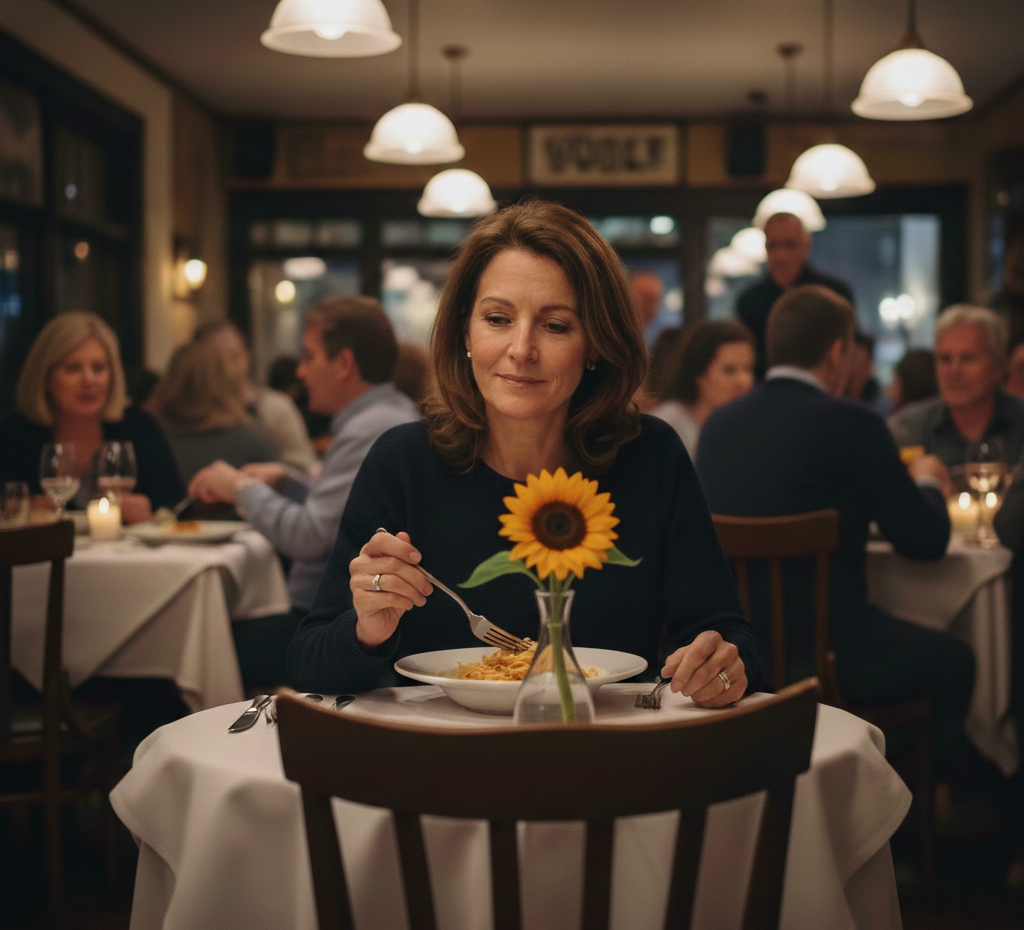

You’re sitting in the restaurant, staring at the menu. Across from you is an empty chair. There is no one to split the appetizer with. There is no one leaning over to ask if you want to share a dessert. Around you, every other table seems full. Couples. Families. People in easy conversation. You feel like you are the only one sitting alone. You wonder if anyone is watching you. You wonder if you should have stayed home. You wonder if this is what going out to a restaurant will look like for the rest of your life. This is what losing a partner to suicide looks like in the small moments no one mentioned to you.
Losing a partner to suicide does not just break your heart. It breaks the underlying structure your life was built on. Your finances. Your daily routines. Your relationship with your children. Your connection to your partner’s family that was once yours, too. Most of the arrangements that held your life together was built for two people. Now one of you is carrying all of it.
At our support group, SOS Madison, I have sat with people in those first months after losing their partner. They come in still in shock. They come in facing things no one warned them about. The grief is layered and specific. It is hard to explain to anyone who has not lived it. This post tries to capture some of it. The part that is grieving. And the part that is trying to figure out how to pay the mortgage or rent.
When the Ground Shifts Under Your Feet
Losing a partner to suicide is not simply losing a person. It is also losing your identity as a partner. It is losing the future you both held in your minds. It is losing the shape of ordinary Tuesday evenings and weekend mornings and every plan you had made together.
Research on suicide bereavement shows that surviving spouses often carry a particular form of pain on top of all the other grief. The sense that the person who knew you best, who you chose, has left you by suicide. Many surviving spouses name that feeling abandonment. It is not rational. It does not mean the death was about you. But it is real. And it sits on top of an already crushing weight.
Many surviving partners also carry guilt. The replaying of last conversations. The search for what was missed. The question of what might have changed things. If your partner had been struggling with mental health for a long time, you may have been both caregiver and partner at once. That combination leaves its own particular grief. If the death came with no warning, the shock can be so complete that the early weeks feel more like bewilderment than grief.
Both are real. Neither is wrong.
When Grief Comes With a Price Tag
Nobody talks about the financial devastation of losing a partner. But it is one of the most immediate realities surviving partners face.
If your partner worked, you may now be operating on half the income you had before. If your partner managed the finances, you may be encountering accounts, debts, insurance policies, and bills for the first time. If you were not legally married, you may face additional complications that married partners are somewhat shielded from. Life insurance policies sometimes contain clauses around suicide. Fighting through those clauses while actively grieving is its own particular cruelty.
If you have children, you are now the only one handling school drop-off, bedtime, homework, meltdowns, and every other part of parenting that was once shared. Single parenthood after the suicide of your partner is not just a logistical challenge. It is a relentless reminder of the absence.
Your children are grieving too. They lost a parent. They are trying to make sense of something that adults cannot make sense of either. They may act out. They may go quiet. They may ask questions you do not have answers to. And they will be watching you, closely, to figure out whether it is safe to fall apart.
That puts you in an impossible position. You are trying to hold yourself together for them. And you are falling apart at the same time. Both of those things are true at once. Being strong for your children does not mean pretending you are not broken. It means showing them that broken people keep going.
Many surviving parents also find that something shifts in the way they watch their children after a suicide loss. A new anxiety moves in. You notice mood changes more sharply. You lie awake running through conversations. You scan for signs. That is not overreaction. It is hypervigilance after suicide loss, and it is one of the common responses to this kind of grief. It deserves to be understood, not dismissed.
Returning to work after suicide loss is its own chapter. Many surviving partners face it too soon, pushed back before the shock has even lifted, driven by financial pressure they cannot afford to ignore.
If you are facing financial difficulty, reach out. Many survivors do not know they are allowed to ask for help. You are. If your situation involves housing instability, legal questions, or insurance disputes, consulting a financial advisor or attorney who works with bereaved families is not extravagant. It is necessary.
The Ring on Your Finger
At some point, the question will surface. Maybe someone will ask. Maybe you will find yourself staring at the ring and asking it yourself. Do you keep wearing it? If so, for how long? And if you take it off, does that mean something you are not ready for it to mean?
There is no right answer.
Some people wear their wedding ring for years. The marriage happened. The relationship was real. The ring honors that. For some people, taking it off feels like an erasure they are not willing to make. Some people move the ring to a different finger. Some wear it on a chain. Some put it away after a few months. Not because they stopped caring for the person who died. But because wearing it began to feel like holding on in a way that kept them stuck.
There is no schedule for this. Anyone who suggests otherwise is simply wrong. This is one of the most personal decisions you will make. It belongs entirely to you. Give yourself permission to decide slowly. Give yourself permission to change your mind.
Questions at the Cemetery
If your partner is buried, another decision may be waiting. The headstone. Specifically, whether to have a double headstone, with room for your name beside theirs.
This is a tradition with long roots. Many surviving spouses find it meaningful. But it is also a decision some people make quickly in the fog of early grief and later feel uncertain about. And for others, seeing their own name on a stone at the cemetery is simply too much right now. Too concrete. Too permanent, when so much about the future still feels unknown.
There is no urgency here. Cemeteries work on longer timescales than grief does. A temporary marker can hold space while you take the time you need. If you are not ready to decide, you do not have to decide.
But maybe you did decide. Maybe you felt the pressure of the moment and said yes to the double stone. Maybe guilt played a role. Maybe you were not in a state to weigh it carefully, and the decision got made before you were ready to make it. That happens more often than people admit.
If that is where you are, there is something important to know. Headstones can be changed. The choice you made in the worst weeks of your life does not have to be permanent. Stonemasons work with families on this more than you might expect. You have the right to revisit it. You have the right to change your mind. The choice, then and now, is yours.
If you are struggling with the ritual and meaning of remembrance after a suicide loss, you are not alone. These decisions carry weight that is hard to explain to people who have not had to make them.
Your Partner’s Family
The relationship between a surviving partner and the family of the person who died is one of the more complicated dynamics that very few people openly talk about.
In the best cases, families come together in grief. They support each other. They share memories. They stay connected. But grief after a suicide does not always bring out the best in people. Some of the people who also cared deeply for your partner, will be searching for somewhere to put their pain. Sometimes that somewhere becomes you. You may face blame. Spoken or unspoken. You may find that your partner’s parents or your partner’s siblings begin to pull away. And you may lose not just your partner, but an entire extended family, at the same moment.
When the world keeps turning around you, the social wreckage of a suicide loss can reach much further than most people expect. This is real. It is a loss inside the loss.
If there are children involved, the complexity deepens further. Children may have grandparents and aunts and uncles on the other side who are also grieving and also struggling. Managing those relationships while managing your own grief can feel like more than one person can carry. Because it often is more than one person can carry alone.
The Smallest Silences Are the Loudest
The empty bed is its own form of grief.
When you share a home with a partner, their presence is woven into every room. Their spot at the table. Their side of the closet. The way they took up space in the kitchen or on the couch. After they are gone, the physical absence is specific and located. It hits you in rooms you did not expect. Their toothbrush still in the holder. Their hair brush still on the bathroom counter. Nobody tells you that the bathroom may be one of the hardest rooms.
Solo meals can feel nearly unbearable in those first weeks. You learned to cook for two, to shop for two. You ate at the same table across from the same person. Many people in our group have stopped eating at the table altogether for months. Some ate standing at the counter. Some made something small late at night, when the silence felt slightly less loud. Some meals are just too hard to make, because it holds memories of the person you lost. In our house, we did not have twice baked potatoes for many years after the death of our son. It just caused too many painful memories.
The writer Alisha Bozarth, writing for the Alliance of Hope for Suicide Loss Survivors, described this particular grief as a trifecta of loneliness. Missing the specific person. Missing the role of having a partner. And facing the broader aloneness of widowhood in a world that mostly moves in pairs. All three of those losses are real. They do not always hit at the same time. That is part of what makes the grief so disorienting.
“You Should Start Dating Again”
It will happen. Someone who cares for you and means it as encouragement will say something like: you’re young, you should put yourself back out there. I just want you to be happy again.
You may hear it six months after your partner died. You may hear it sooner. However early it comes, it is likely to land badly. What it sounds like, even when that is not the intent, is your grief has an expiration date. There is a point at which you are expected to move on. The suggestion carries an assumption that you are ready for something you may not be anywhere near ready for.
The decision to date again after losing a partner to suicide belongs entirely to you. On your timeline. No one else’s.
Some survivors never remarry or re-partner. That is a complete and dignified choice. Some find, years later, that they are open to new connection. They discover that it does not diminish or betray the person they lost. Both paths are valid. What is not helpful is being pushed toward either of them before you have had time to grieve the one you are already in.
You more than most people understand how to love, how to commit to a relationship. You have lived through the “To have and to hold, from this day forward, until death do us part”. You have demonstrated the capacity, but the choice going forward is yours. There is no timeline or obligation.
Moving beyond guilt after any part of suicide grief takes time. That includes the guilt that can come with eventually finding happiness again. Give yourself permission to heal at your own pace. You do not have to measure it against anyone else’s expectations.
If the comments come regularly, a simple boundary can help. “I’m taking it one day at a time.” You do not owe anyone more than that.
Finding the People Who Understand
The isolation that follows losing a partner to suicide is real and severe. Your coupled friends may not know what to say. They may invite you to dinner, and all you see is the empty chair at the table with them. The social world that was built around two people now has a gap that no one knows how to fill. The specific nature of this grief, with its unanswered questions and complicated emotions, is hard to carry in a circle of people who have not lived something similar.
This is exactly what peer support was built for.
Support groups for survivors of suicide loss provide something that well-meaning friends and family often cannot. A room full of people who have lived some version of what you are living. People who will not flinch. People who will not try to fix it. People who understand the difference between grief after other kinds of loss and this particular, specific grief.
The Alliance of Hope for Suicide Loss Survivors offers a specialized “Finding Your Way” program specifically for women who have lost a spouse or partner to suicide. It runs online, in small groups, led by experienced facilitators who have walked this path. The American Foundation for Suicide Prevention can help you locate in-person survivor support groups near you. If you need support right now, at any hour, the 988 Suicide and Crisis Lifeline has loss survivor resources at 988lifeline.org.
If you are in New Jersey, our group at SOS Madison meets twice a month in Madison. You are welcome to join us.
You Are Still Standing
There will be evenings in restaurants when the waiter sets a menu across from you out of habit, and you have to say there is only one of you tonight. There will also be evenings when you get through it. When the waiter brings your check and you realize you made it. That is not a small thing. That is survival. And survival matters.
The questions you are carrying do not all have answers yet. The ring, the headstone, whether you will ever feel ready for whatever comes next. Those will resolve in their own time. On your terms. Some of the other questions, the ones about the person you lost and the night everything changed, may never fully resolve. Learning to hold them without being consumed by them is its own slow work.
What I can tell you, from seventeen years of sitting in support groups with survivors of suicide loss, is this, people who come in broken by exactly this loss do find their way through it. Not around it. Not over it. Through it. At their own pace. With the people who understand beside them.
Your grief is not a problem to solve. It is evidence of a life you built with someone. That deserves to be honored, however long it takes, however it needs to look for you.
If you are ready to find that community, start here.
Posts You May Also Like
- Picking Up the Pieces: Rebuilding Life After Suicide Loss – For anyone starting to ask what daily life looks like now, this post addresses the slow work of rebuilding when everything has changed.
- When the World Keeps Turning: Navigating Social Connections After Suicide Loss – A look at the social fallout of suicide loss, including friendships that fade and connections that surprise you.
- Life Insurance After Suicide Loss: What Survivors Should Know – Covers the practical and emotional cost of a life insurance claim specifically, useful for the structural financial questions that follow losing a partner.
- Moving Beyond Guilt: A Path Toward Healing After Suicide Loss – A compassionate exploration of the guilt almost every survivor carries, and how others have begun to work through it.
- Dealing With Difficult Questions After a Suicide Loss – For when people ask things you do not know how to answer, about what happened, about how you are doing, about all of it.
- The Second Year After Suicide Loss: What to Expect – What changes and what does not as you move past the first-year firsts and into a landscape that is still unfamiliar.
- Dating After Losing a Partner to Suicide: A Survivor’s Guide When you feel ready to think about companionship again, this guide walks through the emotional terrain of dating after suicide loss — including guilt, timing, and how to talk about your loss with someone new.
- Sexual Intimacy After Suicide Loss: When the Connection Changes – Covers the physical and emotional dimensions of intimacy after a partner’s death, including the loneliness of an empty bed and what tends to help over time.

Leave a Reply