

Somewhere between centuries of fear and the mercy at the heart of the Gospel, sits one of the most painful questions a Catholic suicide loss survivor ever asks.
Do people who die by suicide go to heaven?
Before we go further: if you are in crisis right now, please reach out to the 988 Suicide and Crisis Lifeline by calling or texting 988. They are available around the clock. This post will be here when you are ready.
I am a Roman Catholic dad. I lost my son John to suicide on Good Friday, April 10, 2009. He was seventeen years old. That question, which first ran through my head when I was informed of his death by a police officer, has been the deepest question of my faith for seventeen years.
I have carried it into conversations with Deacons, Priests, Monsignors, Bishops, and Rabbis. I have returned to the Catechism, to scripture, and to prayer. I have watched other survivors carry this same question into support groups, into churches, and into sleepless nights.
This post is my heartfelt answer. Not just what the Church teaches, though that matters and it is far more merciful than many survivors have ever been told. It is what I believe in my heart, in my bones, after seventeen years of faith tested hard and still standing.
Walking by Faith, Not by Sight
Before anything else, I want to say something honestly. This question cannot be answered with certainty by any human being. Not a Pope, not a theologian, not a grief blogger from New Jersey. What we are doing when we search for this answer is exactly what Paul describes in his second letter to the Corinthians.
We walk by faith, not by sight.
That is not a concession to doubt. It is the foundation of what faith actually means. We were never promised a window into heaven. We were promised something better. We were promised that the God who holds that window is a God of love, mercy, and compassion that has no limits.
If you start there, the rest of the answer begins to come into view.
What the Church Once Said, and What It Says Now
If you grew up Catholic, you may have absorbed the idea that suicide was a mortal sin. That those who died by suicide could not receive a Catholic burial. That the Church held this death apart from the mercy extended to others.
That early teaching caused enormous pain to families for generations. Some of that pain still echoes today in the fear survivors carry to church, to confession, and to the questions they are afraid to ask aloud. I have heard that fear in support group meetings more times than I can count.
But Catholic doctrine is not static. The Church, guided by what the church has come to understand about the human person and about mental illness, has moved toward mercy.
The current Catechism of the Catholic Church, in paragraphs 2280 through 2283, addresses suicide directly. It acknowledges, explicitly, that grave psychological disturbance, anguish, and suffering can diminish the moral culpability of those who die by suicide. It states that we should not despair of the eternal salvation of those who die in this way. It entrusts them to God’s mercy.
The Church is telling you not to despair. That is doctrine, not just consolation.
The Brain Is an Organ That Can Fail
At the center of this question is one of the most important things a survivor can come to understand.
The brain is an organ. Depression, bipolar disorder, psychosis, and other mental health struggles are illnesses of that organ. They change how a person perceives reality, how they reason, how they see the future. When someone is in the grip of severe mental health struggles, their capacity for the kind of clear, free, deliberate choice that moral theology requires is profoundly compromised.
The Church has always held that all three conditions must be present for mortal sin: the act must be gravely wrong, the person must have full knowledge of that, and they must give full and free consent. Mental illness can remove the second and third entirely. This is not a theological loophole. It is the Church thinking clearly about what human suffering actually does to the human mind.
John had been diagnosed with bipolar disorder less than four months before he died. His brain, not his heart, had betrayed him. God sees what no one else can see. He sees the illness, not just the moment.
The AFSP’s survivor resource hub can be a helpful starting point for survivors trying to understand the mental health dimensions of suicide loss, including what was likely happening in the mind of the person who died.
God Was Watching All of Holy Week
We are approaching Good Friday again. That day carries particular weight in our family. John died on Good Friday in 2009. How I understand that coincidence, and I am no longer sure coincidence is the right word, has shaped everything that followed.
God did not look away during Holy Week. He witnessed every moment of his son’s suffering. The agony in the garden, where Jesus asked that the cup be taken from him. The scourging. The weight of the cross on the road through Jerusalem. The cry from Calvary, those words of complete abandonment spoken by the Son of God in the depth of his pain. “My God, my God, why have you forsaken me.”
God the Father watched all of it. He did not intervene to stop it. And he did not turn away from his son because of how it ended.
That has always meant something to me. The Father who stood witness to that suffering is the same Father who watched John’s pain through all of those terrible last months. He was not absent. He saw every moment of what John was carrying. And the God who welcomed his own son after the cross was waiting for John.
That is not theology I arrived at from a book. That is what I believe with my whole heart. You can read more about how that particular Good Friday shaped my faith in Faith After Suicide Loss: What Good Friday Taught Me About Faith.
A God Who Runs Toward Us
The parable of the prodigal son is one of the most challenging stories in the New Testament. A son demands his inheritance, squanders it, and comes home in ruin, expecting nothing more than to work as a servant. Instead, his father sees him while he is still far away and runs to meet him. There is no interrogation at the door. There is no examination of what the son did before he got home. There is an embrace and a feast.
Pope Francis had returned to this image of God again and again during his papacy. A God whose mercy has no limits. A God who does not wait at the door. A God who runs. When asked directly about those who die by suicide, Pope Francis said this in a 2019 homily at the Casa Santa Marta: “To the very end, to the very end, there is the mercy of God.”
To the very end.
The survivor who fears that their person arrived at heaven’s door and was turned away because of how they died is imagining a father who waits with a ledger. That is not the God of the Gospels. That is not the God of the parable. The God of the Gospels runs.
The Alliance of Hope has a thoughtful page on faith after suicide loss that reflects this same movement toward mercy, and it is worth sitting with if these questions are heavy for you right now.
The Prayer the Church Already Prays
There is something beautiful hiding in plain sight in the Catholic funeral liturgy.
When John’s funeral mass was celebrated in April 2009, the Church prayed for him. Not tentatively. Not with asterisks. The church prayed the ancient words of the “In Paradisum.”
“May the angels lead you into paradise. May the martyrs receive you at your arrival and lead you to the holy city Jerusalem.”
The Church prays these words at Catholic funerals, including the funerals of those who die by suicide. The church does not pray for the damned. When the church places someone into the hands of a merciful God with these words, the church is not going through the motions. The church is expressing what the faithful actually believes is possible. What the church hopes. What the church trusts.
The liturgy of the Church tells you, in the most formal and sacred language the church has, that hope is warranted.
The Mass of Resurrection
I want to tell you about John’s funeral, because it matters for the question this post is asking.
It was April 15, 2009. Our Lady of The Mount Church in Warren, New Jersey. A bagpiper stood outside in the intermittent drizzle, playing “Amazing Grace.” Inside, the church was nearly full before the service began. The pews held John’s high school friends, too young to be wearing the colors of mourning. On the altar were the Easter lilies and tulips that had been there for Easter Sunday. Funeral flowers had been added among them, arranged in the sign of the cross and the shape of a heart.
We had spent the Easter weekend with our pastor, thinking carefully about what the service should say. Every choice was intentional. We wanted the music, the readings, the imagery, and the words to be symbolic of hope and of faith. We wanted everyone who loved John to leave with something to hold onto.
The casket entered the church to “On Eagles Wings.” The congregation joined in the familiar chorus:
“And he will raise you up on Eagles wings / Bear you on the breath of dawn / Make you to shine like the sun / And hold you in the palm of His Hand.”
Fr. Sean Kenney, our pastor, delivered the homily standing next to the coffin. He asked the congregation to close their eyes and picture their favorite photograph of John. “Imagine John’s smile,” he said. “Now, look into his eyes. See his love, and hang onto that. Keep his love close to your heart.”
At the presentation of the gifts, John’s cousins came forward one by one, each carrying a sunflower. They assembled a bouquet in a glass vase on the altar, from the oldest cousin to the youngest. In the middle of a church full of grief, those sunflowers became a beacon.
John’s sister gave the eulogy. She was eighteen years old, seventeen months older than her brother, burying her best friend. She stood up there and she said this. Five days ago, she told the congregation, she had lost a brother.
“But I have gained a guardian angel.”
The editor of the local Echoes-Sentinel newspaper was present that day. He had not told us he was coming. He was so moved by what he witnessed that he wrote a column about it, naming John’s death openly at a time when the stigma around suicide pressed many families into silence. His piece was titled “John Klingert: Lift Him Up on Warrior Wings.” At the end of it, he wrote that we should have faith that John
“is cradled now in the palm of the safest of all hands.”
A reporter in a New Jersey newspaper, in 2009, writing the answer in plain English.
The service ended with “Another Hallelujah” by Lincoln Brewster. Electric guitar, joyous and rock-edged, the song John had been learning to play himself in the weeks before he died.
The song opens with a declaration of love for God, and then these words:
“you have given me a brand new start.”
That phrase, sung at a funeral for a boy who died by suicide, was not accidental. It was chosen. A brand new start is resurrection language. It is heaven language. It is that same answer, set to an electric guitar and sung by a church full of people who were weeping and praising at the same time.
The reporter wrote that it seemed like John himself was in the room, urging everyone to sing along. It seemed there and then, he wrote, that the whole church wept.
The Altar Under the Giant Tree
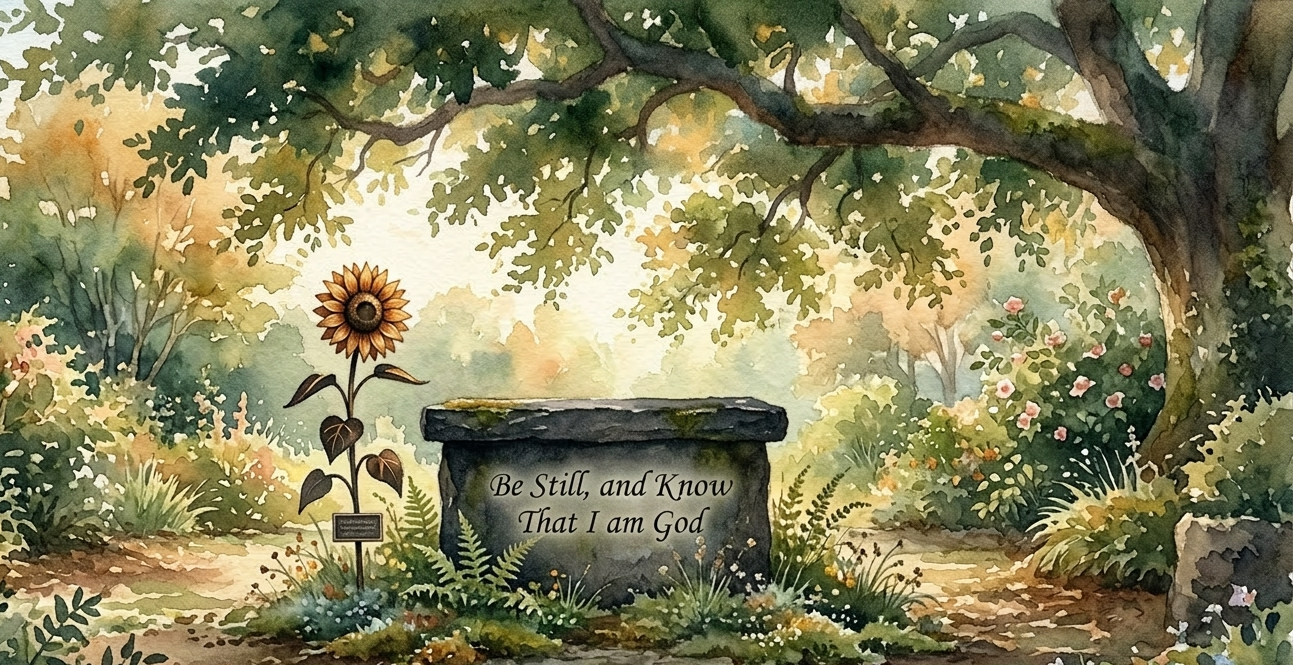
After John died, our family wanted to create something permanent. Something that would honor his life and hold the faith that carried us through that Easter weekend. John was an active participant at Our Lady of The Mount Church. He loved the outdoors and loved to garden. So we built a memorial prayer garden on the church grounds, centered under a giant tree he would have loved.
The garden is open to everyone. A place where anyone can sit and find peace, joy, and beauty. A place where the grief is held and the faith can breathe.
The focal point is a custom-built black granite altar. Three thousand pounds, hand-crafted by stone masons in Vermont. And on that altar are the inscriptions that carry our answer.
On the front of the tabletop, deeply engraved:
“Be still, and know that I am God.” Psalm 46:10
Most people encounter that verse as a gentle invitation to quiet. But Psalm 46 is not a peaceful psalm. It is a psalm of crisis. Nations are collapsing. Waters are roaring. The earth is giving way beneath your feet. And into that catastrophe, God speaks. Not with explanation. Not with comfort in the soft sense. With authority. In the middle of all of this, know who I am. Know that I hold this.
We chose that verse because we had lived the catastrophe it describes. We needed something carved in granite that could bear the weight.
On the back of the tabletop, a single word:
“Hallelujah”
That word is not generic. It is the final word of John’s funeral mass. The song that ended with the congregation weeping and singing at the same time. John had been learning to play it on his electric guitar before he died. When we engraved it on the back of that altar, we were not choosing a religious word at random. We were placing John’s music in stone.
To write “Hallelujah” on an altar built after suicide loss is an act of faith so specific it almost took our breath away. To us it meant, even here, even in this, even after this, praise God. Not because the pain is gone. Because of where we believe John is.
On the top of the altar, there are engraved five Latin crosses. Each one representing one of the five wounds Christ suffered on Good Friday. The altar built for a boy who died on Good Friday carries those wounds in its granite. The suffering of Christ and the suffering of John are not separated on that stone. They are held together.
Throughout the garden, stones are embedded with scripture and song. One reads
“He will raise you up on Eagles Wings.”
The first line of the chorus that carried John’s casket into the church. The line that completes the song is not in the garden. It is engraved on John’s headstone at his grave:
“And hold you in the palm of His Hand.”
The garden and the grave complete each other. Together they speak the whole sentence.
The entrance to the garden is through a gateway covered in flowering vines, drawn from Acts 3:1-10, the miracle at the Beautiful Gate, where a man unable to walk is healed and leaps with faith. We chose it with open hearts. Maybe someone who comes through it will find what they need. Hope, faith and mercy are all things we can share with each other.
And there is a bronze sunflower in the garden. It will always be in bloom, through every season. John said sunflowers were his favorite because they always looked like they were smiling at you. The bronze one does what the real ones cannot. It stays with you all year round.
Seventeen Years of Asking
Over seventeen years, I have sat with faith leaders of many traditions. Deacons, Priests. Monsignors. Bishops. Rabbis. Men and women who had spent their lives at the intersection of God and grief. I was not doing research. I was a dad who needed to know where his son was.
Not one of them told me John was lost.
Every tradition had its own language for the mystery. None of them came with certainty. But all of them confirmed what I already believed in the deepest part of myself. That a God of love does not turn away a seventeen-year-old boy whose illness had stolen his choices from him. That mercy is not cancelled by mental illness.
That the question of heaven does not have a human answer, but the God who holds that answer is one in whom we can trust.
Fr. Charles Rubey, who founded the LOSS program in Chicago and has spent more than forty years in suicide bereavement ministry, puts it plainly.
Faith is not an easy activity.
The mystery of God is not a platitude. It is the only honest landing place for questions that do not have human-scale answers.
John Got the Keys
I want to say plainly what I believe.
I believe John is in heaven. I believe he arrived and was welcomed. I believe he is with his grandfather and with others who went before him. I believe the God who watched his own son suffer on a cross, and then raised him, was not absent from the last four months of John’s life. I believe the God who runs toward the returning son ran toward John.
He is in a pretty good place. He would have put it exactly that way.
That belief was not instant. It was built slowly, through prayer and conversation and years of sitting with the mystery. But it is not wishful thinking. It is what my faith, examined honestly and tested hard, has come to hold.
And the proof of it, for our family, is not a feeling. It is carved in stone. A black granite altar under a giant tree in Warren, New Jersey, with “Hallelujah” carved into the back.
A Bus Station, Not a Prison
I want to talk about purgatory, because for Catholic suicide loss survivors it often sits just beneath this question like a quiet fear. If heaven is possible, is purgatory a punishment? Is my person suffering there?
The honest answer is that Catholic teaching on purgatory is far more hopeful than most survivors have been told.
Someone once offered me an image that has stayed with me. Purgatory, they said, is like a bus station. You arrive carrying burdensome baggage, everything you no longer need. All the weight you accumulated. The pain that distorted your thinking. The fear that drove you to the edge. And at the station, you set it down. You leave the baggage behind. Then you walk through to your ultimate destination.
That is not a place of punishment. It is a place of release. And it always ends in the same destination.
The direction of purgatory is heaven. It is not a holding cell for the condemned. It is the final kindness of a God who knows we arrive incomplete and loves us enough to say, you do not have to carry that anymore. It is a place where we are purified.
St. John Vianney, one of the most beloved parish priests in Catholic history, once encountered a woman devastated by the death of her husband, who had died by jumping from a bridge. She was terrified he was in hell. Fr. Vianney, by what the Church regards as a special grace, whispered to her that her husband was saved. He is in purgatory, Fr. Vianney told her. Between the parapet of the bridge and the water, he had time to make an act of contrition. The woman was comforted beyond what she had thought possible.
I grew up as a young boy learning my catechism at St. John Vianney Church in the Bronx. The saint’s deeds have always been familiar to me. But after losing John, they carry a weight they never had before. St. John Vianney is the patron Saint of parish priests. He gives strength to those that help us in our darkest days.
The Church has preserved that story across almost two centuries because it answers exactly this question.
The mercy of God reaches into moments we cannot see. It reaches into the space between the edge and what comes after. We do not know what John carried into that space. But we know the God who was waiting on the other side.
If you are a Catholic survivor who wants to go deeper into these questions with others who share your faith, the Association of Catholic Mental Health Ministers created a free eight-part video series called When a Loved One Dies by Suicide. The sixth session addresses directly what the Church teaches about suicide, covering mercy, judgment, and purgatory. The series includes a free reflection guide designed for use individually or in a grief support group. It was created by Catholics who have lost someone to suicide, and it shows.
The Communion of Saints Is Not a Metaphor
At John’s funeral, his sister stood up and told a church full of grieving people that five days earlier she had lost a brother. Then she said something that has never left me.
“But I have gained a guardian angel.”
She was eighteen years old. She was burying her best friend. And in the middle of that, she spoke the theology of the Communion of Saints better than any homily I have ever heard.
The Church teaches that all who are in heaven are part of the Communion of Saints. They are not distant or sealed off from us. They are present and active, praying for our souls, praying for our healing, praying for the reunion that all of our faith-filled lives have pointed toward.
If John is where I believe he is, he is not simply at rest. He is present. He is interceding. The separation we feel as survivors is real. The bond, however, is not severed.
The Church does not describe heaven as a place where the dead wait in isolation. The church describes it as a living communion of those who love us and continue to love us across the boundary of death. For those who have experienced what many survivors describe as unexpected moments of connection after loss, that understanding is worth sitting with. You can explore those experiences in Finding Signs and Messages: Experiences of Connection After Suicide Loss.
The Communion of Saints is also the ground for what we spend the rest of our lives working toward. Reunion. Not as a vague hope but as the specific, named destination of Catholic faith. The people we have lost are part of the body that is praying for us to get there.
His sister knew that. Standing at her brother’s casket, she knew it.
For me, that is a comfort.
What This Belief Makes Possible
Believing that John is in heaven does not end the grief. I want to be honest about that. The grief continues. Good Friday still arrives. The anniversaries still carry weight that no amount of faith has dissolved.
But this belief lifts one specific weight. The fear that he is suffering somewhere because of how he died. The fear that God’s mercy had limits that John hit. When that fear eases, even a little, something in the grief changes shape.
What grows in its place can become something more useful. The capacity to remember John with love rather than sadness.
The capacity to bring that love into service for other families carrying the same question in the dark. That is what seventeen years of grieving, facilitating, and sitting with other survivors has taught me about what faith and loss can produce together.
If you are carrying this fear right now and it is too heavy to hold, the 988 Suicide and Crisis Lifeline is available around the clock. If you want to connect with others walking a similar path, the Catholic Charities LOSS program offers support that holds both the grief and the faith at the same time. A suicide loss support group, whether Catholic or otherwise, can also be one of the most powerful places to bring questions like this one. Finding Your People: The Healing Power of Suicide Loss Support Groups talks honestly about what to expect when you walk through that door. And the Knights of Columbus have published a free guide specifically on Catholic teaching and pastoral response after a suicide loss, written for survivors and those who support them.
A Final Word
The question of heaven after suicide is the question underneath a hundred other questions survivors carry. It is really the question of whether you were right to love the person you lost. Whether the God you believed in was paying attention. Whether there is anything solid left to stand on.
My answer, from seventeen years of grief and faith together, is yes.
Yes, John is in heaven. Yes, God was paying attention. Yes, there is something solid. It is not always visible.
Sometimes it is carved in granite. Sometimes it is spoken by a eighteen-year-old sister at her brother’s casket. Sometimes it is written by a newspaper editor who showed up to a funeral and was moved to tell the truth.
He wrote that we should have faith that John is cradled in the palm of the safest of all hands.
That is what I believe. That is what the granite says. That is what his sister said.
So I continue to walk by faith, not by sight.
Will you join me on the walk?
Posts You May Also Like
- Faith After Suicide Loss: What Good Friday Taught Me About Faith – The post that planted the seed for this one, tracing how John’s death on Good Friday reshaped everything Jack thought he knew about faith.
- The Hard-Fought Hallelujah: Finding Spiritual Healing After Suicide Loss – Spiritual healing after suicide loss is perhaps the most complex and least discussed part of the grief journey. This post explores the three paths of healing (intellectual, emotional, and spiritual) and what it looks like to find your own hard-fought hallelujah after years of struggle and searching.
- Finding Signs and Messages: Experiences of Connection After Suicide Loss – Many survivors describe moments of unexpected connection after their loss, and this post explores those experiences with honesty and openness.
- Obituary After Suicide Loss: What to Say and How to Say It – Where the mercy question meets a practical deadline, with faith phrasing that avoids the judgment some traditional funeral wording carries.
- Forever Young: The Remix That Taught Me to Dance Again – A personal essay that pictures a son dancing in heaven, grounded in this same faith and heaven framing.
- The Quest for Understanding: When Facts Don’t Answer the Question “Why” – The “why” question is one of the heaviest any survivor carries, and this post sits with it honestly rather than rushing toward resolution.
- Physics = Love: Continuing Bonds After Suicide Loss – Explores how the bond with the person who died continues to evolve over time, rather than simply ending with death.
- Finding Sunshine and Forgiveness – A reflection on how forgiveness, including forgiveness of God and of ourselves, becomes part of the longer arc of healing.
A Footnote on Church History: Why Generational Differences Still Echo
For those of us who grew up before the mid-1980s, the Catholic Church was very clear about what happened to those who died by suicide. It is not uncommon for older family members and some religious personnel, raised and trained in an earlier era, to still carry a substantially different understanding of where the Church stands today. I used to describe my 1960s Catholic education as the “Hell, Fire and Damnation” period. One of the first questions a well-meaning older family member asked us after John died was whether we could have a mass and a funeral for our son. They simply had not learned how the Church had evolved.
The history is long, and it matters.
For centuries the Catholic Church condemned those who died by suicide. In 1917 that theological position became explicit Church law. The Code of Canon Law published that year listed those who “deliberately killed themselves” among those to be denied ecclesiastical burial. This was not pastoral guidance or theological opinion. It was binding Church law. Families were officially excluded from having a mass, a funeral, or burial in consecrated ground. The social and spiritual pain this caused was enormous, and it remained the law for more than sixty years.
By the early 1960s the Church underwent a major series of reforms with the Second Vatican Council. Vatican II planted the seeds of many modern practices, but it did not touch the outright ban on Catholic burial for those who died by suicide. The seeds were planted in how suicide was thought about, but the law remained.
The first real change came with the revised Code of Canon Law in 1983. Canon 1184 quietly dropped suicide from the automatic exclusion list entirely. Ecclesiastical burial could now only be denied to “manifest sinners” whose funerals would cause public scandal. Because suicide was no longer explicitly named, local bishops and priests gained discretion, and in practice the vast majority of Catholic funerals for those who died by suicide began to proceed normally. This was not yet a doctrinal statement about the soul, but it was a significant pastoral shift that most Catholic families never heard formally announced.
The modern theological position was finally codified in the Catechism of the Catholic Church, promulgated by Pope John Paul II in 1992. Paragraphs 2280 through 2283 address suicide directly. The Catechism retains the language that suicide is “gravely contrary to the moral law,” but paragraph 2282 states explicitly that grave psychological disturbances, anguish, and suffering can diminish the responsibility of the one who dies by suicide. Paragraph 2283 went further than anything the Church had formally said before: “We should not despair of the eternal salvation of persons who have taken their own lives. By ways known to him alone, God can provide the opportunity for salutary repentance. The Church prays for persons who have taken their own lives.”
That final paragraph was a genuine turning point. For the first time in the Church’s authoritative teaching, families were given official theological permission to hope. But it was not something regularly discussed from the pulpit, and older Catholics remembered the faith they were taught. The recent changes were simply not part of their education.
Through the late 1990s and into the 2000s, the 1992 Catechism filtered slowly into parish-level pastoral care. Catholic grief ministries began developing resources specifically for suicide loss survivors. Pope Francis, who became pope in 2013, reinforced the merciful direction through his broad pastoral emphasis on God’s unconditional mercy and his repeated insistence that the Church should not turn people away. His overall theological tone consistently supported the compassionate trajectory begun in 1992.
In November 2025, Pope Leo XIV declared that month a time of reflection on mental health and those struggling with suicidal thoughts, a significant signal of where the Church’s pastoral leadership is heading.
One of the most visible signs of that direction is Bishop John P. Dolan of Phoenix, appointed by Pope Francis in June 2022. Bishop Dolan is open about having lost three siblings and a brother-in-law to suicide. He serves as chaplain to the National Association of Catholic Mental Health Ministers and is co-editor of two books the association has published on suicide loss. His close relationship with Pope Leo XIV makes him a significant figure to watch. I anticipate that together they will continue to move the Church further along this path of mercy and understanding in the years ahead.
The Church has come a long way. Not everyone has received the message yet. But the direction of that journey is unmistakably toward mercy.

Leave a Reply