
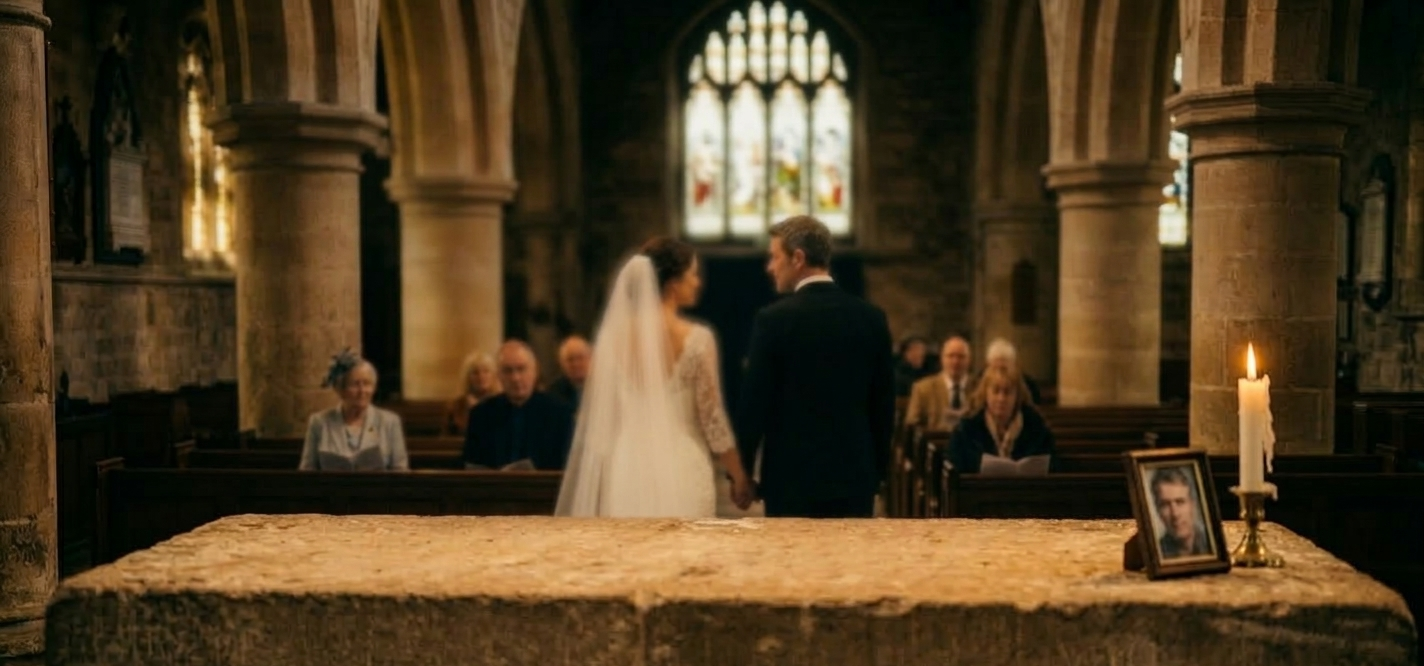

There is a moment, somewhere in the middle of a wedding reception, when the music is loud and the room is full of light and people are laughing and dancing, and you look around and think, he should be here.
It catches you, even when you expected it. Even when you told yourself you were ready.
Weddings after suicide loss carry a weight that is unlike almost any other occasion. They are supposed to be pure joy and celebration. They usually are, in some way, joyful. But for those of us who are grieving, they arrive loaded with absence. A chair that nobody sits in. A name that hangs unspoken in the air. A role that someone was supposed to fill.
I know this personally. When our daughter got married, more than seven years had passed since we lost our son John to suicide. We had done the grief work. We had survived the early years. We had built a life that had real joy in it again. And still, walking into that wedding knowing John would not be standing up there with us was one of the harder things I have done.
This post is for anyone facing a wedding in the shadow of suicide loss. The couple planning the day. The parent or sibling who has to stand up and get through it. Anyone who is walking into a celebration while carrying grief. There is no single right way to do this. But there are ways to hold both the grief and the celebration, to let John or Maria or whoever you are missing be present in their own way, and to trust that the day can still be beautiful.
Why a Wedding After Suicide Loss Hits Differently
Any significant milestone can surface grief. A graduation, a holiday dinner, a new baby. These are the moments where the person you lost would have been there, where their absence becomes specific and sharp instead of diffuse and general.
Weddings are particularly layered. They are family events, and suicide loss often reshapes the family in deep ways. They involve rituals that assume a certain wholeness, a father walking someone down the aisle, siblings clustered together for photographs, a best friend giving a toast. When someone is missing, the ceremony itself keeps pointing to the gap.
For suicide loss survivors specifically, the grief that rises at a wedding can carry extra weight. Many of us are still carrying guilt and unanswered questions years after the death. Research on suicide bereavement consistently shows that survivors tend to experience more persistent guilt than people who have lost someone to other causes. A wedding, with all its emphasis on family and presence and shared future, can stir all of that back up.
That is not a problem to be solved. It is just the truth of what this grief is. And knowing it is coming can help.
Grief researchers have a name for what happens at moments like this. Dr. Therese Rando, a psychotherapist and grief counselor, identified these milestone-triggered spikes as subsequent temporary upsurges of grief, or STUGs, predictable waves of acute grief that arrive at events where the person who died is profoundly absent. Naming it does not make it hurt less. But knowing it has been studied and observed in thousands of people can make it feel less like something is wrong with you and more like the grief doing exactly what grief does.
Planning a Wedding After Suicide Loss
Planning a wedding while grieving is genuinely hard. It is not just emotionally difficult. It is practically difficult. Grief affects concentration, decision-making, energy. For many people, tasks that would normally feel exciting, choosing flowers, writing vows, finalizing a guest list, become weighted with sadness.
A few things to think about during the planning process.
Give yourself more time than you think you need. Grief is tiring in ways that are easy to underestimate. If you are working on anything that involves the person you lost, like wording an acknowledgment in the program or selecting a photograph for a memorial display, build in time to step away afterward. You will likely need it.
Talk to your partner about what you are carrying. This sounds obvious, but many people try to protect their partner from the weight of their grief, especially around what is supposed to be a happy occasion. Keeping it private often makes it heavier. Let them in. You are building a life together, and this is part of who you are.
Decide together what honoring your person looks like. Some survivors want something visible and clear. Others prefer quiet and private. Both are ok. What matters is that the choice is intentional, made with thought, and feels true to who the person was and what they meant to you. The next section has specific ideas to potentially try.
Let your vendors know. It may feel like your loss is written all over you, but your florist, caterer, and venue coordinator almost certainly do not know unless you tell them. A brief mention early in the process, either directly or through a wedding planner, allows them to be thoughtful rather than accidentally careless. Most vendors have been through this before with families. Give them the chance to show it.
Consider getting help with the words. Writing vows, program acknowledgments, or a tribute to the person you lost while you are actively grieving is genuinely hard. What many people do not realize is that there are professional writers who specialize in exactly this. You supply the feeling. They handle crafting the words. It is not a shortcut. It is a way to release the pressure so the words that end up on the page are the ones you actually meant.
Designate a wingman. Pick one person who knows you might need a few minutes at some point and is ready to make that happen without a fuss. Work out a quiet signal in advance, a word or phrase that means “I need a moment, come with me.” They do not have to do anything dramatic. They just have to be paying attention and be someone you trust to step outside with you for five minutes of air without turning it into a bigger moment than it needs to be.
Consider talking to someone before the day. A grief counselor with experience in suicide loss and milestone grief can help you think through what you are carrying before you walk into the wedding, not just after things feel stuck. If you have not done that yet, the post on finding a grief counselor after suicide loss can point you in the right direction.
Ways to Bring the Person You Lost Into the Day
When our daughter got married, she carried her brother John’s high school ring tied to her bouquet. It was small and quiet and completely her own decision. Nobody had to know it was there unless she told them. But she knew. We knew.
She also placed his photograph and a candle on the high altar, directly behind where they stood during the ceremony. The candle read words she had written for him. Part of what was written came from this place of wanting his presence there in that space, in the light of a flame that could stand for everything words could not quite reach.
The back of the wedding program included a remembrance, a few lines that acknowledged his absence and held his name.
These three things together, the ring, the altar candle, the program, created something that felt complete without being overwhelming. The wedding was still a wedding. There was still laughter and dancing and toasts and a cake that nobody remembered cutting. But John was there with us too.
Ideas that others in the suicide loss community have used include a memory table with photographs near the entrance; a candle at the ceremony lit specifically in the person’s name; a chair with flowers; a piece of the person’s jewelry worn by the bride or incorporated into the groom’s boutonniere; a donation in their name in lieu of a wedding favor; a moment of silence or a specific reading in the ceremony; their favorite song played during the reception. For more ideas, What’s Your Grief on remembering at receptions and their broader wedding day planning guide are both worth a look.
What makes any of these work is intention. It is not about the size of the gesture. It is about the truth behind it.
It is also worth knowing that some families choose a more general acknowledgment, honoring all those who are no longer with them rather than naming one person specifically. A single candle for everyone who could not be there. A line in the program that holds multiple names. This approach can feel less exposing, particularly for families who are still dealing with the stigma that can surround suicide loss, and it is no less meaningful. You are still holding the person you lost. You are simply choosing how much of that is visible to the room.
Not everyone grieving at a wedding had a simple relationship with the person who died. Mental health struggles can strain relationships in ways that leave real hurt behind. Some survivors arrive carrying not just grief but unresolved anger, or the memory of years that were hard. If that is you, honoring the person who died does not require putting them on a pedestal or rewriting your history into something simpler than it was. You can hold their memory with love and with complexity at the same time. The tributes you create do not have to be without ambiguity. They just have to be true.
The Role of Ritual and Memory in Making Space for Grief
There is something important that grief researchers have found about rituals of remembrance. When we create intentional space for the person who died, whether at a wedding or a holiday or a birthday, we are not pulling ourselves backward into grief. We are doing something that actually supports the process of continuing the bond with the person we lost, which is how healthy grieving actually works. We are not asked to leave them behind. We are asked to find a new way to carry them forward.
This is one reason I believe that meaningful, personal acknowledgment on a wedding day tends to help people rather than deepen their pain. It gives grief somewhere to go. It says, out loud or in some symbolic way, that this person was real, that they mattered, that we are not pretending the day is complete without them.
If you want to think more about the role of ritual in ongoing grief, the post on ritual and remembrance goes deeper into how intentional practices help survivors stay connected while still moving forward.
Asking the Photographer to Capture What Matters
This is something that made a real difference for our family. Before the wedding, our daughter asked her photographer to capture two specific things. The bouquet with John’s ring tied to it, and the candle and photograph on the altar.
Not as an afterthought. Not grabbed quickly between other shots. As intentional photographs, taken with care, that documented what she had put there.
Those images are among the ones we carry forward. The ring resting among the flowers. The flame burning next to John’s face. They are not sad photographs, not exactly. They are photographs of love. They are proof that he was held in that day in a real, physical, deliberate way.
There is a particular kind of ache that comes when you realize you might not have thought to do this and the day moved too fast. A wedding photographer is moving through hundreds of shots and cannot know which details carry the most weight for you unless you tell them. So tell them. Write it down. Be specific. This bouquet, this altar, this photograph. The ring is small. The photographer needs to know it is there.
Many photographers who work with grieving families are moved by these requests. It is not an imposition. For most of them, it is the kind of work they got into this profession to do. Our photographer also framed a beautiful shot of our daughter and son-in-law in front of the candle and picture of her brother. She knew that it had meaning and she took the initiative to capture it. It was not posed. She just saw the special moment and captured it.
The photographs from the wedding become part of the ongoing relationship with the person you lost. We have written here before about what Preserving Photos and Videos After Suicide Loss, how they hold presence in a way that is different from memory alone. Wedding photographs that include deliberate tributes to the person who died extend that. Years from now, those images will still be doing their work.
If You Are a Grieving Parent, Sibling, or Family Member Attending
Not everyone reading this is the one getting married. Some of you are the mother or father of a bride or groom who has lost a sibling. Some of you lost a parent, a spouse, or a close friend, and now you are going to stand up at someone’s wedding and get through the day as best you can.
I walked our daughter down the aisle without John being physically present in the church. That is not something that I thought about the specific implications of in the months before the wedding.
There was something my wife Teri had to sit with that I think deserves to be said plainly, because she is not alone in it. She realized, as the wedding approached, that John was supposed to be the one to walk her down the aisle. That role. That specific moment. It belonged to him, and now it had to belong to someone else.
We asked our godson to step into that role. He said yes without hesitation. And on the day, having him there beside Teri was genuinely comforting, not a replacement, nothing could be that, but a presence that said we are still here, we are still family, we are going to get through this together. He quietly said, we got this, and proceeded to walk her down the aisle. Her concerns were released.
If there are roles in your wedding or your family member’s wedding that the person who died was supposed to fill, it is worth discussing that directly and thinking through who might step in. Not to erase the absence, but to make sure the moment is held by someone who cares deeply for you. Be intentional.
There was another layer that stayed with me. The man our daughter was marrying never got to meet John. He married into a family already changed by a loss he could not fully understand from the inside. Many families carry exactly this into a wedding, the new spouse who arrives after the grief, learning to know someone only through stories and photographs. There is no single way to handle that tenderness, only the willingness to hold it honestly.
One thing does stand out to me when I look back. Before the ceremony, I said a quiet prayer to John. I asked him to be with his sister and her partner, to be a presence over everything. We had our own guardian angel watching over that wedding. And we knew his name.
Give yourself those private moments. You do not owe anyone a performance of cheerfulness.
We were not shy about saying John’s name that day. His name was in the program, spoken aloud in the ceremony, and in my father of the bride speech I thanked the people who had helped our family heal after his death. Not obliquely. I named what we had been through. There was something freeing about that. It was not a sad moment. It was an honest one. The room received it.
Say the name. Find a way to say it in your speech, in a toast, in a quiet word to the person beside you. Grief lives in silence. It loses some of its weight when it is spoken. If you are not sure how much to share or how to frame it, the post on telling your story after suicide loss is a guide to doing that on your own terms. And if the words feel like too much to carry alone, professional speechwriters can help. Getting help is not giving something up. It is making sure the words you stand up and say are actually the ones you meant.
What to Expect on the Day
Before anything else, joy is not a betrayal. Feeling genuine happiness at a wedding is not disloyal to the person you lost. Most of the people who die by suicide were people who cared deeply for the people around them. Whatever pain drove them to that place, they would not have wanted to take your joy with them. Many of us have found, with time, that we can hold both things. The grief does not cancel out the happiness. The happiness does not cancel out the grief. They live alongside each other. That is the duality of surviving a suicide loss.
There will probably be a moment when it hits you. It may come during the vows. It may come during a slow dance. It may come when the photographer gathers the family and you feel the shape of who is not there with a sharpness that is hard to describe. A photograph is a record of who is present. That makes the absence exact in a way that is different from other moments in the day.
That moment is coming and it will pass. It may come at a completely unexpected moment too, a song you did not expect, or the smell of flowers that reminds you of something. Let it come. Give yourself sixty seconds to feel it. Then come back.
Having a plan for difficult emotions does not mean suppressing them. It means knowing that when the wave comes, you have gotten through hard moments before. You will get through this one too.
Something else worth holding in mind. Every person at that wedding who knew the person who died is grieving differently. A parent grieves differently than a sibling, a sibling differently than a friend. Some people in that room may be visibly emotional. Others may seem fine in a way that puzzles or stings you. Neither response means they loved the person more or less. It means they had a different relationship, different memories. Grief is not a competition. Giving each other that grace, and giving it to yourself, is one of the quieter acts of love a day like this asks of you.
Finding signs and messages is something many survivors experience at milestones, a certain quality of light, a butterfly, a song that arrives at an exact moment. Whether or not you hold those experiences as literally meaningful, they can be a source of comfort. Let them be what they are.
If you are heading toward a wedding and you are worried about getting through it, the What’s Your Grief journal exercise on wedding day advice is a thoughtful way to think through what you are carrying in advance.
The Days After the Wedding
For many survivors, the hardest moment is not the wedding itself. It is the two or three days after it. The event you spent weeks or months quietly bracing for is suddenly over. The guests have gone home. The flowers are wilting. The house is quiet again. And the adrenaline that carried you through the day has worn off, leaving grief with nothing to push against.
This is not unusual. It is not a sign that something went wrong. It is the crash that follows any sustained emotional effort, and a wedding while grieving asks for a great deal of that effort.
Be gentle with yourself in the days that follow. Do not make the mistake of measuring how you feel the day after the wedding against how you felt at the reception. Those are two very different states and the comparison is not fair to either one. If the days after feel heavier than the day itself, that is common. It will move. Let the people around you know that you may need a little more support in the week that follows, not just on the day.
It can help to plan something small and restorative for that window. Not a distraction, but something that gives you somewhere gentle to land after the intensity of the wedding weekend.
For Those Who Are Newly Bereaved
If your loss is recent and there is a wedding on the horizon, either one you are planning or one you are expected to attend, and you do not know how you will get through it, please be honest with the people around you about where you are.
There is no version of this that is not hard. Walking into a room full of celebration when you are still in the thick of grief is one of the more disorienting things a person can be asked to do. That is just true. You are not being dramatic. You are not ruining anything by feeling this. You are carrying something enormous, and the fact that you are trying to show up at all says something real about who you are.
You are allowed to arrive late. You are allowed to step outside. You are allowed to skip parts of the reception that feel impossible. You are allowed to cry during the ceremony. The people who love you will not be surprised by any of this. They will likely be relieved that you are telling them what you need rather than disappearing behind a face that says you are fine.
Grief resources like those at AFSP’s survivor support hub can be a help when you are trying to figure out how to get through the earliest milestones after a loss. You do not have to get through this alone. And if the weight of it ever feels like too much, the 988 Suicide and Crisis Lifeline is always there. You can call or text 988 any time.
And if grief is feeling stuck or impossible to manage, reaching out to a grief counselor who has specific experience with suicide loss is worth considering. The post on finding a grief counselor after suicide loss can help you know what to look for.
The Day Will Have Beauty in It
Here is what I learned after going through the process as a family.
Our daughter’s wedding was beautiful. It was full of laughter and people who loved each other and a joy that was real and hard earned. John was in it in every way we had put him there. And we said his name, out loud, more than once, without shyness and without apology.
We felt his presence. That is not a figure of speech. The people who cared deeply for him were in that room, and they brought him with them. Our son-in-law, who never got to meet John, married into a family that carries John in it. He has come to know John through us. That is its own kind of continuing bond, a new person learning to carry someone they never had the chance to know.
The day was not diminished by John’s absence. It was deepened by the love that his presence in our lives had made possible. The people who stood in that room had been changed by knowing him. His sister, who had grown up alongside him, who had lost him at an age when loss of a sibling reshapes you completely, had somehow found her way to this day.
I do not have a clean or simple way to say that. It is just true. We have now attended three weddings where the family was impacted by a suicide loss. All were beautiful, all were touching, and all were intentional.
Your day will have beauty in it too. You are allowed to receive it. I wish you and your family and friends a special and joyous wedding.
Posts You May Also Like
- Feeling Happy After Suicide Loss: Letting Joy In Without Guilt – A closer look at joy and longing sharing the same day, with the research behind why that is not a betrayal.
- Ritual and Remembrance – Explores how intentional practices for honoring the person you lost can help survivors stay connected while still moving forward.
- Physics = Love: Continuing Bonds After Suicide Loss – A look at how our bonds with those we have lost do not end with their death, and how survivors can hold those connections in healthy ways.
- Finding Signs and Messages: Experiences of Connection After Suicide Loss – Many survivors report experiences of presence or connection at milestones; this post explores what those experiences mean and how to hold them.
- Preserving Photos and Videos After Suicide Loss – A thoughtful exploration of the role photographs play in grief and memory, relevant for anyone incorporating photos into a wedding tribute.
- When the World Keeps Turning: Navigating Social Connections After Suicide Loss – What happens when life moves on around you while you are still in grief; particularly relevant for the post-wedding crash and the experience of being a survivor at a celebratory event.
- Grieving the Future They Never Had After a Suicide Loss – For readers grieving not just the missing wedding but the role they never got to play in it, mother-in-law, grandmother, this post gives that second layer of loss its own space.


Leave a Reply