
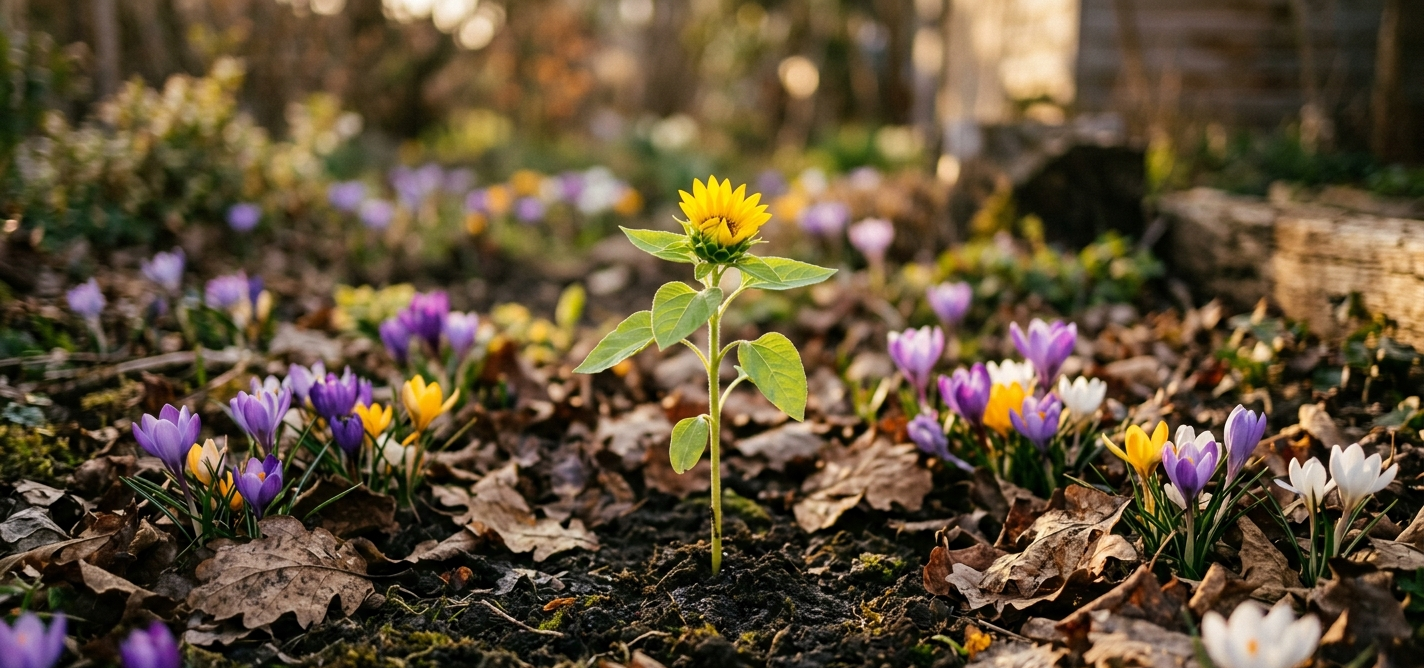

Every spring, I hear a version of the same thing. Someone is managing. Getting through the days. And then the birds come back, the light shifts, and suddenly it is harder, not easier. Spring after suicide loss has a quality that is difficult to prepare for. It is not the seasonal grief of the December holidays, where the culture at least acknowledges that the season is hard. Spring arrives quietly, cheerfully, without asking your permission. It is full of new growth, longer days and more light, and it asks nothing of your feelings. For many survivors, that is exactly the problem.
The disconnect between the world’s renewal and your own grief is one of the challenges of spring for suicide loss survivors. When everyone around you seems to be opening windows and putting seeds in the ground, and you are still carrying the weight of what you carry, that contrast can feel sharper than the darkness of winter ever did. You are allowed to struggle inside during the most beautiful season of the year.
This post is about what spring can feel like after you have lost someone to suicide, why the season sometimes lands harder than the people around you might expect, and what may help you carry both at once.
Why Spring After Suicide Loss Can Feel Harder Than Winter
There is a particular difficulty to contrast. Winter, at least, matches. The cold and gray and early dark feel consistent with grief. Many survivors describe the winter months as oddly manageable, emotionally, because the world seems to understand without needing to be told.
Spring does not match. Every tulip pushing through the soil, every neighbor washing their car in the driveway, every burst of birdsong at six in the morning, can feel like evidence that the world has moved on and left you standing still.
Bereavement researchers describe a painful gap between a person’s internal emotional state and what the world around them is signaling. Spring amplifies that gap. Everything signals renewal and forward motion. Your grief does not obey that signal. The season’s brightness can feel alienating when you are personally disconnected from it. The world’s cheerfulness becomes contrast rather than comfort. Seeing the natural world renew itself while you feel frozen in place is one of the more disorienting experiences survivors describe in the months and years after a loss.
Research on suicide bereavement, including findings reviewed in peer-reviewed journals on suicide grief and summarized by the Suicide Prevention Resource Center, consistently shows that grief after losing someone to suicide tends to be more intense and more prolonged than many other forms of loss. The unique weight of guilt, confusion, and unanswered questions makes this grief harder to set down, even briefly, even in a season that is trying to offer you something.
This is particularly true in the early years. The first spring after a suicide loss is often among the hardest seasons survivors encounter. The second and third can be hard too. Grief does not organize itself into calendar years, and the season’s insistence on beauty can feel like a demand you are not equipped to meet.
When Spring Brings Grief Back Without Warning
For some survivors, spring carries a more specific weight. The anniversary of their loss or a birthday falls in spring. The phone call came on a warm afternoon. The last good memory they have is from a spring day, and returning to the season means returning to the edge of something that happened just after.
Spring is full of moments that bring grief rushing back without announcement. A particular quality of afternoon light. The smell of cut grass. The sound of a lawnmower in a neighboring yard that always ran on spring weekends. A song that comes through a car window with the season’s first warm air. These moments arrive through the side door, in ordinary places, at ordinary times. You do not see them coming. They find you.
Identifying what is happening in those moments can take away some of their power, though not all of it. When you recognize that a sudden wave of grief is your nervous system responding to something associated with the person you lost, it can feel a little less like falling apart and a little more like carrying something real. Grief researchers have a name for these sudden surges: a STUG, or sudden temporary upsurge of grief, coined by psychotherapist Dr. Therese Rando. Knowing the name does not make the wave smaller, but many survivors find it helps to recognize what is happening as a known and normal part of loss. If you have been finding it hard to understand what keeps getting in the way of healing after your loss, these unexpected surges are often part of the answer.
My son John died on April 10, 2009. So for me, spring has always carried a double weight. The season arrives, and the anniversary arrives with it, year after year. I have learned to hold both. It took a long time. In the first years, April was something I simply had to survive.
If your loss is also a spring loss, you already know this. And if spring carries the general weight of grief rather than a specific date, that is its own form of real. Both deserve acknowledgment. Neither is easier than the other.
The Guilt That Arrives When Something Feels Good
Something else happens in spring that is worth also discussing.
Some survivors begin to notice small openings. A walk in the afternoon that felt almost normal. A moment of laughter with a friend that surprised them. A patch of flowers that briefly lifted something before the weight came back.
And then the guilt.
Feeling better, even momentarily, can feel like a betrayal. Of the person you lost. Of the grief itself. Of the seriousness of what happened. Around the room at SOS Madison, I have heard this described in many ways over the years. “I felt guilty for enjoying anything.” “How can I laugh when he is gone?”
This experience is among the most common things survivors carry, and it does not get talked about as openly as it deserves.
Research on suicide loss grief confirms that small moments of relief and pleasure are not signs of forgetting. They are signs of survival. Grief after losing someone to suicide tends to move in waves rather than in a straight line; the sharp pains become less constant over time, though they do not disappear entirely. A moment of warmth on your face does not erase what you have lost. It does not mean you have stopped grieving. It means something in you is still alive, still responding to the world, still reaching toward the light the way living things do.
If guilt is one of the central weights you are carrying right now, Moving Beyond Guilt: A Path Toward Healing After Suicide Loss goes deeper into why guilt attaches so powerfully to suicide loss and what may help you carry it differently over time.
If you are experiencing thoughts of harming yourself, please reach out. The 988 Suicide and Crisis Lifeline is available by call or text, any time. Survivors of suicide loss are at elevated risk for their own suicidal thinking. You do not have to manage that alone, and reaching out is not weakness.
What This Season Does Not Require of You
There is a version of the spring-renewal message that can feel like pressure, and it is worth naming that too.
“The flowers come back, so will you.” “It is time to open your windows.” “Let the season lift you.” These things are said with kindness. Sometimes they help. Sometimes they don’t help, because they imply that renewal should be happening on nature’s schedule rather than yours.
Grief does not work that way. Healing after suicide loss, in particular, moves on its own nonlinear, unpredictable rhythm. There is no seasonal requirement attached to it. Some of the most significant progress I have seen survivors make happened in January. Some of the hardest moments I have witnessed came in June. The calendar does not determine where you are in your grief.
What the season actually offers, if anything, is an optional invitation. Not a deadline. Not a benchmark. Not proof that you are falling behind if you cannot feel what the world around you seems to feel.
Giving yourself permission to be where you are, in the exact moment you are in, without judgment about whether you are ahead or behind where spring seems to want you to be, is one of the most practical forms of self-care available to you right now.
What this looks like in practice is different for everyone. For some survivors it means allowing a short walk without expecting the walk to mean anything. For others it means sitting by a window without needing to open it. For others it means reaching out to someone else who understands, because the isolation of spring grief is its own particular weight.
The Alliance of Hope for Suicide Loss Survivors offers an online community where survivors connect across time zones and all stages of loss. If spring has you needing to be understood right now, that community is available any time of day.
Spring After Suicide Loss: Moving Through the Season at Your Own Pace
The most useful thing I have found, both in my own grief and in sitting alongside survivors for more than fifteen years, is this.
You do not have to choose between grieving and letting a little light in. You can be in both at once.
You can step outside on a warm afternoon and feel the sun on your face and also feel the absence of the person you are grieving. You can notice that the crocus are vivid this year and also feel that noticing it hurts. You can accept a moment of warmth without owing the season anything in return. Grief and beauty are not opposites. They do not take turns. They can occupy the same afternoon, the same hour, the same minute.
Spending time outside, even briefly, has something to offer. Not as a cure. Not because nature will fix what grief has broken. But because your body still responds to the physical world even when the rest of you feels like it cannot. A few minutes in the sun, a walk around the block, sitting on the front step with something warm to hold, can reach something that words do not always reach. Start small. Let it be enough.
For survivors who are further out from their loss, spring often begins to soften. Not because the grief becomes smaller, but because the person carrying it becomes more practiced. More capable of holding both at the same time without one crowding out the other. That is not betrayal. That is what long-term survival after suicide loss can begin to look like, slowly, on its own schedule, in its own time.
If you are in your first spring, none of that may feel possible or even interesting right now. That is okay. The first spring is just about getting through it. Noticing that you did.
Connection with others who understand is one of the most consistently helpful things survivors describe, across every season. Finding a suicide loss support group puts you in a room, physically or virtually, with people who know this season from the inside. Our support group at SOS Madison, and groups like it across the country, exist for exactly this reason. So that you do not have to carry spring alone.
A Few Words Before the Season Passes
Several years after losing John, I found myself standing in the backyard on a morning in April. I had not planned to feel anything. I was just out there with coffee, waiting for nothing in particular.
I noticed that the garden John used to help tend had come back. The sunflowers were not up yet. The ground was just ready for them. And for the first time, that felt like something other than sadness. I could be mad at him for not being there to help me turn over the garden soil, and I could be happy knowing that there would be sunflowers poking out of the ground in a few weeks.
The feeling did not last the whole day. Grief came back before noon. But that morning happened, and it belonged to both of us.
Spring after suicide loss is not a milestone to reach or a test to pass. It is a season that keeps arriving, year after year, as the world turns and as you continue to carry what you carry. You are not behind. You are not failing spring by struggling inside it. You are a survivor, doing what survivors do.
Let the light in where it finds you. You do not have to open every window. Just the ones you can reach right now.
If you are looking for support beyond this post, the AFSP’s survivor resources offer guidance and community for people at every stage of loss. And if spring has you wondering what healing can actually look like, Something You Get Through: Finding Hope After Suicide Loss may be worth a quiet read.
You are not alone in this season.
Posts You May Also Like
- Changing Seasons – A reflection on the seasonal rhythms of grief and what spring can invite survivors to consider about their healing.
- The Fall Transition – How the shift from summer to fall can surface grief in unexpected ways, and what that season asks of survivors.
- Feeling Happy After Suicide Loss: Letting Joy In Without Guilt – For the moment when the season turns bright, a good afternoon sneaks up on you, and the guilt arrives right behind it.
- Something You Get Through: Finding Hope After Suicide Loss – An honest look at what hope actually feels like in suicide grief and why healing is less a destination than a process.
- What Does Healing Look Like? – A grounded exploration of what healing after suicide loss actually looks and feels like, and why it rarely looks the way we expect.
- Seventeen Years and Still Counting: Long-Term Survival After Suicide Loss – A personal reflection on what long-term survival after suicide loss has taught one survivor about grief, growth, and the seasons in between.
- Memorial Day After Suicide Loss: Remembering and Beginning Again – On what comes next after spring, when the season tips into summer and the first major holiday of that stretch arrives.
- Fourth of July After Suicide Loss: Getting Through the Holiday – The next seasonal challenge after spring: how to get through the holiday when the world is celebrating and your grief is keeping its own schedule.
PRINTABLE GUIDE PDF
A two-page PDF guide has been generated for survivors to print, save, or share.

Leave a Reply